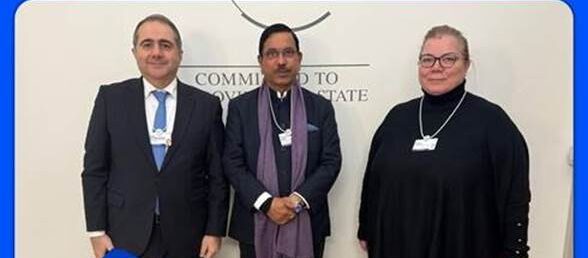







India’s participation at the World Economic Forum (WEF) Annual Meeting 2026 in Davos marked a defining moment in its transition from a high-growth emerging economy to a consequential actor within the global political economy. Convened under the theme “A Spirit of Dialogue,” the meeting unfolded amid global recalibration shaped by tariff realignments, technological disruption, climate imperatives, geopolitical transitions, and evolving debates over multilateral governance. Against this dynamic backdrop, India’s largest-ever delegation advanced a coherent narrative centred on macroeconomic stability, strategic autonomy, and inclusive international engagement.
Comprising Union ministers, chief ministers from ten states, senior national security officials, and over one hundred corporate leaders, the delegation fused political authority, federal diversity, and private-sector capacity. The engagement generated investment commitments exceeding ₹45 lakh crore while advancing India’s priorities across trade, technology governance, energy transition, connectivity, and institutional reform. This article offers an analytical assessment, situating India’s Davos engagement within contemporary debates on geoeconomics, multipolar power transitions, and global governance. WEF 2026 demonstrated India’s growing credibility as a stabilizing force in a fragmented global economy and reinforced its vision for a cooperative, rules-based, and multipolar international order, strategically connecting its G20 presidency legacy, its ongoing 2026 BRICS chairship, and deepening India–EU partnership ahead of Republic Day celebrations.
Davos 2026 and the Reconfiguration of Global Power
The 2026 World Economic Forum convened amid structural transformation in the global economy. Advanced economies across North America and Europe faced growth projections below two percent and persistent inflationary pressures, while industrial policy regained prominence. Geopolitical tensions reshaped trade and investment flows. The resurgence of tariff-focused economic strategies, coupled with rapid technological innovation and climate-driven disruptions, amplified opportunities for adaptive economies like India to assert influence in global markets and governance structures.
India’s economic performance distinguished it in this environment. With a nominal GDP exceeding four trillion dollars, foreign-exchange reserves above 640 billion dollars, and annual FDI inflows surpassing 80 billion dollars, India arrived in Davos as a source of stability, policy continuity, and demand. Merchandise exports nearing 450 billion dollars, alongside services exports exceeding 320 billion dollars, underscored its role as a central node in global production and knowledge networks. Davos provided both a platform to signal India’s systemic relevance and a venue to attract strategic capital flows.
The forum served as a platform for proactive agenda-setting. India framed its development strategy as a synthesis of domestic capacity-building and global integration, presenting Atmanirbhar Bharat (Self-Reliant India) initiatives as instruments for resilient participation in global value chains. Delegates emphasized systemic priorities—from environmental sustainability to urban pollution mitigation—while leveraging domestic innovation and technological capacity to integrate effectively into global markets. These measures align economic growth with global responsibility and collaborative frameworks for sustainable development, further strengthening India’s credibility and role in shaping inclusive, rules-based global economic governance.
Prime Minister Narendra Modi’s strategic declarations during India’s G20 Presidency in 2023 resonated strongly at Davos 2026, serving as a reference point for India’s multilateral diplomacy. These declarations—emphasizing global unity, resilience, and inclusive growth—echoed in discussions on multipolarity, Global South solidarity, and reformed governance. For example, Modi’s call for “One Earth, One Family, One Future” (Vasudhaiva Kutumbakam) was invoked in side-line meetings on climate action and African development, reinforcing India’s role as a bridge-builder. Analysing the G20’s Africa focus, Dr Maheep noted that “Modi’s framework resonated by aligning India’s soft power with practical multilateral reforms,” amplifying its influence at WEF amid India’s ongoing BRICS 2026 chairship. Simultaneously, discussions on President Trump’s Board of Peace proposal highlighted India’s principled and pragmatic approach to emerging security architectures. This continuity underscored how India’s G20 legacy and careful engagement with global security initiatives shaped Davos narratives, reinforcing a cooperative, rules-based, and multipolar world order.
Federalism Synergy and India’s Global Voice
A defining feature of India’s Davos presence was the prominent role of its states. The India Pavilion—spanning nearly ten thousand square feet—united the central government and nine states under a single investment and policy platform, showcasing a mature federal political economy. Subnational governments acted as proactive agents of global engagement, coordinating with the centre to present a coherent national vision while demonstrating local innovation and investment potential. As Dr Maheep observed on federalism’s role in India’s diplomacy, “India’s federal structure enhances its global voice by turning regional diversity into a strategic asset for multilateral engagement.”
Union ministers responsible for information technology, renewable energy, agriculture, civil aviation, and infrastructure collaborated with chief ministers representing diverse regions and political affiliations. Senior national security officials ensured economic diplomacy integrated strategic priorities. More than one hundred corporate leaders across technology, manufacturing, finance, and infrastructure reinforced India’s growth narrative credibility.
This alignment turned diversity into strategic advantage. States presented complementary pathways—from manufacturing and logistics to digital services, clean energy, and urban infrastructure—offering global investors multiple points of entry into a unified market. Side-line engagements advanced innovation partnerships, workforce development, and skills collaboration, highlighting federalism as an instrument of domestic transformation and global competitiveness.
Investment Diplomacy and Structural Transformation
India’s Davos engagement yielded substantial material outcomes. Investment commitments exceeding ₹45 lakh crore were announced across advanced manufacturing, artificial intelligence, renewable energy, logistics, urban development, and digital infrastructure. Maharashtra accounted for the largest share with memoranda of understanding valued at approximately ₹30 lakh crore, while Gujarat, Telangana, Uttar Pradesh, Kerala, and other states secured sector-specific commitments. Dr Maheep, in his analysis of India’s investment diplomacy, noted that “These commitments reflect India’s strategic pivot toward high-value sectors, positioning it as a key player in global economic transformation.”
Beyond headline figures, these investments signal a structural evolution in India’s growth model. Capital prioritized productivity-enhancing sectors with high technological content and export potential. Production-Linked Incentive programmes—mobilizing commitments exceeding 30 billion dollars across fourteen sectors—provided institutional support for this transition. Electronics exports, now surpassing 25 billion dollars annually, illustrate India’s role in diversified global supply chains.
Realizing these commitments enhances growth through strategic skill development, regulatory efficiency, and sustainable practices. India’s demographic advantage—over 500 million workers with a median age of 28—positions it to meet high-tech and knowledge-intensive sector demands. Davos 2026 functioned both as a catalyst for investment and a benchmark for domestic reform.
Trade, Tech, and Strategic Interdependence
Trade and technology were central to India’s Davos agenda. Engagements with the United States emphasized investment flows, technology collaboration, and skilled-mobility frameworks, reflecting deep economic interdependence. India articulated strategies to enhance market diversification and supply-chain resilience, including engagement with emerging-economy groupings.
Progress toward a comprehensive trade agreement with the European Union featured prominently. Covering goods, services, digital trade, and sustainability standards, the agreement carries systemic significance given the combined economic weight of the two partners. India emphasized reciprocity, regulatory alignment, and development space, framing liberalization as mutually reinforcing rather than asymmetrical. With European leaders scheduled as chief guests at India’s Republic Day 2026 celebrations, the ongoing momentum toward this agreement underscores the strategic consolidation of India–EU relations. As Dr Maheep analysed, “The deepening partnership reflects a shared commitment to multipolar stability, with economic ties serving as the foundation for broader strategic convergence.”
Technology governance emerged as another area of influence. India’s digital public infrastructure, serving more than one billion users and facilitating payment volumes exceeding two trillion dollars annually, attracted international attention. Discussions on artificial intelligence, data governance, and cybersecurity positioned India as a constructive leader shaping global norms that balance innovation, ethics, access, and security.
Energy Transition, Climate Responsibility, and Global Alliances
Energy security and climate transition were closely linked. India highlighted renewable energy capacity exceeding 190 gigawatts by 2025 and committed to 500 gigawatts by 2030. Nuclear energy discussions underscored the role of diversified clean-energy sources. India’s leadership in the International Solar Alliance (ISA) and the Global Biofuel Alliance exemplified its ability to align sustainable energy initiatives with economic growth, providing scalable solutions for the global energy transition. Dr Maheep, commenting on India’s energy diplomacy, stated that “India’s alliances in renewable and biofuel sectors exemplify its leadership in driving global climate responsibility through practical, scalable solutions.”
Initiatives in green hydrogen, clean manufacturing, and energy-efficient digital infrastructure demonstrated how climate action strengthens competitiveness while advancing shared global goals.
Strategic Autonomy in a Multipolar World
At Davos 2026, geopolitical discussions highlighted India’s steadfast commitment to strategic autonomy within an increasingly multipolar global order. Engagements across the G20, ongoing BRICS 2026 chairship, and the Shanghai Cooperation Organisation underscored India’s preference for flexible coalitions rooted in shared interests, institutional legitimacy, and collaborative problem-solving. India also emphasized UN-cantered multilateralism and principled, constructive dialogue, exemplified by its careful evaluation of emerging proposals such as President Trump’s Board of Peace, reinforcing its role as a thoughtful and reliable global actor.
India’s multilateral approach continues to prioritize reform, representation, and effectiveness. Leveraging its G20 presidency, India advocates for greater voice and agency for developing regions, particularly Africa, positioning itself as a credible interlocutor between advanced and emerging economies. The ongoing BRICS 2026 chairship further amplifies these efforts, strengthening India’s influence in development finance, energy diplomacy, and technology governance. Through these engagements, Davos provided a platform to project India’s vision of a cooperative, rules-based, and multipolar world order, blending strategic autonomy with proactive global leadership.
Conclusion
India’s engagement at the World Economic Forum 2026 underscored its emergence as a system-shaping power actively defining the contours of global governance. The convergence of economic scale, federal coordination, technological capability, and strategic clarity enabled India to articulate a vision of global engagement rooted in openness, resilience, and sovereign agency.
Davos 2026 demonstrated India’s capacity to contribute constructively to a transforming international order. By linking domestic transformation with global responsibility, India positioned itself as a stabilizing force—advancing a cooperative, multipolar world economy grounded in dialogue, inclusivity, and shared prosperity, while reinforcing its leadership in global climate, energy, and technology initiatives, under a vision of peace, progress, and shared prosperity.
Views: 1323

Dr. Maheep
Dr. Maheep is Director, Indian Perspective on Global Affairs (IPGA), and a leading analyst of India’s foreign policy and South Asian geopolitics. He earned his PhD in Arab and Islamic Studies. With more than a decade of teaching and research experience in International Relations and Global Politics, he contributes regularly on issues shaping national and global affairs.