


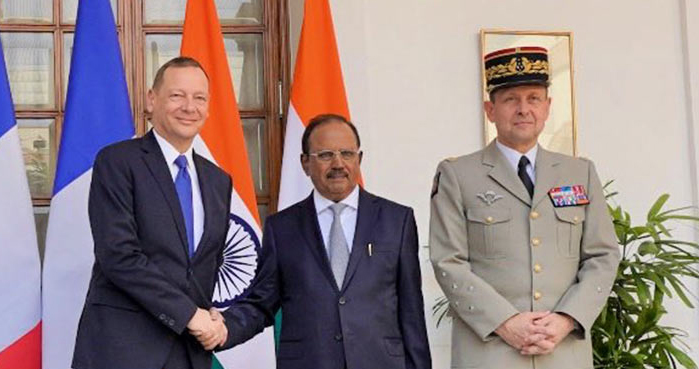







The 38th India–France Strategic Dialogue, convened in New Delhi on 13 January 2026, represents a decisive consolidation in one of India’s most consequential and enduring strategic partnerships. Held ahead of President Emmanuel Macron’s state visit to India, the Dialogue functioned as a strategic coordination mechanism aligning defence-industrial cooperation, technological sovereignty, Indo-Pacific maritime security, climate–energy convergence, and long-horizon geopolitical planning under the Horizon 2047 framework. India–France relations have now entered a capability-centric phase of strategic autonomy, wherein diplomacy is increasingly directed toward sovereign defence capacity, industrial resilience, and stabilising multipolar cooperation. Preparations for President Macron’s participation in the India AI Impact Summit (19–20 February 2026, New Delhi) further illustrate how the partnership connects immediate strategic priorities with longer-term leadership in global technology governance.
The Dialogue was co-chaired at the senior strategic level by India’s National Security Adviser Shri Ajit Doval and Mr Emmanuel Bonne, Diplomatic Adviser to the President of the French Republic, underscoring the centrality of the relationship within the strategic calculus of both capitals. Discussions reviewed cooperation across security, defence, technology, space, and civil nuclear domains, with explicit emphasis on joint development and industrial collaboration aligned with Make in India and Atmanirbhar Bharat (Self-Reliant India). In parallel with the Dialogue, Mr Emmanuel Bonne held substantive meetings with External Affairs Minister Dr S. Jaishankar and called on Prime Minister Shri Narendra Modi, reinforcing the depth of political trust and strategic confidence that underpins the partnership beyond institutional mechanisms. The engagement thus functioned not as a retrospective diplomatic ritual, but as a preparatory platform for leader-level strategic delivery.
These deliberations took place against the backdrop of intensified geopolitical competition, fragmentation of trade and technology regimes, and growing maritime contestation across the Indo-Pacific. In this environment, India and France have steadily consolidated a partnership oriented toward strategic autonomy, diversification, and institutionalised cooperation, with a clear emphasis on translating political alignment into durable material capability. At the same time, this evolution must navigate persistent asymmetries, including regulatory constraints arising from France’s European obligations, requiring careful calibration between strategic hedging and norm-based cooperation.
The durability of this partnership rests on a foundation laid in 1998, when France opted for sustained engagement following India’s nuclear tests, establishing a relationship grounded in sovereign equality and mutual respect. Over subsequent decades, cooperation expanded from defence and civil nuclear energy into space, climate action, education, technology, and research, enabling coordination across sensitive domains while preserving national autonomy. The articulation of the Horizon 2047 roadmap further institutionalised this long-term orientation, projecting cooperation beyond electoral cycles and short-term geopolitical fluctuations, with indicative targets of €100 billion in bilateral tradeand €30 billion in defence co-production by mid-century. While frictions related to technology transfer, regulatory constraints, and project execution have periodically surfaced, the renewed emphasis on co-development reflects an intent to manage these challenges through structured industrial partnership rather than episodic transactions.
Defence cooperation remains the backbone of the India–France strategic relationship, and its evolution is particularly illustrative of this broader shift. What began largely as platform-centric procurement has progressively matured into a more integrated industrial relationship encompassing manufacturing, maintenance, upgrades, and innovation. India currently operates 36 Rafale fighter aircraft inducted into the Indian Air Force and, in 2025, concluded a contract for 26 Rafale-M carrier-based aircraft for the Indian Navy, comprising twenty-two single-seat and four twin-seat variants, with deliveries extending through the end of the decade. This acquisition significantly strengthens India’s carrier aviation capability while embedding French platforms within India’s maritime strike architecture.
Beyond existing contracts, the Dialogue unfolded amid advancing discussions on a proposal for 114 additional Rafale fighter aircraft, which received clearance from India’s Defence Procurement Board in early 2026 and is progressing through the Defence Acquisition Council. If concluded, this would represent one of India’s largest fighter acquisitions, addressing squadron strength requirements while deepening long-term industrial engagement. At the same time, earlier experiences regarding offset depth and cost escalation underline the importance of deeper technology absorption to advance India’s long-term defence-industrial objectives.
The industrial dimension of defence cooperation has acquired tangible momentum through Dassault Aviation’s partnership with Tata Advanced Systems to manufacture Rafale fuselages in Hyderabad, marking the first production of critical Rafale airframe structures outside France. This development represents a qualitative shift from offset-driven arrangements toward embedded aerospace manufacturing in India. Parallel cooperation continues in the undersea domain through Project-75 (Scorpene-class submarines) and through regular bilateral exercises such as Varuna and Garuda, enhancing interoperability across air, surface, and sub-surface domains. Collectively, these initiatives integrate procurement, industrial participation, sustainment, and future capability development within a single strategic continuum.
Maritime cooperation occupies a similarly significant place in the partnership. France’s status as a resident Indo-Pacific power, with overseas territories and sustained naval presence across the Indian and Pacific Oceans, complements India’s regional priorities. The Dialogue reviewed regional and international security concerns with particular attention to maritime stability, freedom of navigation, and respect for international law. Rather than adopting overtly adversarial postures, both sides emphasised stability through presence, interoperability, and maritime domain awareness, contributing to equilibrium in an increasingly contested Indo-Pacific environment.
Emerging and critical technologies formed another central pillar of the Dialogue, particularly artificial intelligence and digital governance. Preparations for President Macron’s visit were closely linked to cooperation under the India–France Year of Innovation 2026 and his participation in the India AI Impact Summit. AI cooperation now intersects with defence modernisation, cyber resilience, data governance, and strategic decision-making. President Macron’s engagement reflects an intent to co-shape global norms for responsible, sovereign, and human-centric AI governance, while recognising the practical challenge of translating normative convergence into sustained research collaboration and industrial outcomes across differing regulatory environments.
Space cooperation continues to serve as a quietly strategic pillar of the relationship, grounded in decades of joint satellite missions, climate monitoring, and scientific exchange. As outer space becomes increasingly congested and contested, India and France share an interest in preserving it as a stable global commons governed by responsible behaviour. Civil nuclear cooperation likewise remains emblematic of deep strategic trust. In an era of climate urgency and energy volatility, nuclear energy provides India with reliable low-carbon baseload power, while France contributes technical expertise and operational experience. The Dialogue reaffirmed commitment to the Jaitapur nuclear power project (9.9 GW) and explored cooperation in small modular reactors alongside expanding collaboration in renewables and green hydrogen.
Although the Strategic Dialogue did not culminate in new trade agreements, it took place amid global economic fragmentation and supply-chain reconfiguration. Strategic alignment with France strengthens India’s engagement with Europe, particularly as standards-based trade regimes and regulatory frameworks gain prominence. India’s approach remains calibrated, encouraging openness while safeguarding policy autonomy and long-term competitiveness.
The Horizon 2047 roadmap provides the conceptual anchor for this evolving partnership, envisioning sustained cooperation across defence, technology, education, energy, and global governance through mid-century. Its emphasis on long-term planning, resilience, and institutional continuity reflects a shared commitment to strategic patience and durable convergence.
The 38th India–France Strategic Dialogue reflects a mature and forward-looking partnership shaped by strategic realism, institutional depth, and long-term vision. It demonstrates how sustained political trust can be translated into concrete cooperation across defence, technology, maritime security, and energy, without diluting strategic autonomy on either side. As global power structures become more fluid and security challenges increasingly interconnected, the India–France relationship stands out for its ability to balance capability-building with restraint, and partnership with independence.
Both sides affirmed that deeper and more sustained cooperation is no longer optional but essential to navigating an unsettled global security landscape, positioning the India–France partnership as a stabilising force committed to peace, resilience, and long-term strategic equilibrium.
Views: 1352

Dr. Maheep
Dr. Maheep is Director, Indian Perspective on Global Affairs (IPGA), and a leading analyst of India’s foreign policy and South Asian geopolitics. He earned his PhD in Arab and Islamic Studies. With more than a decade of teaching and research experience in International Relations and Global Politics, he contributes regularly on issues shaping national and global affairs.


