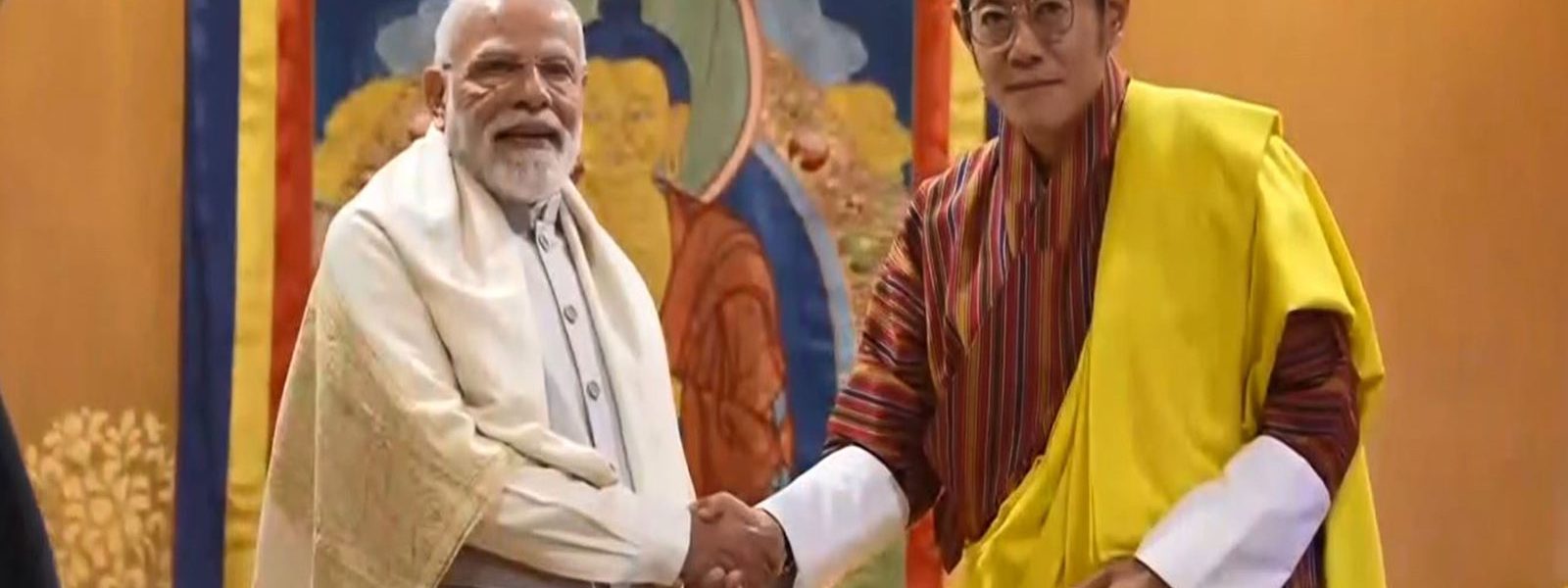







THIMPHU: Indian Prime Minister Narendra Modi’s two-day State Visit to Bhutan, at the invitation of His Majesty the Fourth Druk Gyalpo, marked a pivotal milestone in the continuum of India’s engagement with the Himalayan kingdom. The visit transcended ceremonial splendour and embodied the renewal of an enduring partnership that blends civilisational depth with strategic foresight. Beneath the warmth of cultural celebration lay the framework of value-based diplomacy—where trust, sustainability, and shared progress remain the defining principles of India–Bhutan relations. At a time when global politics is marked by environmental crises, shifting alliances, and technological transitions, the visit reaffirmed how India’s neighbourhood policy—rooted in respect rather than rivalry—redefines diplomacy as an instrument of empowerment. The agreements signed, the projects inaugurated, and the spiritual reaffirmations exchanged together reflect a vision where geography becomes partnership, and proximity transforms into shared purpose.
Civilizational Realism and the Foundations of Trust
India’s engagement with Bhutan is guided by a distinctive civilizational realism—an approach that blends strategic prudence with spiritual depth. It resonates with the constructivist understanding of international relations, where shared ideas, identities, and cultural memories, rather than power alone, define interstate relations.
The transfer of the sacred Piprahwa Relics of Lord Buddha to Bhutan exemplifies this spiritual diplomacy. It was not a ceremonial act but a reaffirmation of a shared civilizational consciousness, a form of dialogue that binds political cooperation with ethical continuity. Through such gestures, India acts as a normative power, shaping regional harmony through persuasion and values rather than pressure or dominance.
Faith, culture, and continuity thus constitute the grammar of India–Bhutan friendship, where modern policy is anchored in ancient wisdom. Viewed through this lens, India’s diplomacy becomes the stewardship of trust—a form of relational capital that transcends borders and political cycles, making Bhutan the most enduring reflection of India’s ethical and strategic partnership.
Strategic Geography and the Politics of Balance
Bhutan’s geographic position—situated between India and China along the fragile Himalayan arc—renders it central to the strategic equilibrium of South Asia. India’s engagement with Bhutan has thus remained rooted in partnership, not patronage. The inauguration of the 1,020 MW Punatsangchhu-II Hydropower Project in 2025 and the extension of a ₹4,000-crore Line of Credit epitomise a vision of constructive equilibrium—power shared through collaboration, not control.
In contrast, Beijing’s regional pursuits—whether through the Belt and Road Initiative (BRI) or the China–Pakistan Economic Corridor (CPEC)—have come to exemplify debt-trap diplomacy and coercive financing that erode economic sovereignty. From Sri Lanka’s Hambantota Port lease to Maldives’ mounting repayment obligations, and from Tibet’s cultural subjugation to Nepal’s creeping economic dependence, China’s regional conduct reveals a hunger for dominance, not integration.
India, by contrast, represents transparent, humane, and responsive engagement. Guided by the SAGAR vision—Security and Growth for All in the Region—New Delhi offers stability grounded in trust. Whether rebuilding Nepal after the 2015 earthquake, assisting Sri Lanka during financial crises, or supporting Bhutan’s hydropower and connectivity initiatives, India’s leadership rests on empathy over ambition and cooperation over control.
Ecological Diplomacy: The Green Compact of the Himalaya
Bhutan stands as the world’s only carbon-negative nation, constitutionally committed to preserving over 60 percent of its forest cover. Its ecological philosophy resonates profoundly with India’s climate ethics and environmental stewardship. Together, the two nations have built a Himalayan Compact for Sustainability—a partnership that aligns technological innovation with the sanctity of nature.
Their collaboration found renewed expression in the spirit of COP 30 in Belém, Brazil, where India reaffirmed its commitment to inclusive and sustainable growth, and Bhutan reiterated its moral leadership in environmental governance. Looking ahead to COP 33, both nations are working toward a Himalayan agenda centred on renewable energy, biodiversity protection, and green innovation—creating a blueprint for the Global South’s climate resilience.
India’s leadership of the International Solar Alliance and the Global Biofuels Alliance, advanced through its landmark G20 Presidency, demonstrated that climate responsibility can harmonize with economic growth. Combined with Bhutan’s ecological integrity, this partnership gives global resonance to the belief that sustainable diplomacy can achieve what extractive geopolitics cannot.
Human Development, Digital Bridges, and AI Governance
The MoUs signed during this visit on healthcare, mental well-being, and education signify a decisive shift from infrastructure-based cooperation to human development diplomacy. This new phase reflects India’s vision of empowering Bhutan’s social and knowledge sectors through sustainable partnerships and technological capacity-building.
India’s digital public infrastructure, spanning telemedicine, fintech, and e-learning, has become an enabler of empowerment in Bhutan, bridging geography through technology and ensuring inclusive access to essential services. These initiatives mark the transition from material connectivity to human-centric cooperation, where technology serves as both a tool of progress and a symbol of shared purpose.
This represents knowledge diplomacy at its most transformative. As India emerges as a leader of the global south in ethical artificial intelligence, framing norms that balance innovation with inclusion, its collaboration with Bhutan gains even greater relevance. Together, they are crafting a humane technological future that reflects the values of responsibility, fairness, and moral restraint. Through this digital and ethical collaboration, India and Bhutan not only modernise their economies but also redefine what progress means in the age of AI: innovation grounded in humanity.
Regional Stability and the Power of Principle
Amidst South Asia’s volatile geopolitics, India and Bhutan represent a rare model of stability built on trust. Their cooperation refutes the deterministic logic of asymmetry and proves that influence can coexist with integrity.
While China extends its reach through debt and dependency, India extends its hand through partnership and purpose. From cross-border trade to the forthcoming railway link between Assam’s Kokrajhar and Bhutan’s Gelephu, every initiative underlines a simple truth—India builds capacity, not captivity. The shared waters of the Brahmaputra and Manas flow as metaphors of partnership rather than contestation—a triumph of hydro-diplomacy guided by mutual respect.
The Monarch’s Vision and the Ethic of Leadership
His Majesty the Fourth Druk Gyalpo remains Bhutan’s moral anchor. His philosophy of Gross National Happiness fuses economic progress with ethical governance, offering the world an alternative to materialist models of growth. Prime Minister Modi’s tribute to the King during the Thimphu celebrations acknowledged this synergy of values—of leadership that uplifts rather than dominates.
The King’s vision mirrors India’s own civilizational conviction that true leadership is measured not by dominance but by service. The India–Bhutan relationship thus endures as a moral alliance: a partnership of humility, dignity, and shared humanity.
Vision Beyond Borders: Youth and the Future Horizon
The true custodians of the India–Bhutan partnership are its youth—the innovators, researchers, and environmental entrepreneurs who will shape the Himalaya’s future. Joint R&D centres, AI-based climate modelling, and sustainable start-up ecosystems will redefine the region as a crucible of green innovation.
In this shared journey, India provides the scale and technological depth; Bhutan contributes moral balance and ecological wisdom. Together, they chart a path of responsible modernity, blending scientific advancement with spiritual restraint.
Conclusion
Prime Minister Modi’s 2025 visit to Bhutan reaffirmed that diplomacy, when rooted in conscience, can transform geography into fraternity and development into dignity. In a world often driven by competition and coercion, India’s neighbourhood policy stands apart — guided by empathy, balance, and the quiet strength of shared values.
As the flagbearer of the International Solar Alliance, the Global Biofuels Alliance, and a pioneer in AI regulation, India — through its G20 Presidency — has redefined global governance as a platform for inclusivity, sustainability, and collective progress. In Bhutan, it finds a partner that mirrors its ecological integrity and ethical interdependence, proving that moral clarity and strategic vision can coexist.
Together, India and Bhutan illuminate a path where diplomacy becomes a dialogue of hearts as much as of nations, where power yields to principle, and where progress is measured not only in growth but in goodness. Their alliance transforms the Himalaya from a contested frontier into a sanctuary of peace and prosperity — an enduring sustainable partnership defined by the art of mutual respect, trust, progress, and empowerment.
Views: 665

Dr. Maheep
Dr. Maheep is Director, Indian Perspective on Global Affairs (IPGA), and a leading analyst of India’s foreign policy and South Asian geopolitics. He earned his PhD in Arab and Islamic Studies. With more than a decade of teaching and research experience in International Relations and Global Politics, he contributes regularly on issues shaping national and global affairs.