









In 1950, the People’s Liberation Army marched into Tibet under the banner of “liberation.” What followed was not liberation but a systematic campaign of conquest, repression, and cultural destruction. Over seven decades, the Chinese Communist Party (CCP) has sought to erase Tibetan identity, dismantle its institutions, and silence its spiritual leaders. Today, under Xi Jinping’s centralization of power, the repression has intensified. At the forefront of this campaign is Li Ganjie, the current head of the United Front Work Department (UFWD), whose enforcement of “Sinicization” represents the most aggressive attempt yet to extinguish Tibetan culture. His actions may meet the threshold of crimes against humanity and demand international accountability.
The CCP’s record in Tibet is one of sustained atrocity. During the Invasion and Seventeen Point Agreement (1950–51) Tibet was coerced into signing away sovereignty under military duress. The PLA’s entry brought mass violence and the dismantling of Tibetan governance. When Tibetans rose against Chinese rule, the PLA crushed the revolt, killing tens of thousands, according to Tibetan exile sources and many historians. The Dalai Lama fled into exile, beginning a diaspora that continues today.
Tibet’s monasteries, centers of learning and spiritual life, were razed. Tibetan exile sources say over 6,000 were destroyed, sacred texts burned, and monks imprisoned or executed. Post-1978 “Reform” Era while Deng Xiaoping’s reforms promised liberalization, Tibet remained under tight control. Arbitrary arrests, torture, and surveillance became routine. The CCP has transformed Tibet into a laboratory of repression, where facial recognition, digital monitoring, and ideological indoctrination are deployed to suppress dissent.
These atrocities are not isolated incidents but part of a deliberate strategy: to assimilate Tibet into the Chinese nation-state by erasing its distinct identity.
The United Front Work Department and Li Ganjie’s Mandate. The UFWD is the CCP’s instrument for controlling religion, ethnic minorities, and civil society. Under Xi Jinping, it has been elevated to a central role in governance. Li Ganjie, appointed head of the UFWD in April 2025, has expanded its reach into Tibet with unprecedented vigor.
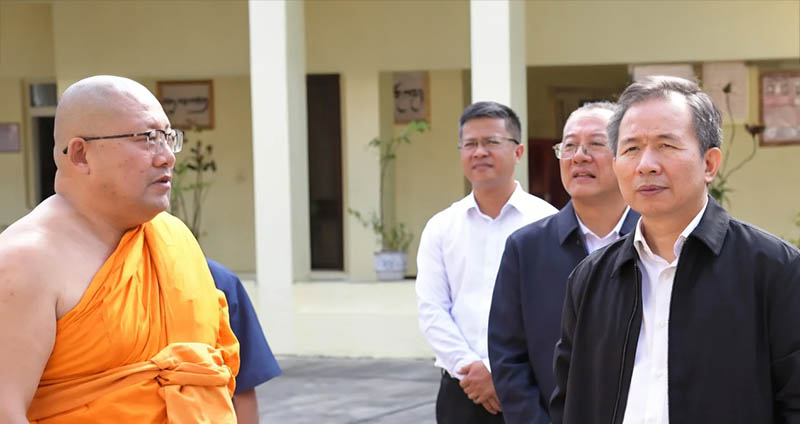
Li has reinforced campaigns requiring Tibetan Buddhism to conform to “socialist values.” Monks must pledge loyalty to the Party, not the Dharma. Religious education is restructured to produce “politically reliable monks.” The Dalai Lama remains the spiritual leader of Tibetans worldwide, but CCP directives criminalize devotion to him. Monasteries are compelled to denounce “foreign infiltration,” a euphemism for Tibetan loyalty to their exiled leader. Li has personally toured Tibetan regions, inspecting monasteries and religious academies to enforce ideological conformity. His presence signals the CCP’s determination to crush any vestige of autonomy. Tibetan language, festivals, and traditions are subordinated to Han-centric narratives. Schools prioritize Mandarin; Tibetan cultural expression is framed as separatist.
Li’s role is not bureaucratic. He is a senior enforcer of policies that weaponize culture and religion against Tibetans themselves.
International law defines crimes against humanity as widespread or systematic attacks against civilian populations. Li Ganjie’s policies may meet this standard: Persecution on Religious Grounds: Tibetans are targeted for their devotion to Buddhism and the Dalai Lama. Religious practice is criminalized unless subordinated to CCP ideology. The forced assimilation of Tibetan identity, language suppression, destruction of monasteries, and ideological indoctrination, constitutes what Tibetan advocates describe as cultural genocide. Surveillance, arbitrary detention, and torture are not isolated abuses but state policy. The UFWD’s directives institutionalize repression.
Just as perpetrators of ethnic cleansing in Bosnia or Myanmar have faced international scrutiny, Li’s role in Tibet warrants investigation through available international legal mechanisms.
The world has been slow to respond to Tibet’s plight. Yet Li Ganjie’s leadership of the UFWD presents an opportunity to reframe Tibet not as a “domestic issue” but as a case of possible crimes against humanity. Documentation: NGOs and governments must document UFWD directives as evidence of systematic repression.
Li should be sanctioned under Magnitsky-style laws, which target individuals responsible for human rights abuses. Tibet’s case must be elevated at the UN Human Rights Council, linking religious repression to broader authoritarian expansion. Legal Accountability: International lawyers should prepare dossiers for international legal mechanisms, framing Li’s actions as possible crimes against humanity.
The CCP’s atrocities in Tibet are not relics of the past. They continue today under Li Ganjie’s leadership. His role in the campaign to erase Tibetan identity through forced Sinicization may amount to a crime against humanity. Holding him accountable is necessary to uphold international justice and protect Tibet’s survival.
The world must recognize that Tibet’s struggle is not simply about autonomy. It is about survival. And survival requires accountability. Li Ganjie’s name should be listed alongside those who have orchestrated forced cultural assimilation and religious persecution. Only then can Tibet’s dignity be defended against the machinery of repression.
Views: 125

Khedroob Thondup
Khedroob Thondup is the son of Gyalo Thondup, elder brother of the Dalai Lama. Educated at St. Stephens College Delhi University and the University of San Francisco. He was a personal assistant to the Dalai Lama and accompanied him on his first trip to the U.S. in 1979. He was sent by the Dalai Lama to Beijing from 1980 till 1993 for dialogue talks where he interacted with Xi Zhongxun and Hu Jintao. He has served as Member of the Tibetan Parliament in Exile for three terms and is the President of the Tibetan Refugee Self Help Centre Darjeeling since 1987. He has edited two books, Dalai Lama My Son and Tibet in Turmoil and presently lives in Taipei, Taiwan.


