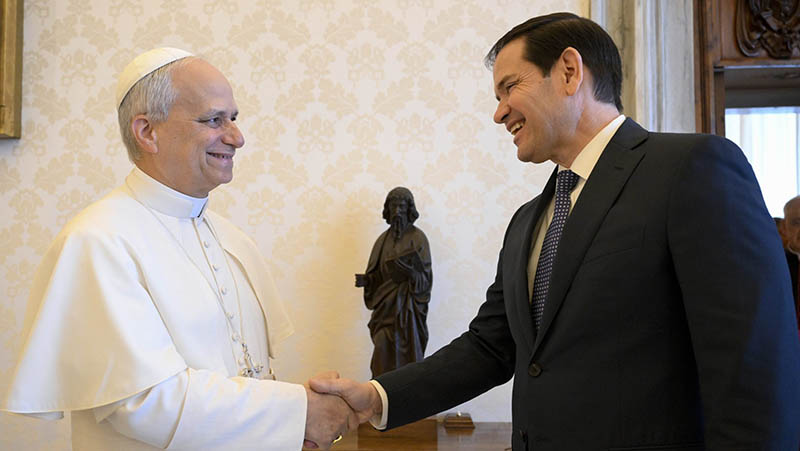







Diplomacy often unfolds in conference rooms and summits, but sometimes its most consequential gestures occur in sanctuaries. Secretary of State Marco Rubio’s meeting with Pope Leo should be seen not as ceremonial theater but as a calculated act of statecraft. In a world where moral authority and geopolitical power intersect, the encounter carries strategic weight for Washington’s global posture.
The Vatican remains one of the few institutions whose moral authority transcends borders. By engaging directly with Pope Leo, Rubio underscores that America’s foreign policy is anchored not only in interests but in values. This is particularly salient in contexts like Tibet, Xinjiang, and Ukraine, where moral clarity strengthens strategic resolve. The meeting signals that human dignity and religious freedom are not peripheral concerns but central to U.S. diplomacy.
History reminds us that papal diplomacy has shaped global affairs, from Pope John Paul II’s role in Eastern Europe to Vatican mediation in Latin America. Pope Leo’s voice resonates across continents, influencing debates on migration, climate change, and human rights. Rubio’s outreach leverages this influence, aligning U.S. policy with a moral compass that challenges authoritarian narratives and bolsters legitimacy.
Authoritarian regimes often dismiss human rights as Western constructs. By standing with the Vatican, Washington amplifies a universal moral framework that challenges this relativism. Rubio’s meeting offers a counter-narrative. Sovereignty cannot excuse repression. The symbolism is clear. America is not alone in insisting that values remain a cornerstone of global order.
The meeting also plays to a domestic audience. Rubio, a Catholic himself, reinforces the administration’s commitment to faith-informed values without blurring the line between church and state. For American voters, the gesture demonstrates that foreign policy is not divorced from moral conviction. It strengthens bipartisan appeal by framing diplomacy as both principled and pragmatic.
Secretary Rubio’s meeting with Pope Leo is more than a photo opportunity. It is a strategic move that blends symbolism with substance, reinforcing America’s moral authority abroad while bolstering credibility at home. In a geopolitical landscape where legitimacy is contested as fiercely as territory, the encounter reminds allies and adversaries alike that values remain a cornerstone of U.S. power.
Views: 19

Khedroob Thondup
Khedroob Thondup is the son of Gyalo Thondup, elder brother of the Dalai Lama. Educated at St. Stephens College Delhi University and the University of San Francisco. He was a personal assistant to the Dalai Lama and accompanied him on his first trip to the U.S. in 1979. He was sent by the Dalai Lama to Beijing from 1980 till 1993 for dialogue talks where he interacted with Xi Zhongxun and Hu Jintao. He has served as Member of the Tibetan Parliament in Exile for three terms and is the President of the Tibetan Refugee Self Help Centre Darjeeling since 1987. He has edited two books, Dalai Lama My Son and Tibet in Turmoil and presently lives in Taipei, Taiwan.