


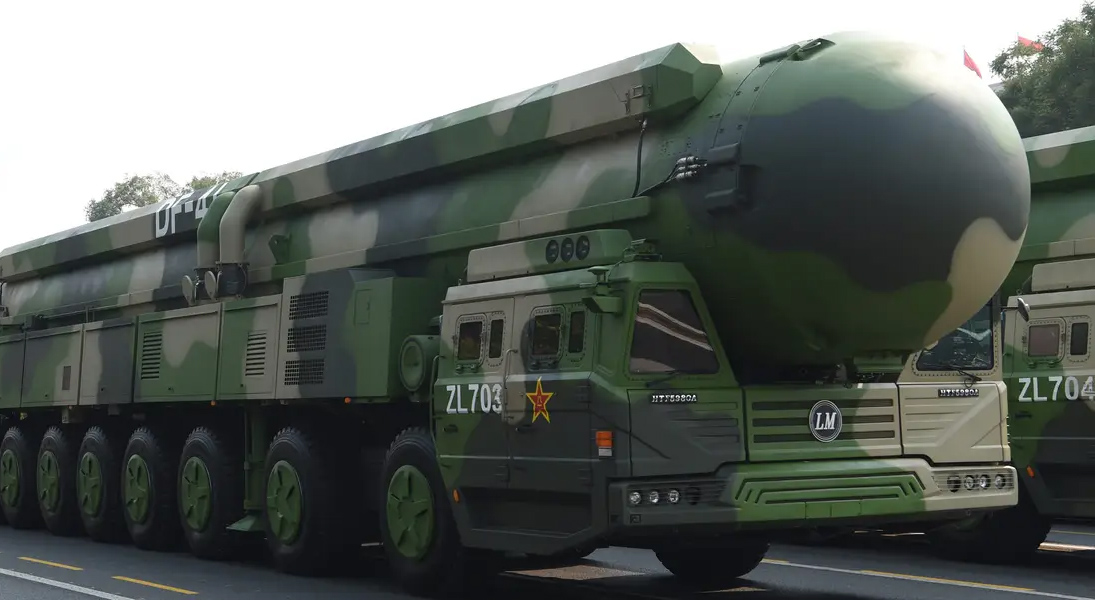







In the quiet deserts of western China, hundreds of missile silos are rising from the earth. For decades, Beijing’s nuclear posture was defined by restraint; a minimalist doctrine rooted in deterrence, not dominance.
Today, that doctrine is being rewritten. China is no longer content with a modest second-strike capability. It is building a nuclear force that signals parity, leverage, and permanence. This transformation is not merely quantitative. It is philosophical.
China’s nuclear arsenal, once estimated at around 200 warheads, is projected to exceed 1,000 by 2030. The deployment of MIRV-capable missiles, those that carry multiple warheads, marks a leap in sophistication. Submarine-launched ballistic missiles and hypersonic glide vehicles further diversify Beijing’s strategic toolkit.
These developments suggest a shift from “minimum deterrence” to “dynamic deterrence”: a posture that can respond flexibly to regional crises, technological threats, and geopolitical rivalries. Three forces are converging.
First, Beijing perceives growing encirclement, from U.S. alliances in the Indo-Pacific to missile defense systems in South Korea and Japan. Second, the Taiwan question looms larger than ever. A credible nuclear umbrella could deter American intervention in a cross-strait conflict. Third, China seeks recognition as a global peer, not just economically, but militarily. Nuclear parity is a currency of status.
Yet this expansion carries risks. Without transparency or arms control agreements, miscalculation becomes more likely. The opacity of China’s command-and-control systems, its no-first-use policy, and its launch-on-warning capabilities all raise questions. In a crisis, ambiguity can be dangerous.
The United States and Russia have decades of arms control experience. China does not. Its nuclear diplomacy remains cautious, even aloof. But as its arsenal grows, so too does its responsibility. Strategic stability is not a gift; it is a discipline.
China’s nuclear ambitions are not inherently destabilizing. But they demand dialogue. They demand doctrine. And above all, they demand clarity. The world must understand not just how many warheads China possesses, but what it intends to do with them.
In the end, nuclear weapons are not just instruments of war. They are instruments of meaning. They signal how a nation sees itself—and how it wishes to be seen. China’s nuclear pivot is a message. It is time we listened.
Views: 110

Khedroob Thondup
Khedroob Thondup is the son of Gyalo Thondup, elder brother of the Dalai Lama. Educated at St. Stephens College Delhi University and the University of San Francisco. He was a personal assistant to the Dalai Lama and accompanied him on his first trip to the U.S. in 1979. He was sent by the Dalai Lama to Beijing from 1980 till 1993 for dialogue talks where he interacted with Xi Zhongxun and Hu Jintao. He has served as Member of the Tibetan Parliament in Exile for three terms and is the President of the Tibetan Refugee Self Help Centre Darjeeling since 1987. He has edited two books, Dalai Lama My Son and Tibet in Turmoil and presently lives in Taipei, Taiwan.


