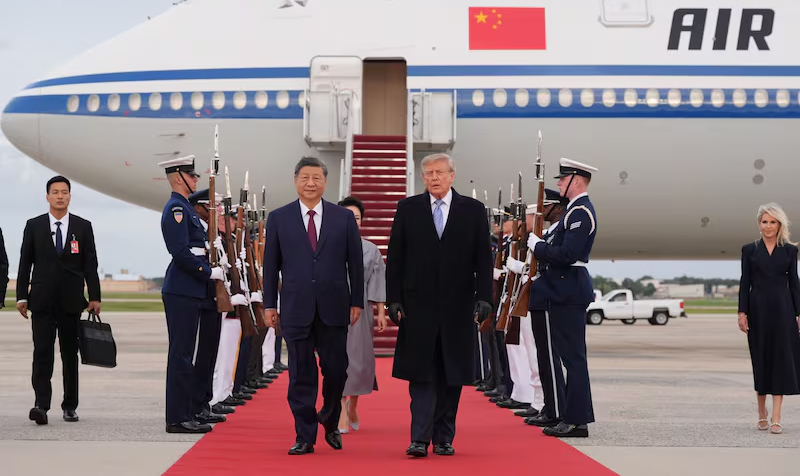







When Chinese President Xi Jinping boarded his plane home from Washington last week, he carried himself with the air of a man who had just fulfilled an obligation rather than achieved a diplomatic triumph. The summit with U.S. President Donald Trump ended much as observers had predicted: with generous praise from Trump for both Xi and himself, warm rhetoric about the importance of the bilateral relationship, and little evidence of any meaningful shift in the strategic rivalry between the world’s two largest powers.
If anything, Xi appeared to leave with confirmation that time and circumstance are working more in Beijing’s favor than Washington’s.
That may seem counterintuitive. After all, Chinese leaders traditionally seek concrete deliverables from high-level summits. Yet Xi’s restrained demeanor suggested that securing dramatic agreements was never the primary objective. Instead, the visit resembled the sort of dutiful social call one makes to an aging relative: respectful, cordial, necessary, but unlikely to change underlying realities.
The reason lies in the changing balance of confidence between the two countries.
For years, American administrations approached China from a position of overwhelming economic, technological, and geopolitical strength. Even when relations were tense, Washington generally assumed it possessed the greater capacity to shape outcomes. Today, however, Beijing sees a different landscape. The United States remains enormously powerful, but it is also increasingly polarized, burdened by domestic political conflict, and struggling to translate its global ambitions into consistent policy.
From Beijing’s perspective, American politics has become a source of unpredictability. Policies shift with administrations. Strategic priorities change. Harsh rhetoric is often followed by abrupt reversals. Chinese officials may dislike many American actions, but they also recognize a pattern: Washington’s attention is frequently divided by domestic concerns.
Xi therefore had little reason to chase headlines or seek grand bargains. His objective was more modest and arguably more sophisticated. He needed to stabilize relations, avoid unnecessary confrontation, and demonstrate that China remains willing to engage. Simply maintaining a functional channel with the United States serves Beijing’s interests while preserving flexibility for the future.
Trump’s enthusiastic praise during and after the summit only reinforced that impression. Compliments may generate positive headlines, but they do not alter the structural issues that define the relationship: trade tensions, technological competition, military rivalry, and competing visions of international order. Neither side showed any sign of resolving those disputes. The summit produced atmospherics rather than transformation.
That is why Xi could afford to appear calm, even detached. He was not arriving in Washington to negotiate China’s future. He was arriving to manage the present.
The deeper significance of the meeting may be what it revealed about expectations. Washington still often speaks as though bilateral summits should yield breakthroughs. Beijing increasingly acts as though breakthroughs are unrealistic and stability itself is a sufficient achievement. Those are very different mindsets.
Seen through that lens, Xi’s visit was not a disappointment for China. It was a successful exercise in diplomatic maintenance. He met the American president, reduced the risk of immediate escalation, projected confidence, and departed without making major concessions.
The image that lingered afterward was not of a leader returning home triumphant. Nor was it of one returning defeated. Instead, it was the image of a leader who had completed a necessary obligation, exchanged pleasantries, and moved on, convinced that the fundamental trajectory of the relationship would be determined elsewhere and over a much longer horizon.
That is why Xi left Washington looking less like a man who had won a negotiation than like someone who had paid a respectful visit, fulfilled his duty, and quietly concluded that the family dynamics were unlikely to change anytime soon.
Views: 30

Khedroob Thondup
Khedroob Thondup is the son of Gyalo Thondup, elder brother of the Dalai Lama. Educated at St. Stephens College Delhi University and the University of San Francisco. He was a personal assistant to the Dalai Lama and accompanied him on his first trip to the U.S. in 1979. He was sent by the Dalai Lama to Beijing from 1980 till 1993 for dialogue talks where he interacted with Xi Zhongxun and Hu Jintao. He has served as Member of the Tibetan Parliament in Exile for three terms and is the President of the Tibetan Refugee Self Help Centre Darjeeling since 1987. He has edited two books, Dalai Lama My Son and Tibet in Turmoil and presently lives in Taipei, Taiwan.