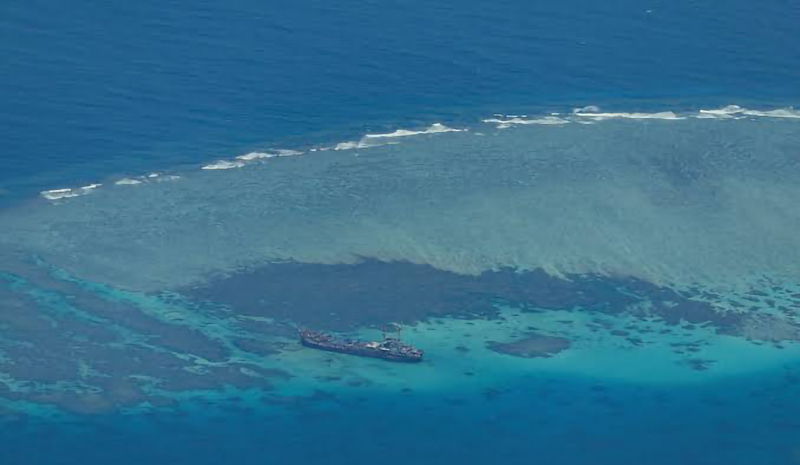







China’s rejection of the 2016 Hague tribunal ruling is not simply a matter of legal disagreement—it is a deliberate policy choice rooted in strategic imperatives. By insisting on its nine-dash line, Beijing asserts “historic rights” that international law has already invalidated. This defiance signals that China prioritizes power projection and sovereignty narratives over adherence to global norms.
Several strategic considerations underpin Beijing’s position in the South China Sea. Resource security is one of them. The South China Sea holds vast reserves of oil, gas, and fisheries. Securing these resources supports China’s long-term energy and food security. Military leverage is another important driver. Artificial islands equipped with runways and missile systems extend China’s reach, enabling control over critical sea lanes. National legitimacy also plays a central role. Domestically, the claim reinforces nationalist narratives, bolstering the Communist Party’s legitimacy by portraying China as reclaiming lost territory. Finally, geopolitical positioning remains integral to Beijing’s strategy.Control of the South China Sea strengthens China’s hand in the Indo-Pacific, challenging U.S. alliances and reshaping regional security dynamics.
It is for these reasons that much of the international community continues to push back against Beijing’s claims.The Hague ruling affirmed that China’s expansive claims have no legal basis under UNCLOS. Southeast Asian nations—Philippines, Vietnam, Malaysia, and Brunei—see their Exclusive Economic Zones encroached upon. Roughly one-third of global shipping passes through these waters, meaning that any disruption threatens worldwide commerce. China’s dredging and militarization have devastated coral reefs and fisheries, sparking ecological alarm.
China’s stance illustrates a broader tension between rule of law and power politics. For smaller states, the Hague ruling is a shield affirming their rights. For China, it is irrelevant compared to the strategic value of dominance. This divergence underscores the fragility of international law when confronted with great-power defiance.
The policy challenge for the international community is twofold. The first is deterrence—ensuring freedom of navigation through joint patrols and alliances. The second is diplomatic pressure—sustaining multilateral consensus that the ruling is binding, even if unenforceable.
China’s persistence in claiming the South China Sea is not about legal entitlement but about strategic necessity and nationalist legitimacy. The Hague ruling stripped away its legal cover, yet Beijing continues to rely on military presence and diplomatic leverage. The South China Sea thus remains a litmus test of whether international law can constrain a rising power, or whether might will continue to define right.
Views: 44

Khedroob Thondup
Khedroob Thondup is the son of Gyalo Thondup, elder brother of the Dalai Lama. Educated at St. Stephens College Delhi University and the University of San Francisco. He was a personal assistant to the Dalai Lama and accompanied him on his first trip to the U.S. in 1979. He was sent by the Dalai Lama to Beijing from 1980 till 1993 for dialogue talks where he interacted with Xi Zhongxun and Hu Jintao. He has served as Member of the Tibetan Parliament in Exile for three terms and is the President of the Tibetan Refugee Self Help Centre Darjeeling since 1987. He has edited two books, Dalai Lama My Son and Tibet in Turmoil and presently lives in Taipei, Taiwan.