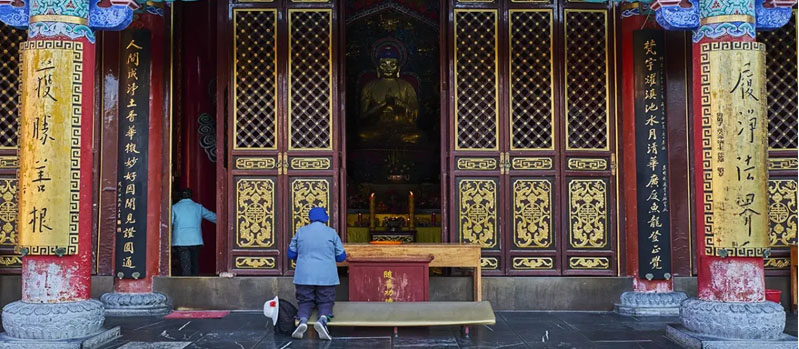







China’s paradoxical embrace of Buddhism is not about faith but function. The CCP, constitutionally atheist, has long sought to neutralize religion’s independent authority. Buddhism is tolerated and even promoted when it can be reframed as a cultural asset, a tourist attraction, or a moral supplement to socialism. But when Buddhism carries political or ethnic identity, as in Tibet, it is treated as a threat.
Tibetan Buddhism: Faith Under Siege
Control of reincarnation: Beijing insists it has the authority to approve the reincarnation of Tibetan lamas, including the future Dalai Lama. This is a direct attempt to sever Tibetan Buddhism from its spiritual lineage and bind it to state power.
Monastery surveillance: Monasteries in Tibet are heavily monitored, with monks required to undergo “patriotic education.” Religious study is subordinated to political indoctrination.
Cultural erasure: Tibetan Buddhist rituals, festivals, and teachings are restricted, regulated, or rebranded as “folk culture,” stripping them of their spiritual depth.
Targeting loyalty: Public allegiance to the Dalai Lama is criminalized, casting devotion itself as subversion.
Why Buddhism, Why Now?
Domestic stability: Buddhism is framed as a “harmonious” tradition that discourages dissent. By promoting state-approved Buddhism, the CCP channels spiritual yearning into politically safe expressions.
International soft power: China presents itself as a steward of Buddhist heritage, restoring temples, hosting conferences, and funding pilgrimages to gain legitimacy in Buddhist-majority countries like Thailand, Sri Lanka, and Myanmar.
Countering resistance: In Tibet, Buddhism is not just religion but identity. By controlling it, Beijing aims to weaken Tibetan nationalism and dilute resistance to assimilation.
China’s use of Buddhism reveals a hollowing of belief. Temples become tourist sites, monks become state employees, and scriptures are reinterpreted to preach obedience. The spiritual pursuit of enlightenment is replaced by the political pursuit of loyalty. In Tibet, this distortion is most acute: Buddhism is not merely managed but weaponized against the very people who hold it sacred.
Even in an atheist state, religion remains too powerful to ignore. The CCP’s paradoxical reliance on Buddhism shows that belief, when stripped of transcendence, can be repurposed as ideology. But the repression of Tibetan Buddhism demonstrates the limits of this strategy: faith, at its core, resists control. The more Beijing tries to own it, the more it exposes its own insecurity.
Views: 116

Khedroob Thondup
Khedroob Thondup is the son of Gyalo Thondup, elder brother of the Dalai Lama. Educated at St. Stephens College Delhi University and the University of San Francisco. He was a personal assistant to the Dalai Lama and accompanied him on his first trip to the U.S. in 1979. He was sent by the Dalai Lama to Beijing from 1980 till 1993 for dialogue talks where he interacted with Xi Zhongxun and Hu Jintao. He has served as Member of the Tibetan Parliament in Exile for three terms and is the President of the Tibetan Refugee Self Help Centre Darjeeling since 1987. He has edited two books, Dalai Lama My Son and Tibet in Turmoil and presently lives in Taipei, Taiwan.