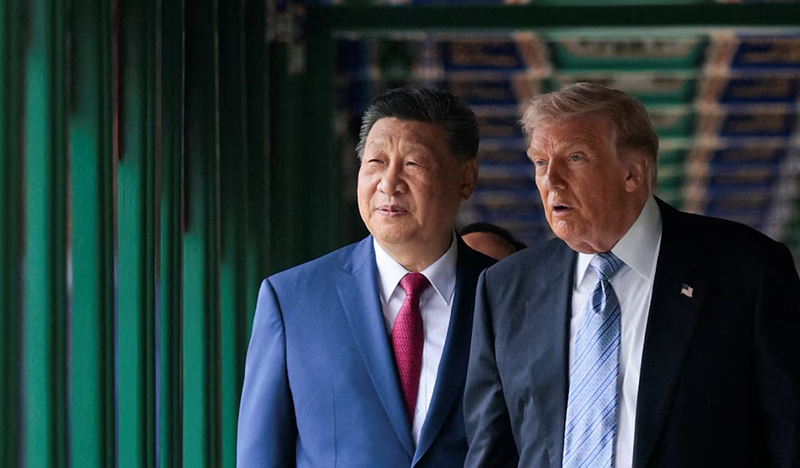







Xi Jinping’s upcoming September 24 visit to Washington has already forced Trump and the U.S. government into a posture of accommodation, highlighting both the fragility of U.S.-China relations and the leverage Beijing now wields. Despite Trump’s fiery rhetoric about Chinese election interference, the administration is bending backwards to ensure the visit goes smoothly, underscoring how strategic necessity often trumps political bravado.
Why Xi’s Visit Matters
Xi’s arrival comes amid Trump’s accusations that China illegally accessed U.S. voter data, a claim that could have derailed the visit. Yet Washington quickly reaffirmed the trip, signaling that dialogue with Beijing outweighs domestic political disputes. Strategic stakes: The U.S. is seeking cooperation on artificial intelligence, trade, and Indo-Pacific security. Trump himself emphasized AI as a key agenda item, showing Washington’s eagerness to secure Chinese buy-in on tech governance.
Secretary of State Marco Rubio and Chinese Foreign Minister Wang Yi have been laying groundwork for a “positive visit,” despite tensions. This reflects Washington’s willingness to smooth over disputes to keep Xi engaged.
Softening rhetoric
Trump’s administration appears to have toned down its confrontational language in the lead-up to Xi’s arrival, pivoting from accusations of election meddling to stressing “responsibility to continue dialogue” and by prioritizing optics over accountability. By not pressing Beijing on alleged election interference during preparatory talks, it looks like Washington is signaling that maintaining Xi’s visit is more important than confronting China on sensitive issues.
It also appears like the US appparatus is elevating Xi’s stature. Trump invited Xi to the White House after his own May trip to Beijing, effectively granting Xi symbolic parity and reinforcing the narrative that U.S.-China ties hinge on personal rapport between leaders.
Why it looks like this Signals U.S. Weakness.
This position demonstrates a dependence on dialogue. The U.S. is presenting Xi’s visit as indispensable, revealing how much Washington fears diplomatic rupture. It is also important to consider Global perception. By accommodating Xi despite serious allegations, the U.S. risks appearing reactive and desperate to preserve ties, rather than setting terms.
which gives rise to a strategic imbalance. Xi arrives with leverage and Trump needs cooperation on AI, trade, and security, while Beijing can afford to stall or extract concessions.
The Larger Picture.
Xi’s visit is not just a diplomatic event; it’s a test of U.S. resolve. Trump’s government appears to be bending backwards because it cannot afford a breakdown in relations with China at a time when AI competition, Indo-Pacific alliances, and trade stability are all in flux. The irony is stark: Trump’s nationalist rhetoric collides with geopolitical reality, forcing him into a conciliatory stance that underscores China’s rising influence.
Views: 85

Khedroob Thondup
Khedroob Thondup is the son of Gyalo Thondup, elder brother of the Dalai Lama. Educated at St. Stephens College Delhi University and the University of San Francisco. He was a personal assistant to the Dalai Lama and accompanied him on his first trip to the U.S. in 1979. He was sent by the Dalai Lama to Beijing from 1980 till 1993 for dialogue talks where he interacted with Xi Zhongxun and Hu Jintao. He has served as Member of the Tibetan Parliament in Exile for three terms and is the President of the Tibetan Refugee Self Help Centre Darjeeling since 1987. He has edited two books, Dalai Lama My Son and Tibet in Turmoil and presently lives in Taipei, Taiwan.