


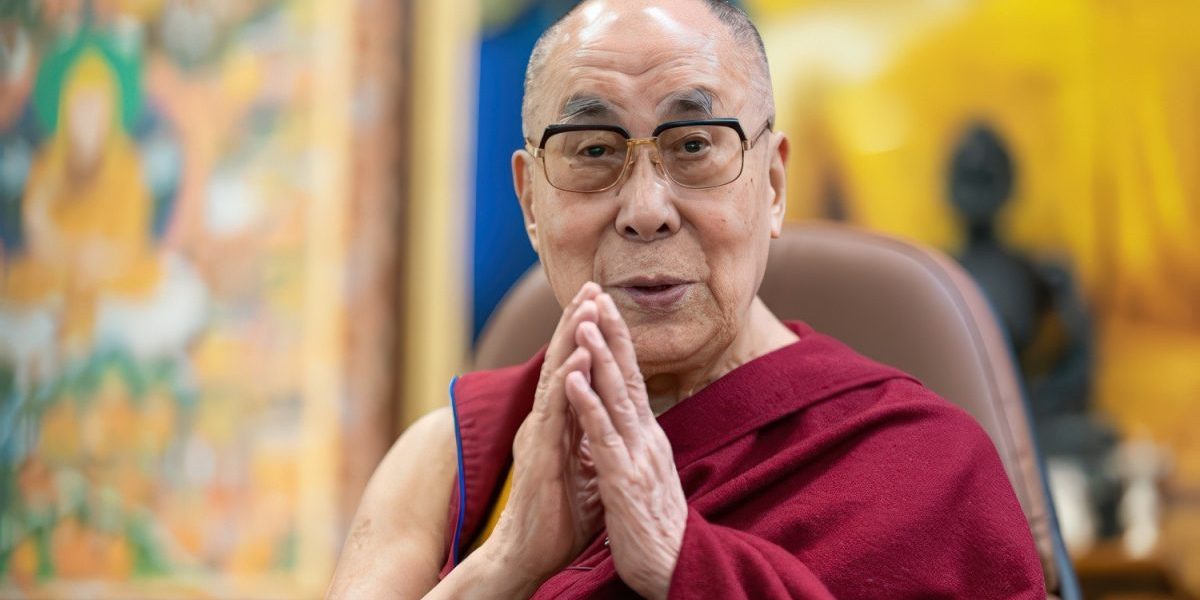







TAIPEI/OP-ED: As the Dalai Lama approaches his 90th birthday, the question of his reincarnation has reignited a geopolitical and spiritual tug-of-war between India and China. At the heart of this debate lies a deeper question: Will India assert its moral and strategic agency by supporting the Dalai Lama’s right to determine his own successor, even if it risks Beijing’s ire?
The Spiritual Sovereignty at Stake
The Dalai Lama has made it unequivocally clear: his reincarnation will be decided by the Gaden Phodrang Trust, not by any government—least of all China A B. This declaration is not just a spiritual assertion; it’s a political act of resistance against Beijing’s decades-long attempt to control Tibetan Buddhism. China insists that any reincarnation must be approved by its central government, invoking imperial-era rituals like the “golden urn” lottery A C. India, home to the Dalai Lama since his exile in 1959, finds itself at a crossroads. Union Minister Kiren Rijiju recently voiced support for the Dalai Lama’s autonomy, stating that only he and the established religious conventions should decide his successor A D. Yet, the Ministry of External Affairs has maintained a cautious line, emphasizing that it does not comment on religious matters E F.
Strategic Calculus vs. Moral Clarity
India’s dilemma is not just about Tibet—it’s about its broader China policy. Since the 2020 border clashes in Ladakh, Sino-Indian relations have been tense. Supporting the Dalai Lama’s reincarnation plan could be seen as a provocation, potentially derailing efforts to stabilize ties. But strategic ambiguity has its limits. By backing the Dalai Lama’s spiritual sovereignty, India would not only reaffirm its commitment to religious freedom but also send a message that Beijing’s coercive diplomacy has boundaries. It would also resonate with democratic allies like the United States, which has urged China to cease interference in Tibetan religious affairs B.
A Test of India’s Global Leadership
India aspires to be a voice for the Global South, a defender of democratic values, and a counterweight to authoritarianism. Standing up for the Dalai Lama’s reincarnation plan is a litmus test of that ambition. It’s not merely about Tibet—it’s about whether India will champion the principle that spiritual traditions should not be hijacked by political regimes. If India chooses silence, it risks being seen as complicit in China’s cultural suppression. If it speaks with conviction, it may inspire a new era of principled diplomacy—one where moral clarity and strategic pragmatism are not mutually exclusive.
[The opinions expressed in this article are of the author. Europeantimes.org takes no responsibility for the same.]
Views: 45

Khedroob Thondup
Khedroob Thondup is the son of Gyalo Thondup, elder brother of the Dalai Lama. Educated at St. Stephens College Delhi University and the University of San Francisco. He was a personal assistant to the Dalai Lama and accompanied him on his first trip to the U.S. in 1979. He was sent by the Dalai Lama to Beijing from 1980 till 1993 for dialogue talks where he interacted with Xi Zhongxun and Hu Jintao. He has served as Member of the Tibetan Parliament in Exile for three terms and is the President of the Tibetan Refugee Self Help Centre Darjeeling since 1987. He has edited two books, Dalai Lama My Son and Tibet in Turmoil and presently lives in Taipei, Taiwan.


