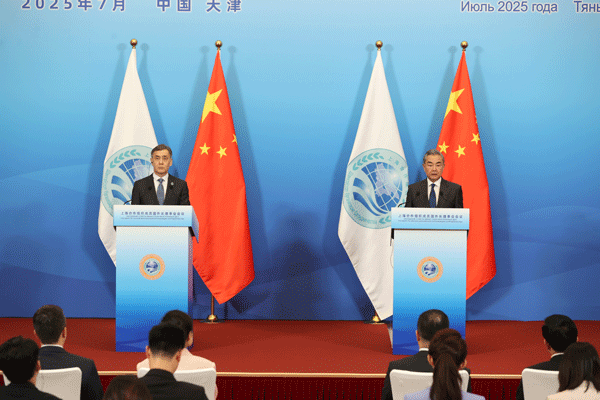







TAIPEI/OP-ED: At the recent Shanghai Cooperation Organisation (SCO) foreign ministers’ meeting in Beijing, China’s top diplomat Wang Yi delivered a performance that was equal parts choreography and charm—an act that, while outwardly harmonious, masked deeper strategic intent. Like a seasoned snake charmer, he played a tune of multilateralism, mutual trust, and regional stability, all while coiling China’s influence more tightly around the Eurasian bloc. Wang Yi’s invocation of the “Shanghai Spirit”—mutual trust, mutual benefit, equality, consultation, and respect for diverse civilizations—was not new, but its repetition served a purpose: to lull member states into a sense of shared destiny A. Yet beneath this melodic rhetoric lies a more serpentine reality. China’s emphasis on “strategic autonomy” and “multipolarity” is less a call for balance and more a subtle rebuke of Western-led alliances. It’s a diplomatic sleight of hand—presenting China as a benevolent partner while quietly positioning itself as the axis around which regional cooperation must revolve. President Xi Jinping echoed this sentiment, urging the SCO to “stay focused, remain confident, act efficiently” and “inject greater stability and positive energy into the world” B. But stability, in Beijing’s lexicon, often translates to acquiescence. The charm lies in the language of inclusivity; the control lies in the architecture of dependence—economic, political, and increasingly, technological. Consider the timing and tone of Wang Yi’s remarks. With tensions simmering in the South China Sea, the Middle East, and along the India-China border, China’s call for “respect for sovereignty” and “opposition to unilateralism” rings hollow A. These statements are not declarations of principle; they are instruments of persuasion, designed to deflect criticism and reframe China’s assertiveness as leadership. The SCO, with its diverse membership and competing interests, is fertile ground for such diplomacy. By presenting itself as the guardian of regional harmony, China sidesteps accountability while shaping the narrative. It’s a masterclass in strategic ambiguity—where clarity is sacrificed for influence, and charm becomes a tool of control. In the end, the snake charmer’s tune is not meant to soothe the serpent, but to mesmerize the crowd. And at the SCO summit, China played its melody with precision, leaving its partners swaying—not in unity, but in quiet acquiescence.
[The opinions expressed in this article are of the author. Europeantimes.org takes no responsibility for the same.]
Views: 43

Khedroob Thondup
Khedroob Thondup is the son of Gyalo Thondup, elder brother of the Dalai Lama. Educated at St. Stephens College Delhi University and the University of San Francisco. He was a personal assistant to the Dalai Lama and accompanied him on his first trip to the U.S. in 1979. He was sent by the Dalai Lama to Beijing from 1980 till 1993 for dialogue talks where he interacted with Xi Zhongxun and Hu Jintao. He has served as Member of the Tibetan Parliament in Exile for three terms and is the President of the Tibetan Refugee Self Help Centre Darjeeling since 1987. He has edited two books, Dalai Lama My Son and Tibet in Turmoil and presently lives in Taipei, Taiwan.