


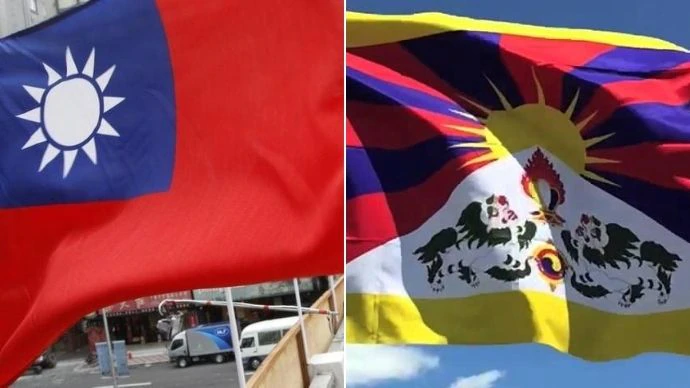







TAIPEI/OP-ED: For decades, China has insisted that any dialogue with the Dalai Lama must begin with his recognition of both Tibet and Taiwan as inseparable parts of China. Yet, despite Beijing’s demands, the Dalai Lama has never publicly acknowledged Taiwan as part of China—a position that has contributed to the long-standing deadlock in negotiations.
China has made it clear that discussions with the Dalai Lama can only proceed if he accepts Beijing’s territorial claims over Tibet and Taiwan. In February 2025, Chinese officials reiterated that the Dalai Lama must publicly recognize Taiwan as an integral part of China before any meaningful talks could take place. This demand aligns with Beijing’s broader strategy of asserting control over regions it considers part of its sovereign territory.
The Dalai Lama’s refusal to comply with China’s preconditions is rooted in his commitment to historical accuracy and his respect for Taiwan’s distinct political identity. His past visits to Taiwan, particularly in 1997 and 2001, reinforced his view that Taiwan operates as a separate entity from China. After witnessing Taiwan’s vibrant democracy and engaging with its leaders, he found it difficult to declare that Taiwan was part of China, despite Beijing’s insistence.
Moreover, the Tibetan parliament-in-exile has consistently rejected China’s demands, arguing that such statements would distort history. Tibetan leaders have emphasized that the Dalai Lama cannot be forced to make declarations that contradict historical realities.
The Dalai Lama’s stance on Taiwan has broader implications for Tibet’s future. If he were to concede to China’s demands, it could set a precedent for Beijing to dictate terms on Tibet’s status as well. By maintaining his position, the Dalai Lama upholds the principle that historical narratives should not be rewritten to serve political agendas.
China’s insistence on preconditions has effectively stalled any potential dialogue, leaving the future of Tibet and Taiwan’s international status unresolved. As the Dalai Lama approaches his 90th birthday, the question of his successor and the future of Tibetan leadership remain pressing concerns. Whether China will soften its stance or continue to demand recognition of its territorial claims remains to be seen.
[Opinions in the article are of the authors only, Europeantimes.org bears no responsibility for the content]
Views: 157

Khedroob Thondup
Khedroob Thondup is the son of Gyalo Thondup, elder brother of the Dalai Lama. Educated at St. Stephens College Delhi University and the University of San Francisco. He was a personal assistant to the Dalai Lama and accompanied him on his first trip to the U.S. in 1979. He was sent by the Dalai Lama to Beijing from 1980 till 1993 for dialogue talks where he interacted with Xi Zhongxun and Hu Jintao. He has served as Member of the Tibetan Parliament in Exile for three terms and is the President of the Tibetan Refugee Self Help Centre Darjeeling since 1987. He has edited two books, Dalai Lama My Son and Tibet in Turmoil and presently lives in Taipei, Taiwan.


