


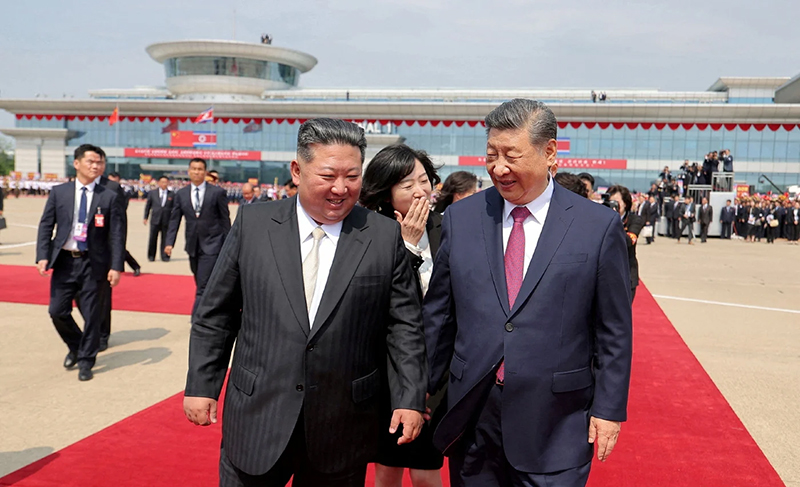







Xi Jinping’s recent visit to North Korea was not simply a ceremonial gesture. It was widely seen as a calculated reminder to Kim Jong Un that Pyongyang’s survival still hinges on Beijing’s goodwill. While North Korea has been emboldened by its deepening ties with Moscow, particularly in the realm of nuclear weapons and military cooperation, Xi’s presence underscored the limits of Pyongyang’s so-called “strategic autonomy.”
North Korea’s growing partnership with Russia has given Kim a sense of leverage. Moscow’s willingness to provide diplomatic cover at the UN, military technology exchanges, and economic lifelines has emboldened Pyongyang’s political posturing. Nuclear weapons and Russian support form the twin cornerstones of North Korea’s claim to independence from external pressure.
Yet Xi’s visit was a reminder that Russia cannot replace China’s role as North Korea’s primary economic partner. Beijing remains Pyongyang’s largest trading partner, the source of critical food and energy supplies, and the gatekeeper of sanctions relief. Without China’s willingness to bend enforcement of international sanctions, North Korea’s economy would face severe strain under its own isolation.
China also provides North Korea with its most important geopolitical buffer and diplomatic backing. While Russia may offer military cooperation, it is Beijing’s geographic proximity and political influence that shield Pyongyang from complete international isolation. Xi’s visit signaled that China still expects North Korea to align with its strategic interests, particularly in balancing U.S. and allied influence in East Asia.
Kim Jong Un’s narrative of “strategic autonomy” rests on nuclear deterrence and diversified partnerships. But Xi’s presence in Pyongyang was a subtle reminder that autonomy is relative. North Korea may flaunt its independence, but it cannot escape the gravitational pull of China’s economic and geopolitical weight.
Xi’s visit was less about friendship and more about leverage and influence. It reminded Pyongyang that while Russia can embolden its defiance, only China can sustain its survival. For Kim Jong Un, the balancing act between Moscow and Beijing is not a choice between equals—it is a reminder that strategic autonomy remains constrained by dependency.
Overall, this only needed light trimming. The main issue was not factual error but presenting analytical judgments as settled facts.
Views: 32

Khedroob Thondup
Khedroob Thondup is the son of Gyalo Thondup, elder brother of the Dalai Lama. Educated at St. Stephens College Delhi University and the University of San Francisco. He was a personal assistant to the Dalai Lama and accompanied him on his first trip to the U.S. in 1979. He was sent by the Dalai Lama to Beijing from 1980 till 1993 for dialogue talks where he interacted with Xi Zhongxun and Hu Jintao. He has served as Member of the Tibetan Parliament in Exile for three terms and is the President of the Tibetan Refugee Self Help Centre Darjeeling since 1987. He has edited two books, Dalai Lama My Son and Tibet in Turmoil and presently lives in Taipei, Taiwan.


