


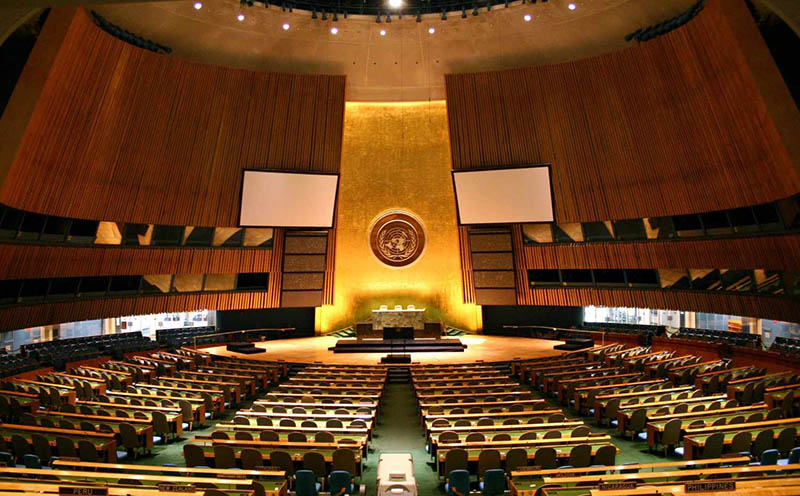







Today the United Nations is facing a crisis of multilateralism. In dealing with security, humanitarian and development crises that are all interconnected, the Organisation is not doing as well as it could. In part, the problems that the UN are facing are a result of serious structural problems within the international system. The absence of consensus between the major powers, the gap between commitments and the ability to implement them, and the increasing complexity of challenges facing the international community all undermine the UN’s ability to achieve its goals. And yet, despite all of these challenges, the Organisation remains a unique and very important forum. Its potential can be realised through substantial reform rather than through abandonment.
There are several longstanding conflicts which, despite the greatest efforts at diplomacy, continue to cause immense problems for civilians. In Gaza, massive numbers of people have been made homeless and are in dire need of relief, yet the UN is unable to secure a lasting ceasefire. In Sudan, millions have been displaced by conflict and the UN is struggling to secure a lasting peace, despite the best efforts of its mediators. Instead, the country remains mired in conflict, and a failure of the international community to secure a lasting peace. These examples serve to highlight the deep-seated structural problems of the UN. The organisation is excellent at facilitating negotiations between warring parties and providing emergency relief to civilians in the midst of conflict. However, it lacks the coercive powers to force a recalcitrant party to implement a peace agreement. In the end, the UN is nothing more than a talking shop, dependent on the geopolitical will of powerful member states for its very existence.
As a symptom of the deep-seated structural malaise in the international system, new health crises are constantly emerging while sustainable development is stagnating. Diseases such as Ebola are once again gaining ground in crisis zones, notably in those torn apart by civil war. They are causing great problems because health systems in these areas are extremely fragile, often disrupted by violence or population displacement. Specialised agencies and organisations such as the World Health Organisation are doing their best to monitor and coordinate the responses to these crises. However, the greatest problem is that health systems in crisis zones are extremely fragile and are often disrupted by the same violence that is creating the crisis in the first place. The required resources to rebuild these systems are lacking due to underfunding of the UN and its agencies. Moreover, the Sustainable Development Goals (SDGs), adopted in 2015 as a follow-up to the Millennium Development Goals, are not making the required progress, particularly not in areas such as poverty, food security, and gender equality. Here, there is a world of difference between ambitious global commitments and the possibilities of individual states in terms of their sovereignty, financial means, and other constraints. It is therefore not possible to overlook the structural contradictions within the UN system.
However, in addition to these problems, the UN also has an outdated structure and lacks funds. A reform of the Security Council, which has not been changed since the war in 1945, is one of the issues that is currently being discussed. The veto power of the five permanent members is one of the biggest problems, because often a veto is used by one of the five permanent members in order to protect the interests of a single country. The other members of the Security Council, including the emerging economies from Asia, Africa and Latin America, feel increasingly underrepresented in the Security Council. Furthermore, the financial basis of the UN is weakened. Most of the UN agencies depend on voluntary contributions by governments, the modalities of which are often influenced by political considerations. This not only makes it difficult to predict available funds, but it also often leads to a focus on immediate crisis management rather than on long-term prevention of conflicts.
Addressing the various problems faced by the UN, as described above, would need to be solved by implementing various changes that need to be made to the UN. This, in the first place, would need to include measures to strengthen conflict prevention. It is here that early warning of possible conflict would need to be strengthened. Regions would also need to be strengthened, and special envoys, appointed by the Secretary-General to negotiate in a crisis, would need to be given more powers to deal with root causes of conflict, such as lack of good governance and control of natural resources.
Third, the UN must establish a fully integrated development program and ensure that humanitarian relief, peacebuilding, and sustainable development are treated as interconnected components of a broad strategy for building resilience. This requires, above all, better inter-agency cooperation and better partnership with civil society, which in its turn requires better financing and more innovative approaches, such as the climate fund and so-called blended finance. Ultimately, however, there is a limit to how much institutional reform can achieve when member states as a whole are lacking in political will to implement their international commitments. Such will is necessary to restore faith in multilateralism, which requires above all that states adhering to UN rules and decisions also live up to their obligations under international law. Aid must not be used for political purposes.
The United Nations is at a crossroads. Its failures to implement peacekeeping, to contain health crises, and to implement sustainable development are symptoms of far greater problems. The problems the UN is facing are a symptom of a greater decay in the international system of today. Yet, in a world of increasing interdependence and vulnerability, the UN is, for the time being, the only forum in which collective action can be taken. Hence, meaningful reform, political will and multilateralism are needed. Anything less would mean increased global instability and fragmentation, not more national sovereignty.
Views: 22

Simon Hutagalung
Simon Hutagalung is a retired Indonesian Foreign Ministry diplomat and received his Master’s degree in Political Science and Comparative Politics from the City University of New York. He writes opinion pieces for Europeantimes and all opinions expressed in his article are his own.


