


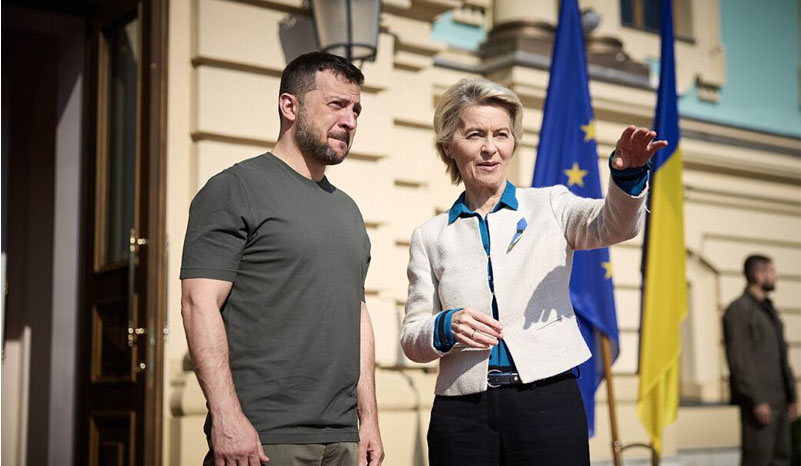







The conflict between Russia and Ukraine has become one of the major geopolitical events of the 21st century. The biggest conflict in Europe since World War II continues to spread far beyond the conflict zone. While temporary ceasefires in the war between Russia and Ukraine are sometimes sealed by diplomats, Russian and Ukrainian goals are so incommensurable that a peaceful resolution of the conflict within the framework of existing international relations is hardly possible. While Russia is trying to achieve its strategic goals by waging war, Ukraine is trying to defend its political independence.
European security architecture lacks a commonly accepted way of dealing with conflicts between great powers and the security of smaller countries. It is in this context that Russia’s ambition to have its interests recognized and Ukraine’s striving for complete independence, territorial integrity and free foreign policy are not easy to reconcile. It is above all the opposing views on security held by both sides that create problems for a peaceful resolution.
The roots of the conflict go back to the Soviet collapse in 1991, when Ukraine declared its independence as the third-largest republic of the Soviet Union. For a long time, Moscow viewed Ukraine within its own strategic sphere of influence. While Ukraine developed closer ties to the West and pursued membership in Euro-Atlantic structures, including NATO, for Russia, such an alliance would pose an existential threat. For Western countries, the ability of any sovereign state to choose its own alliance system is a fundamental principle of European security.
At first, Russia had not managed to achieve a quick political collapse of Ukraine and had not captured Kyiv, while Ukraine and its supporters had managed to hold out and defend themselves against the attacking forces. Thus, the conflict had developed into a long war of attrition with solid fortifications on both sides of the front, a war of artillery, of missile attacks, of drones, and of cyber warfare.
Currently, the conflict is a hybrid of high-intensity warfare and advanced technologies such as drones, space-based intelligence, electronic warfare, and AI. Much of this conflict is focused on traditional metrics of wartime success: the number of men under arms, the volume of ammunition fired, industrial capabilities to produce weapons and supplies, and the logistical chains required to move both into the theater of conflict. These metrics, and the lessons being learned by militaries across Europe and the Indo-Pacific, will be relevant for conflicts that are not yet imaginable.
For Russia, the war with Ukraine has become a primary foreign policy goal to counter Western influence and gain control over important territories to reassert its status as one of the leading world powers. Despite high economic costs from sanctions and unstable defense, demography, and technology, Moscow intends to continue waging the war. Ukraine’s physical destruction, the mass exodus of its citizens, and its economic dependence on abroad, however, have spawned a powerful civil identity.
As part of European stability, Ukraine’s long-term recovery and reconstruction are of extreme importance and must be viewed as more than just humanitarian relief efforts. The European conflict has already had far-reaching effects on international energy markets, agricultural food supplies, trade and even defense production worldwide. Many non-aligned countries in the Global South, including China and India, are for now adopting a pragmatic attitude towards the conflict rather than getting drawn into either the Russian or the US block.
However, the great majority of non-aligned countries in the world classify themselves as neutral in order to avoid being drawn into the confrontation between the two great powers. Meanwhile, in the conflict zone itself, there is a fundamental difference between Russia’s and Ukraine’s goals which, to date, has not been resolved. For Russia, the basic objective is to secure and defend several strategic and territorial objectives that it regards as vital, whereas for Ukraine, in order to defend its sovereignty, it is trying to prevent Russia from achieving its objectives and to secure its own freedom to determine its own foreign policy.
However, achieving a lasting settlement of the conflict remains a great challenge. While the war continues to claim human lives and to exhaust economic resources, both sides’ perception of the war and of each other are becoming more and more entrenched in their respective national narratives. A lasting settlement of the conflict will thus have to be based on step-by-step diplomacy. This can start with issues that are of pragmatic value to both parties, for example with the exchange of prisoners, with the creation of humanitarian corridors, with the protection of critical infrastructure and with local cease-fires.
Even in the case of a ceasefire, it will have to be well monitored in order to ensure that, during the pause in fighting, a warring party is not regrouping its forces rather than launching talks on peaceful settlement. For European security, this would be even worse than the ongoing war, in particular as instability is already growing today. Therefore, an adequate structure for the management of European security has to be found that is intended to support strong deterrence, whereas, at the same time, dialogue and cooperation would be facilitated.
Comprehensive crisis management and, above all, robust tools for dealing with new hybrid threats which are spreading rapidly across Europe, in addition to stabilization of the regional cybersecurity environment and prevention of military escalation, are required by the international community and the new-generation NATO to manage the historic crisis unfolding before our eyes and bring it to an end quickly.
The war between Russia and Ukraine has become a test case of conventional defense and is driving military operational concepts at breakneck speed. When the war is finally brought to an end, it will have profound consequences for the sovereignty of Ukraine as well as for European security and the global balance of power for many years to come.
Moving beyond the active conflict, the greatest challenge for the international community will be in preventing conflict from recurring. A stable peace will require the persistent efforts of diplomats combined with the security guarantees of major powers, financial assistance for the reconstruction of Ukraine, and structures for managing crises on the Continent. Will the twenty-first century be a time when global order is governed by law or by power?
Views: 12

Simon Hutagalung
Simon Hutagalung is a retired Indonesian Foreign Ministry diplomat and received his Master’s degree in Political Science and Comparative Politics from the City University of New York. He writes opinion pieces for Europeantimes and all opinions expressed in his article are his own.


