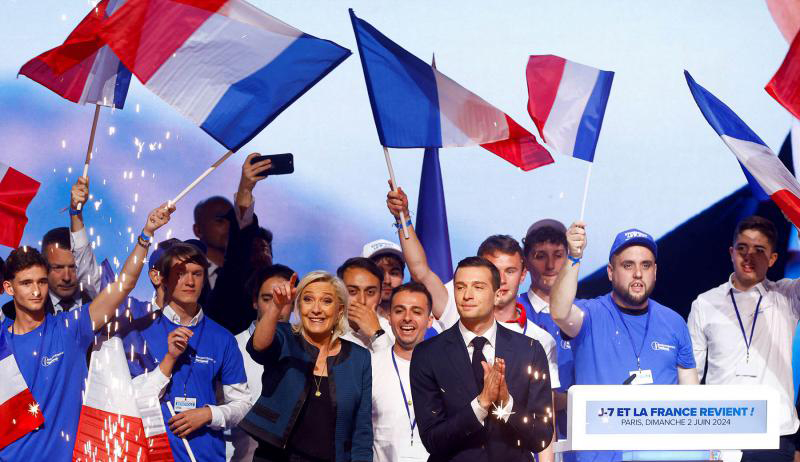







Europe is at a crossroads, and the future of the continent depends to a large extent on the future of France and Germany. Currently, both countries are affected by a radical nationalist upsurge that manifests itself in the growing electoral support for Marine Le Pen’s Rassemblement National in France and the Alternative für Deutschland in Germany. As yet, however, both parties are unable to translate their electoral success into government. But should they suddenly overcome the current structural and coalition-related barriers to power, this would represent a seismic shift in the history of Europe with far-reaching consequences for the continent and the world.
Marine Le Pen is currently the leading nationalist figure in France and is preparing for the next presidential election. Her Rassemblement National has been able to increase its electoral support by gaining the trust of sections of the electorate who harbour fears of immigration, of a decline of national sovereignty and of the increasing dominance of Europe. Although her party has softened its image in recent years to attempt to win over more centre-ground voters, its core nationalist ideology remains unchanged.
The two-round system used in France for presidential elections is a powerful barrier to her becoming head of state. In both rounds, a ‘republican front’ of mainstream voters has to date united to prevent her becoming president. However, there are currently many factors which are weakening this cordon and which are creating a highly volatile situation. These include the continuing stagnation of the French economy, the growing number of protests on the streets of France, and an increasing distrust of established parties and elites.
The Alternative für Deutschland (AfD) has transformed from a small Eurosceptic party into a fully-fledged national political force in Germany. The party’s sharp and increasingly bitter criticism of current immigration policies, climate protection and the stance of Brussels has resonated with an ever-growing part of the German electorate. For the time being, however, the country’s proportional representation system, as well as the cordon sanitaire, which is maintained by all other parties strictly, have so far prevented the far-right group from playing a role in governance. But the consensus which has been at the core of German democracy until now could easily be broken by traditional parties being forced by electoral arithmetic to enter into a coalition with the far-right.
The implications for Europe and for the World at large of a shift to far-right leadership in France and Germany would be severely damaging to the continent and to European affairs. Europe’s two largest countries have traditionally been the wellspring of progressive politics on the continent and the bedrock of Europe’s institutions. The dual nationalist leadership of France and Germany would bring decision-making to a grinding halt as the two countries would likely try to pursue their interests in opposition to one another. Fiscal and economic policy would likely be dismantled.
As the two dominant players in the European Union, France and Germany can impose their will upon other EU countries in a manner that no other two countries can do. In the face of far-right leadership, other Eurosceptic movements across Europe would be inspired and empowered. Regional security would also suffer greatly. The two countries are key to the functioning of NATO and, in the face of dual far-right leadership, would likely turn inward, causing military support for Ukraine and other hotspots around the World to dwindle, and allowing foreign adversaries to pursue their goals with impunity. Economically, protectionism and nationalism would devastate Europe’s supply chains and cause the continent to fall behind in terms of competitiveness with other parts of the World. And, on the social front, identity politics of a restrictive sort would lead to a deepening of social polarisation within European countries, and to an erosion of basic democratic values and the liberal democratic institutions that support them.
In a third sense, the future of Europe would also have far-reaching implications for the rest of the world. As the main counterweight to the US on the global stage, Europe would lose influence and weight, thus becoming an easy prey for other global players, such as China and Russia, seeking to extend their economic and political influence in the respective regions. The consequences of a decline of Europe on a global scale would also manifest in a weakening of multilateralism, a failure to implement global climate agreements, and the erosion of human rights worldwide.
The main challenge in preventing such a scenario would thus consist in implementing defence and energy policies that would foster a deeper integration of member states, and in setting up broader coalitions that would actively involve the smaller member states in their decision-making processes. In addition, civil society has a particular responsibility in this context: it must actively defend the few democratic achievements that have been reached so far against the disinformation that is being spread by nationalist groups.
But though Marine Le Pen has not yet managed to take the first step to power, her party and its values represent a huge threat to democracy and to Europe’s cohesion. If France and Germany are to continue to form the axis that drives Europe forward, if the EU policies and measures are to be shaped and decided collectively, and if the EU is to pursue a joint fiscal policy and to develop further, then nationalism in both countries must be contained. For that reason, it is not enough for the far right of the political spectrum to be kept outside of power. To prevent the dangers that its rise in the polls represents for democracy and for Europe, its influences must be countered.
This requires the two main parties of government in France to take several measures to redress the deep-seated economic, social and other grievances of the sections of the population whose support the party has been able to win. And it requires the governments and parliaments of the two biggest countries in Europe to implement measures that deepen defence cooperation and energy cooperation, and that create larger coalitions within the EU, coalitions that are intended to involve all the member states equally. In addition, civil society has a special role to play in resisting the disinformation that is pumped out by the parties that represent far-right, nationalist ideology and that is aimed at undermining democracy. And it is not sufficient for these dangers to be recognised: a coordinated strategy must be developed and put into practice to contain them.
Views: 76

Simon Hutagalung
Simon Hutagalung is a retired Indonesian Foreign Ministry diplomat and received his Master’s degree in Political Science and Comparative Politics from the City University of New York. He writes opinion pieces for Europeantimes and all opinions expressed in his article are his own.