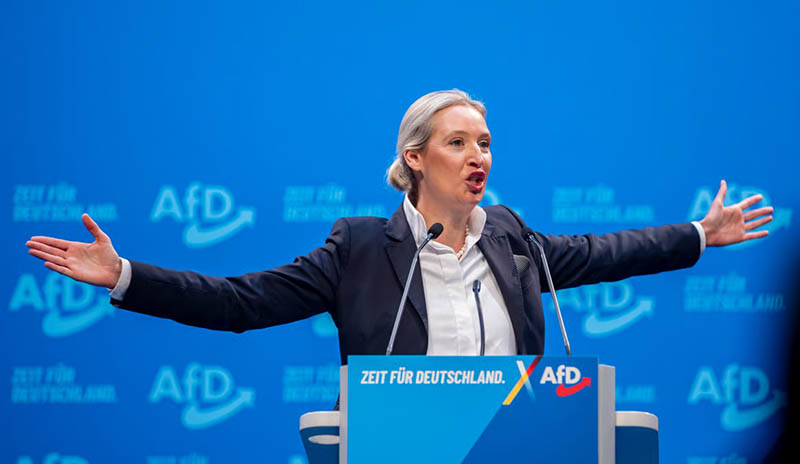







2026 in Germany will be a difficult year for the Alternative for Germany (AfD) as they prepare for several State elections due to take place in 2026, more than a year before the Federal Bundestag elections due in 2029. As support for the AfD increases, established parties in Germany will face growing challenges. These will not only affect Germany but have implications for Europe as a whole and even on a global scale. So, in order to deal with the Alternative for Germany, politicians will have to find a way to deal with the rising discontent among the population that has led to them supporting a populist party. The development of the Alternative for Germany is more than just a change in voting habits.
There is also a change in the political culture of Germany with far-reaching consequences for democracy in Germany and its role in Europe. Above all, the underlying reasons for the rise of the Alternative for Germany to power. The growing discontent with the mainstream parties in Germany, including the Federal Chancellor Friedrich Merz and his CDU/CSU–SPD coalition that was elected in the Federal Bundestag in 2025, is not a new development. Already for a long time, the failure of the post-pandemic recovery in Germany, the high levels of inflation, and in particular the high energy costs have for a long time already been exacerbating problems of existing problems and creating new problems, particularly for low-income households and for rural areas.
The Alternative for Germany party will achieve its greatest successes in the upcoming state elections of Saxony-Anhalt, Berlin, and Mecklenburg-Vorpommern in September 2026. In the eastern German states, the federal government in Berlin is viewed with suspicion and failure. The major issues that have not been solved by the politicians in Berlin include migration, the integration of immigrants, and economic development. Many people in the eastern German states have long felt alienated from the established political parties in Berlin. Their economic and social needs have not been taken into account for decades by the politicians. The Alternative for Germany is happy to fill the resulting political void with its promise of empowerment. The supporters of the party believe that the views and interests of ordinary Germans have been ignored for too long by the politicians in power.
In terms of foreign policy, Germany’s realignment could have significant implications for Germany’s relations with countries in other regions of the world. In the context of EU–ASEAN relations, a more assertive and nationalist Germany under the influence of the AfD would potentially create uncertainty and challenges for both sides. The foreign policy of Germany would be affected in significant ways. In the past, Germany has been a multilateral actor, playing an active role in a range of international institutions and fora. However, under the influence of an increasingly assertive and nationalist party such as the AfD, Germany’s foreign policy could become increasingly focused on Germany’s own interests, potentially at the expense of its relations with other countries.
This in turn could have significant consequences for Germany’s relations with countries in other regions of the world, including for example the Indo-Pacific, where Germany is an important trade and development partner, and where countries such as Indonesia depend on Germany for a range of purposes, including trade, development, and security. An inward-looking Germany, focusing on its own domestic issues, would likely create uncertainty in EU policymaking. This could lead to a situation where Germany is no longer able to play the key stabilizing role that it has in the European Union. This in turn would have significant implications for several current EU negotiations, including those on migration, the green energy transition, and issues of fiscal solidarity.
The AfD’s normalisation into German politics and the implications for EU–ASEAN relations. The normalization of far-right governance in a federal state such as Germany would be a dramatic change. A state like Saxony-Anhalt or Mecklenburg-Vorpommern would be the first federal state in the post-war era to be governed by a far-right party. Such a development would have significant implications for both Germany and the European Union.
The strains on coalition-building in Germany would become even more apparent. Since the CDU and SPD are in decline, it will become increasingly difficult for them to form a governing majority in the states without the participation of the AfD, which could command a majority of seats in some of the states. This in turn would lead to a series of institutional crises, with potentially severe consequences for Germany’s ability to govern itself effectively, as well as to project stability in the European Union. In Brussels, a stronger and more assertive AfD in Germany would inevitably give voice to a more nationalist German stance in EU policy-making.
In the context of current EU negotiations on a range of issues, including migration, the green energy transition, and issues of fiscal solidarity, this could have dramatic consequences. Germany has traditionally played a key stabilizing role in the European Union. An inward-looking Germany, focusing on its own domestic issues, would likely create uncertainty in EU policymaking. This could lead to a situation where Germany is no longer able to play the key stabilizing role that it has in the European Union. The implications for EU–ASEAN relations would also be significant. Germany’s foreign policy under the influence of the AfD could become increasingly focused on Germany’s own interests, potentially at the expense of its relations with other countries. This in turn could have significant consequences for Germany’s relations with countries in other regions of the world, including, for example, the Indo-Pacific, where Germany is an important trade and development partner, and where countries such as Indonesia depend on Germany for a range of purposes, including trade, development, and security.
A scenario analysis of how the above scenarios might play out in more detail is provided below. The results for the Alternative for Germany (AfD) would be as follows: Above all, a victory in Saxony-Anhalt would be a symbolic breakthrough for the AfD, as for the first time a far-right party would be able to govern in a federal state in post-war Germany.
Moreover, a victory in Mecklenburg-Vorpommern would give the AfD a number of important levers to influence national energy policy. Given that Mecklenburg-Vorpommern is home to a number of energy infrastructure projects, such as LNG terminals, the AfD would be in a position to exert influence over these structures. Finally, even in the capital, Berlin, the AfD would be able to achieve significant results, and thus also in several other cities in Germany. To prevent the above-mentioned risks, however, Germany must first get back on track economically, then open up to cooperation between parties, and finally return to its integration into the European Union and into the global community.
Views: 19

Simon Hutagalung
Simon Hutagalung is a retired Indonesian Foreign Ministry diplomat and received his Master’s degree in Political Science and Comparative Politics from the City University of New York. He writes opinion pieces for Europeantimes and all opinions expressed in his article are his own.