


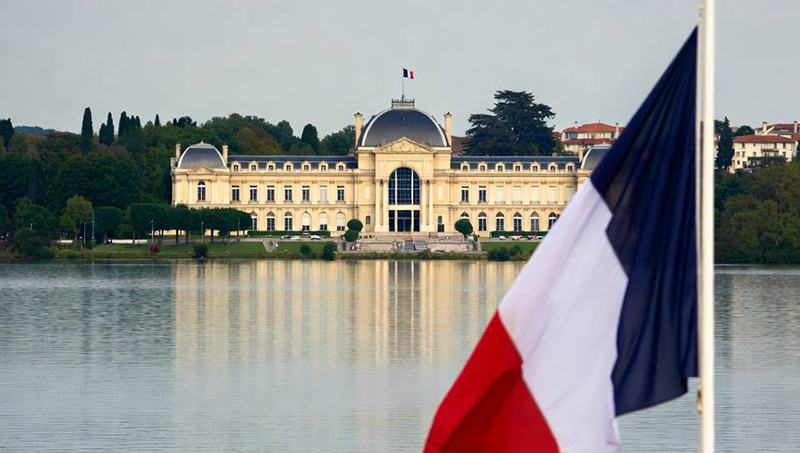







At the G7 summit held in Évian-les-Bains in June 2026, the seven leading industrial countries will try to redefine their roles in a world characterised by an ever-increasing number of risks on a global scale as well as by growing great-power rivalry, an unprecedented technological pace, and the need to reform governance systems. The risks that need to be managed at this summit are those which threaten to disrupt economic growth worldwide. In this sense, the new G7 summits, in addition to acting as meeting places between leaders, are also platforms for analysing the state of the world and assessing the management of several global challenges, to encourage coordination on measures to be taken and to bring about concrete results on the ground.
The economic rebalancing has been at the core of the G7 Summit in Évian-les-Bains. G7 leaders were worried about trade imbalances, overcapacities and the influence of state-directed capitalism most of all from China. Free trade had become a defensive concept of resilience, of diversification, of autonomy of economies. The summit showed that interdependence can become a weakness as well.
In addition to economic rebalancing, summit talks focused on the issue of critical minerals, or so-called raw materials, as well as energy security. The concentration of the processing of rare earth, key battery materials and other important strategic materials on a handful of countries has recently caused a lot of concern among G7 economies. This concern is reinforced by the growing number of export restrictions, which are increasingly being used as a means of geopolitical leverage. The Évian summit thus emphasised the need to create alternative routes for the supply of these resources and to step up production by allied countries. As was already the case at previous summits, discussions at Évian also focused on the situation in the Middle East. Here, too, there are causes for concern with respect to energy, as well as to raw materials, due to the tensions in the region and the resulting risks to the free passage of ships through a number of important maritime chokepoints, including the Strait of Hormuz.
Several themes can be identified within the summit’s discussion of technology. The summit recognised that developments in a number of key emerging technologies such as artificial intelligence, health technology, and online safety and child protection could bring a number of benefits in terms of economic growth, among others. It therefore treated them as strategic challenges requiring international cooperation to address. Yet at the same time the summit exposed some deep divisions on the main approach to take in each of these areas, in particular on the balance to be struck between allowing the development of innovative new technologies and taking a more precautionary approach in order to head off potential negative consequences. In health technology, for example, while European members called for the greatest possible use of innovative treatments to improve health outcomes, the US emphasized the need for a range of different approaches and in artificial intelligence (AI) the Europeans again emphasized the need for precautionary rules emphasizing ethics and accountability while the US view was that the key to achieving the potential of the technology was to foster as much competition and innovation as possible.
The summit also marked a period where the world is beset by many conflicts and crises. The war in Ukraine has, and will for the time being, dominate security deliberations. The presence of the President of Ukraine, Volodymyr Zelenskyy, and further commitments to support Ukraine in its time of need will keep G7 sanctions against Russia, as well as ongoing energy cooperation with third countries, in order to support Ukraine’s economic development and its resilience in the face of ongoing Russian aggression. In the Middle East, efforts will continue to be made to manage crises, while, for the time being, it will not be possible to search for new solutions to the conflicts, in order to bring about durable changes on the ground. Thus, the summit has exposed the limits of economic tools and of diplomatic pressure, in the face of continuing Russian military aggression.
A further feature of the Évian summit was the outreach by the G7 to emerging and developing countries. The participation of a number of these countries, including India, Brazil, Kenya, South Korea and Egypt, underlined the fact that in the 21st century, the management of the global economy is no longer the preserve of the advanced economies. For France, the host of the meeting, this approach was both symbolic and practical: it underscored the continued relevance of the G7 and at the same time it recognised the erosion of Western dominance in decision-making processes around the world. For India, in particular, its participation in the meeting marked an important new role for the country as interlocutor between the developed and developing world.
However, one was also able to see clearly the constraints on the G7. These were not only the result of different national interests and the often competing strategic objectives but also a lack of effective mechanisms to translate summit consensus into action. As a result, even if the G7 is now an important forum for setting an agenda, it will in the future become even more dependent on cooperation between G7 members and other stakeholders and institutions – in other words, non-members.
In conclusion, the G7 Summit of June 2026 in Évian-les-Bains focused on a G7 in transformation. With its traditional membership, the Summit dealt with critical minerals, AI, health, and geopolitical stability. However, the unresolved issues and structural cleavages of the Group remained the hallmarks of its limitations in managing the risks affecting world affairs today.
Views: 15

Simon Hutagalung
Simon Hutagalung is a retired Indonesian Foreign Ministry diplomat and received his Master’s degree in Political Science and Comparative Politics from the City University of New York. He writes opinion pieces for Europeantimes and all opinions expressed in his article are his own.


