


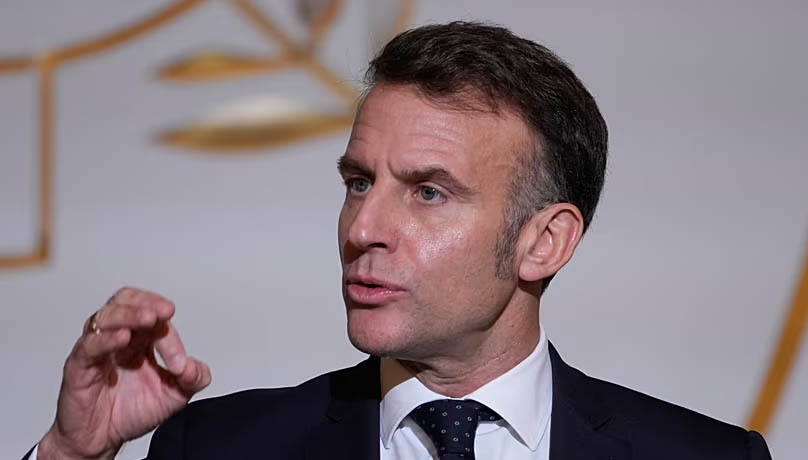







French President Emmanuel Macron recently laid out a “Third Way” for Europe in a world of conflict and interdependence between distance from the US and deference to China. His message is clear and compelling: Europe cannot hope to be strong, rich and relevant unless it regains the strategic autonomy it has lost under increasingly rigid and coercive rules.
The third way vision is not merely about not being passive in negotiations regarding the global order. In today’s world, there are no rules. The system of alliances is in ruins, and the relationships between states are characterised by coercive interdependence. Economic pressure, financial blackmail, monitoring of communications, control of energy resources, armaments, and spying are increasingly visible features of international relations. The third way is, therefore, a vision about power and how to get it back. This is not a vision for a foreign and security policy strategy, but for a possible macro-strategy for the macro and middle powers’ pursuit of sovereignty: the ability to shape their own supply chains, to determine the rules of the markets in which they operate, to defend their strategic interests, and to preserve their capacity for autonomous decision-making.
While the tone of Emmanuel Macron’s speech may appear optimistic, the emphasis on industry and production reveals a more realistic assessment of Europe’s ability to achieve independence. Made in Europe is not just a slogan; it is the evidence of the means Europe has to be independent, not just in terms of values and politics, but most importantly in terms of technology and the military resources needed to defend itself. It is no longer sufficient for Europe to feel secure under American security guarantees and to reap the benefits of globalised supply chains, easily switchable to alternative providers at times of crisis.
French President Emmanuel Macron recently blasted US leaders for apparently ignoring the “reality” of growing Chinese power. What Macron really meant to say, however, is that the US and China are pushing Europe in two opposite directions. On security issues, the US is pushing Europe to assume a greater common defensive role, to impose sanctions on China, and to tackle issues such as technology transfer and data protection. On economic policy, China is encouraging Europe to open up its markets, sign a free trade agreement, and adopt a more critical stance toward the US. As the chasm between these two positions continues to grow, there is less and less room for Europe to chart an independent course.
The third way for Europe is not a conflict-ridden competition with other global powers for influence and dominance. Rather, Europe should strive to become an independent actor on the international stage, i.e. more than a mere battlefield for superpowers on the European continent. This third way for Europe does not mean isolationism. Its hallmark would be diversification and reduction of vulnerability in order to strengthen its own industrial base and to achieve the necessary capabilities in order to act effectively. This would include the option of independent action, of choice, of self-determination and the will to act freely and not be driven by the tides of events.
Realising the “European Way” to strategic autonomy will come with its own internal challenges. Today, Europe remains geographically and functionally fragmented. There is little evidence of any convergence between the major member states with regard to the nature and scale of threats, issues of concern related to economic growth, or approaches to global governance. Achieving strategic autonomy will require shared investment, coordinated policies and sustained political trust among EU member states. Europe can dream up strategies for autonomous action, but it lacks the capacity for actual realisation.
The external environment is not likely to facilitate the third way objectives. In principle, the US may welcome a more assertive Europe, but it will also insist on cooperation on defence issues and push for technology and industrial transfer. Europe’s attempts to pursue greater economic diversification may also not be welcomed in China. In sum, Europeans will continue to face considerable resistance to greater strategic space from both sides.
Shortage of raw materials is one of the many challenges facing strategic autonomy. Pursuing the third way advocated by Macron will require massive resources in terms of defence spending and research, secure energy supplies and an integrated industry policy. Europe possesses significant economic and technological assets, which are distributed unevenly but lack coordination. The EU does not have a unified defence-industrial base. The absence of a consistent long-term approach to defence research and production makes a credible third way very challenging.
Of course, interdependence is not an analytically meaningless term; in fact, it has become much more complex than the simple binary of dependence and conflict. In an ever more interdependent system, power is not simply a matter of weapons or economics, but rather a measure of a state’s or society’s resilience. Europe faces a host of complex dilemmas as to how to manage and diversify its own interdependence, even as they selectively engage with others around the world. Macron’s words capture these dilemmas, even if he does not provide any concrete answers.
The third way is not an ideology. The third way is a strategic challenge. For the West, the third way means moving from independent thinking (autonomy) to effective action (Independence). The returns from autonomy are rapidly diminishing. The risks from depending on others unwilling to help in an increasingly competitive world are growing.
Views: 50

Simon Hutagalung
Simon Hutagalung is a retired Indonesian Foreign Ministry diplomat and received his Master’s degree in Political Science and Comparative Politics from the City University of New York. He writes opinion pieces for Europeantimes and all opinions expressed in his article are his own.


