


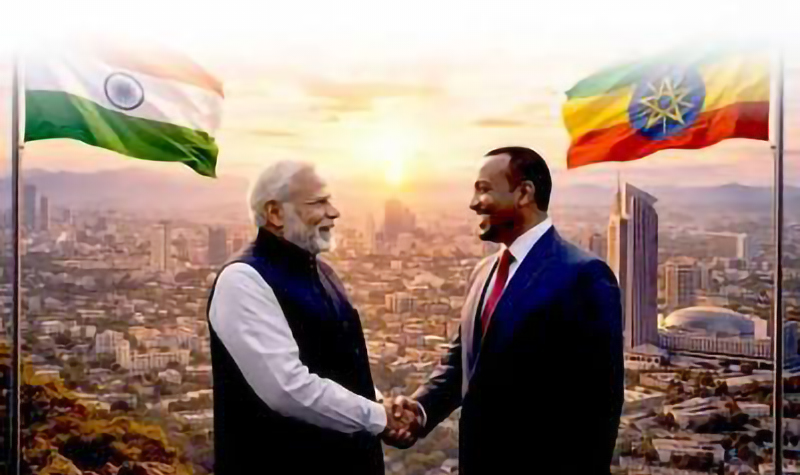







The relationship and outreach between Africa and India dates back to more than a thousand years. India and Africa are bonded together by very long traditions of friendship, cultural interactions and common historical struggle against colonialism, apartheid, racism and injustice. This shared historical background and destiny based on colonialism and a successful attainment of independence is one of the important bases for strengthening India-Africa partnership in the 21st Century.
The rapid emergence of India as a key actor in the globalized world raises a compelling argument for tapping in to Africa’s natural resources, which are available in the African Continent. Africa also has to be industrialized for an equitable distribution in sustainable development of the continent. It is also in the above environment of bolstering the India-Africa Partnership in the 21st Century that India has launched and implemented a number of innovative initiatives to support various aspects of the continent’s peace, stability and overall development efforts. These include meaningful reforms in institutions of global governance.
Such efforts have been visible in the following areas:
1) Human Resources Development and Capacity Building: Many Africans are being trained in Indian Universities and other institutions of higher learning.50,000 scholarships are specially designated for African students by Government of India.
2) India has launched many Lines of Credit to Africa to facilitate its process of development.
3) India has announced the e-connectivity programme which will benefit 53 countries of the African Union to boost development in tele-education and tele-medicine and has provided technical assistance to various African countries under South-South Co-operation. African governments have shown keen interest in accessing Indian assistance in bridging the digital divide. India has already made a vast contribution through building the Pan-African E-Network, which will connect nations of the African Union through satellite and fibre optic network. The network will connect 5 universities, 53 learning centres, 10 super specialty hospitals and 53 remote hospitals in India and Africa. Leading InfoTech firms like Tata Consultancy and HCL, NIIT and Aptech have launched operations across Africa.
4) India has supported the Peace keeping process in many countries in Africa including in South Sudan between 2018 and 2026 under the aegis of UN.
Although India and Africa share a robust relationship including in NAM, Global South and BRICS (wherein South Africa is part of the grouping and Egypt is a new entrant) and India’s successful backing for inclusion of African Union into G20 group of nations in the 2023 Delhi Summit and which yielded result with AU’s entry into the exclusive G20 entourage , there are also onerous challenges. Therefore, the strategic partnership between India and Africa in 21st Century should bring tangible solutions for various issues which are included in the African Programme namely NEPAD (The New Partnership for Africa’s Development).
Some of these issues among others are as follows:
1) Raise the level of key investments in human capital development in Africa;
2) Promote more capacity building, technology acquisitions as well as knowledge generation sharing and applications mechanisms;
3) Rapid Acceleration of the process of African Industrialization so as to add to the huge African natural resources and procure a fair and competitive prices for the African goods;
4) Expansion of development of infrastructure facilities which will enhance facilitate intra African trade and economic development in the continent;
5) Facilitate trade, economic co-operation and provide improved market access for African products;
6) Sharing India’s successful experience on green revolution for boosting food production and agricultural products for combating hunger and disease in Africa.
Specific areas of collaboration in this regard range from provision of agricultural inputs, agro processing and watershed management. Combating hunger and disease in Africa are two of the core areas of strategic partnership in 21st Century. This will be in sync with so as to meet the first of the Millennium Development Goals, set by world leaders at the United Nations Summit 2000, which aimed at reducing the proportion of the hungry people by half by 2020 and substantial reduction of poverty beyond that timeframe. The target areas of the Millennium Development Goals are facing a profound challenge in Africa.
Ever since India’s economic liberalization that was launched in the early-nineties, India’s foreign policy has been increasingly driven towards finding export markets, attracting foreign capital and necessary know-how. This policy shift is echoed across Africa as most of the economies there are going through similar economic reforms and process of liberalisation. The Indian stand on the western agricultural subsidies at the WTO round of negotiations has been in consonance with the views of most African nations.
Another factor is the ‘outward-looking’ attitude of India’s private sector. Tempted by the easy availability of capital and driven by the search for new markets, Indian companies have been targeting those regions in Africa, in which they had shown little interest. The economic boom in India and the success of both home-grown and NRI/PIO (Non-Resident Indian/Person of Indian Origin) companies in Europe and parts of South America have provided Indian businesses the confidence to venture into Africa. Booming trade is an important marker of this shift.
Increased activities of Indian companies in Africa have spurred the government to link its economic diplomacy in the continent more explicitly to its economic requirements. The Indian engagement reflects India’s private-enterprise led bottom-up approach of its economy.
As part of Africa’s Growing Strategic Importance, India’s growing energy needs have forced it to diversify its oil imports. In the past, India has been dependent on West Asian countries for its oil imports. In recent years, India, like the US and the other major powers, has recognised the vast energy potential of African countries.
Also, countries on the eastern coast of Africa from South Africa to Somalia – fall under India’s maritime strategic neighbourhood. Insecurity in the Indian Ocean region is on the rise, given the existence of terrorist, and militant, separatist or extremist organisations and trans-national criminal syndicates involved in trafficking in drugs, arms and humans, and piracy. Alarming increase in incidents of piracy in Somali waters in particular threatens the security of the Sea Lanes of Communications (SLOCs). The Indian Navy particularly its Coast Guard has been active in its diplomacy in the Indian Ocean, providing maritime security cover during the African Union summits and the past World Economic Forum in Mozambique.
African countries hold India in high esteem – in particular, on account of resilience of its democratic institutions and the manner and pace of its economic growth trajectories . India, as a democratic developing country, serves as a role model for these African countries and is a viable source of support in various sectors, especially agriculture, services and small- and medium-scale manufacturing. Above all, it is the new image of India -– that of a leader in the information technology industry and computer software, biotechnology and telecommunications – that has attracted Africa to India.
India and Africa are making a concerted joint effort to improve the well-being of their peoples and societies. It is here that India’s tangible influence in Africa will emanate– from its success in achieving sustained economic growth and lifting millions out of poverty in a democratic, post-colonial setting. The Indian leadership is strongly committed to its African partners in tackling various impediments to its economic growth in fields of infrastructure, education and labour. Through India’s soft power outreach, India has provided generous assistance to Africa in the areas of healthcare diplomacy through donation of Covid vaccines, digital connectivity, ICT sector, popularising Bollywood, extending IPL cricket matches to South Africa. India has extended its hand of cooperation through Make in India, Skills India, Digital India, Start Up India, Smart City initiatives as areas of further collaboration with various African nations. Africa and India are connected through Indian Exim Bank, Confederation of Indian Industry events, India-Africa Conclaves, Africa-India Field Training Exercise (AF-INDEX0, India-Africa Defence ministers Conclave (ADMC0, India, Mozambique, Tanzania Trilateral Exercise (IMT-TRILAT), expansion of train, waterways connectivity, It is imperative that India is dedicated in addressing its own developmental challenges successfully so that countries of Africa, consider it as an attractive and rightful partner for the future.Furthermore, India as a member of AFDB associated African Development Fund, and through the network with 54 African countries and 28 non-African partners, India have had a trust fund which promotes public private partnership (PPP) models in Africa.
While India continues its dialogue with Africans and pitches for inclusion of Africa in major multilateral forums, it (India) should be aware that it cannot and should not match the pace or the extent of engagement of the EU, US or China and rather should leverage the strengths of the unique and distinctive Indian model. This uniqueness is reflected in: recognising the splendid diversity of the African continent, forging ties based on a template that emphasises Indian uniqueness in trade and technological assistance, avoid emulating the Chinese model of investing in Africa, involving the vast Indian Diaspora residing in various parts of Africa, becoming a stakeholder in Africa’s overall development.
Views: 54

Mohammed Badrul Alam
Dr. Mohammed Badrul Alam is Formerly, Director of Research; Professor and Head, Department of Political Science, Retd; Faculty of Social Sciences, Jamia Millia Islamia University, New Delhi. Prof. Alam is a a well regarded expert in International Relations and area studies with over four decades of teaching and research experience. He writes regularly on issues related to global and regional geopolitics.


