






India’s Prime minister, Narendra Modi’s forthcoming visit to Indonesia, the world’s largest archipelagic country, is pivotal as it is poised to raise the bar from Comprehensive Strategic Partnership to a higher level in multiple arenas. Both countries are neighbors as India’s Andaman and Nicobar Islands sharemaritime boundaries with Indonesia along the Andaman Sea.
India and Indonesia have a shard history as both the countries underwent long periods of colonial rule by Britain and Dutch respectively. India’s interim government recognized Indonesian independence on 2 September 1946 and subsequently established formal diplomatic relations on 16 April 1949. A prominent Indian political leader and a pilot, Biju Patnak, in the final years of Indonesian freedom struggle made a daring rescue operation in airlifting two high profileIndonesian politicians, namely, Prime minister Sultan Sjahrir and Vice President Mohammad Hata to safety.
Sukarno, Indonesia’s first President, was a prime architect in laying the foundation of a stable, matured bilateral partnership and had described the existence ofthis bilateral relationship ‘for more than 1000 years’. Top leaders in the early 1950s were instrumental in forging Asia-African Unity by co-hosting the Non-alignment Movement and the historic 1955 Bandung Conference. Both India and Indonesia are member nations of G-20, BRICS, NAM, and the UN.
Historical links and Cultural ties
Two -millennial old civilizational relationships between India and Indonesia were grounded in maritime trade, religion, and shared colonial struggles. Indonesian islands were known to Indians since the ancient times as ‘Suvarnadvipa’ or ‘Suvarnabhumi’, as the Land of Gold, and were referred to in the Jatakas and in the Ramayana epic. Stories from the Hindu epics, Ramayana and Mahabharata were major themes in Indonesian folk arts, classical dance forms and puppetry, WayngKulit.
Famous Indonesian historical sites such as Borobudur and Prambanan are testaments of Hindu temple architecture. Renowned cultural learning centers like Nalanda in India and Muara Jambi in Indonesia as well as University of Udayan in Bali fostered scholarly collaboration of the highest order. The ancient Nalanda University hosted several Indonesian scholars studying Buddhist philosophy. Nalanda inscription records that King Devapala of Pala Empire built a monastery for Indonesian students on behalf of Maharaja Balaputradeva of Suvarnadvipa. New excavations in the ancient ports of Sembiran and Pacung in Northern Bali pushes back the date of bilateral contact to 2ndcentury BC. Hinduism, Buddhism, and later Islam traveled directly from the shores of India to the Indonesian archipelago shaping the region’s primitive societies.
The common heritage of Hinduism and Buddhism came to Indonesia around 8thcentury AD and is evident in the philosophy of Siva-Buddha. Nobel laureate Rabindranath Tagore after visiting Bali and Java in 1927 remarked that ‘I see India everywhere’. India and Indonesia had ancient maritime ties as is evident from Odisha’sfamous annual festival Bali Yatra, commemorating the ancient trade and cultural voyages between Kalinga (ancient India) and the islands of Java, Sumatra, Borneo and Bali. Indonesia was influenced by Dharmic civilization of India. Popular Indonesian music, Dangdut, displays the influence of Hindustani music along with popularity of Bollywood films and music.
In recent times, Embassy of India and its Cultural Centers have popularized India’s soft power through cultural exhibits, literary festivals, art, Yoga, music, and classical dance. The Prambanan temple of Central Java reflects Hindu architectural influences. Indonesia is a major recipient of ITEC and Colombo Plan scholarship. ICCR offers 20 scholarships every year to Indonesian students for pursuing higher studies in India. At present, three ICCR Chairs exist in Indonesian universities. ITEC offers 100 slots to Indonesia every year.
Trade and Investment
Indonesia is India’s second-largest trading partner within the ASEAN region. Bilateral trade in recent years is in the range of US$ 29 billion to US$ 38 billion annually with India being a primary buyer of Indonesian coal and crude palm oil. Bilateral trade increased from US$ 4.3 (2005-06) to US$ 38.84 billion in 2022-23 and US$ 28.18 billion in 2024-25. India is the largest buyer of coal and largest buyer of crude palm oil from Indonesia and imports from Indonesia minerals, rubber, pulp and paper, hydrocarbon resources.
Indian exports to Indonesia include petroleum products, commercial vehicles, telecommunication equipment, agricultural commodities, steel products, plastics. There are about 100 Indian investments and joint ventures in Indonesia amounting to US$ 1.56 billion during 2000-2024. Indonesia’s investment in India is limited to about US$ 668.37 billion , 2000-2025. B
oth nations are aiming to surpass US$ 50 billion bilateral trade target in 2026 and a more ambitious US$ 100 billion by 2030. Discussions are underway to link India’s Unified Payment Interface ( UPI) with Indonesia’s QRIS to facilitate seamless cross-border digital transactions for MSME. With the ASEAN -India Trade in Goods Agreement under review, both economies are seeking to have supply chain diversification in high-value trade and investment through bilateral Investment Fund and fast track investment approval mechanism.
Although India’s absence from regional trade frameworks in South East Asia such as Regional Comprehensive EconomicPartnership (RCEP) and Progressive Agreement for Trans-Pacific Partnership has been a drag and have dented economic integration to certain extent, both India and Indonesia can tap into opportunities provided by India’s Startup ecosystem and Indonesia’s digital hubs and also by removing existing trade barriers.
Defense Cooperation
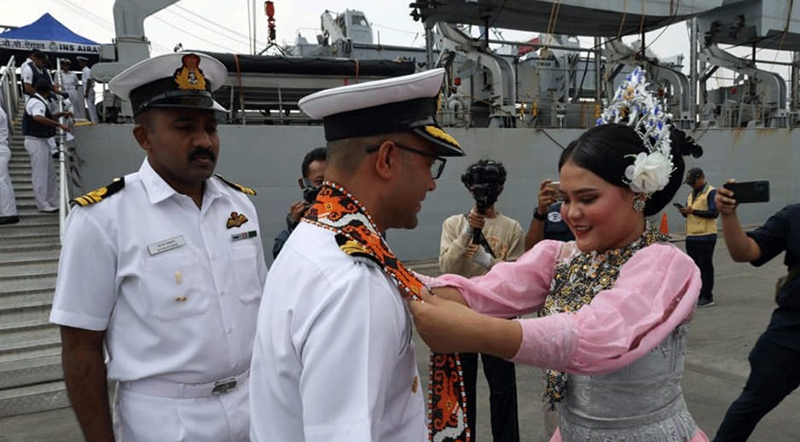
Both India and Indonesia share values of strategic autonomy, democracy, and international law thus laying thefoundations for deeper defense ties. This is marked by maritime partnership, air defense, anti-submarine warfare exercises, maritime search and rescue operations, maritime pollution response, maritime law enforcement through sharing of best practices.
Both India and Indonesia have the potential to establish technological transformations with reputed companies like Tata Advanced Systems (Command Control Systems), and fuselage, Bharat Forge ( artillery systems), and Mazagon Dock shipbuilders Limited (warships and submarines) all equipped with advanced defense facilities for production capabilities, subject matter experts exchange. India does have the capacity and expertise in providing Indonesia necessary technologies related to patrol craft, coastal defense systems, radar technology, UAVs, surveillance systems, and maritime logistics.
Indonesia is also interested in Brahmos supersonic missiles as well as in the acquisition of ‘Make in India’ high-tech sectors such as Akash and Pralay including dual-use for strategic equipment. India and Indonesia have wide ranging cooperation in having multilateral military exercises such as Milan and Komodo as well as in bilateral naval exercises such as Samudra Shakti and Army Exercise, Garuda Shakti. Both India and Indonesia participated in Exercise Pitch Black 2024- Australia’s air combat exercise. India and Indonesia can collaborate in the Indo-Pacific Oceans Initiative and the Indian Ocean Rim Association and work on issues like maritime domain awareness, subsea cables and maritime cybersecurity. These cooperative arrangements are marked by joint defense cooperation committee, services staff training, Indian coast guard, cross visits of warships and aircrafts, training exchanges, subject matter experts exchange, India-Indonesia Defense Industry Exhibition cum seminars.
India offers expertise in maintenance, repair and overhaul capabilities, submarine development and supply chain management specifically regarding the Scorpene-Class submarines for supporting India’s fast fleet plans. In terms of maritime and geopolitical alignment, both India and Indonesia have collaborated on the strategic development of Sabang deep-sea port in Sumatra island and thus providing India vital maritime access at the Western entrance of the bustling Malacca Strat choke point.
Furthermore, both countries closely align under the framework of the ASEAN Defense Miniters Meeting-Plus and work together to counter non-traditional threats and for boosting regional maritime domain related grievances. Indian Armed Forces were instrumental in delivering relief materials following the earthquake and tsunami at Palu in October 2018by providing support to the Indonesian Armed Forces in assisting the victims under Operation Samudra Maitri. .
The Way Forward
With India’s ‘Act East’ policy in full flow across vast swathe of South East Asia and in its peripheries, the coming years are likely to herald a new vista of sustained partnership between India and Indonesia. From trade to investment, tourism to cultural engagement, participation in various bilateral and multilateral forums such as G-20 and BRICs, robust cooperation in defense, maritime security, digital connectivity, etc, there is immense potential of upward trajectory in various fields. In spite of regional and global geopolitical tumult, fast changing geo-economic and geostrategic developments, it is imperative for the political class of both India and Indonesia to remain as steady partners towards a more stable, prosperous and fruitful engagement.
Views: 72

Mohammed Badrul Alam
Dr. Mohammed Badrul Alam is Formerly, Director of Research; Professor and Head, Department of Political Science, Retd; Faculty of Social Sciences, Jamia Millia Islamia University, New Delhi. Prof. Alam is a a well regarded expert in International Relations and area studies with over four decades of teaching and research experience. He writes regularly on issues related to global and regional geopolitics.