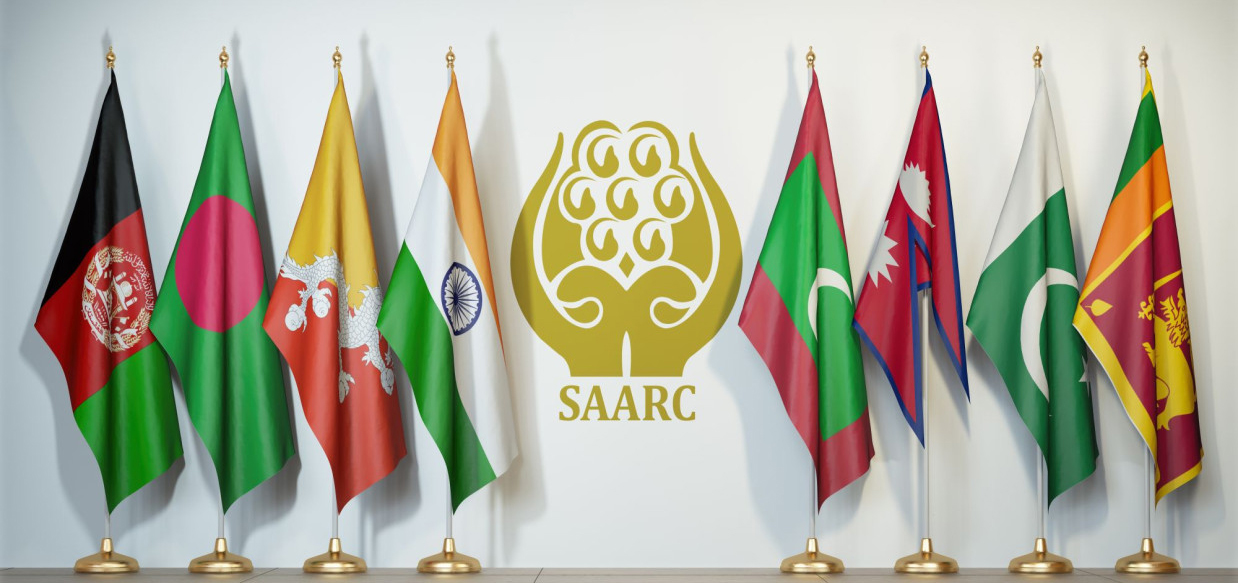







There is a particular kind of courage required to speak inconvenient truths in the language of diplomacy. When Veena Sikri, India’s former High Commissioner to Bangladesh, recently told ANI that New Delhi should “give respect to Pakistan” and move SAARC forward rather than remain trapped in adversarial narratives, she was not merely offering a tactical suggestion. She was holding a mirror to a region that has spent four decades squandering one of the most extraordinary opportunities in modern geopolitical history. The question is not whether her words were bold. The question is whether South Asia’s leadership has the political maturity to act on them.
SAARC was born in Dhaka in 1985, and its birth itself was an act of visionary statesmanship. It was Bangladesh’s President Ziaur Rahman who first wrote to the leaders of seven neighbouring nations, proposing a framework for regional cooperation at a time when the subcontinent was fractured by suspicion, rivalry and the long shadow of Partition. That a relatively young and economically fragile nation took the initiative to build a regional architecture speaks volumes about the power of political imagination unconstrained by the inertia of great-power pride. Nearly four decades later, that architecture lies in near-total ruin. No SAARC summit has been held since 2014. After the Uri attack in 2016, India effectively withdrew from the process, and the organisation slipped into a coma from which it has not recovered. The question now is whether a new generation of South Asian leadership can summon that same founding spirit.
Sikri’s argument is structurally sound. She insists that India has not blocked SAARC merely because of Pakistan rather, it has suspended engagement on the principled question of cross-border terrorism. The distinction matters. It reframes the deadlock not as bilateral hostility but as a policy position grounded in a legitimate security concern. And yet, the uncomfortable reality remains: whatever the stated rationale, the practical consequence has been the paralysis of a regional body that serves the interests of over two billion people. Holding firm on counterterrorism principles and simultaneously keeping open the channels of regional cooperation are not mutually exclusive objectives. The lived experience of other regional organisations across the world makes this abundantly clear.
The European Union offers perhaps the most instructive parallel. France and Germany, whose mutual devastation in two world wars left scars that seemed permanently irreparable, chose within a single generation to build the most ambitious supranational experiment in modern history. They did not erase the memory of conflict they chose, deliberately and courageously, not to allow that memory to dictate the future. The founding logic of the EU was precisely this: that economic interdependence creates a structural disincentive for war. South Asia, with its shared rivers, shared monsoons, shared languages and shared civilisational heritage, has far stronger natural foundations for integration than post-war Europe ever did. And yet it remains, by almost every measurable indicator, the least integrated region on earth.
ASEAN’s trajectory is equally instructive, and perhaps more directly applicable. Ten nations, many of which carried deep historical grievances against one another, built a functional economic and diplomatic bloc on the twin pillars of non-interference and consensus. Vietnam, Indonesia, Thailand and the Philippines did not pretend their differences did not exist they agreed, pragmatically, to disaggregate political disputes from economic cooperation. The results have been transformative. ASEAN today represents the fifth-largest economy in the world, with intra-regional trade accounting for nearly twenty-four percent of total trade. By stark contrast, intra-SAARC trade languishes at barely five to six percent the lowest of any regional grouping on the planet. This is not a geographic or economic inevitability. It is a political choice, renewed every year through inaction.
The broader Asian geopolitical context makes SAARC’s revival not merely desirable but strategically urgent. The Indo-Pacific today is increasingly defined by the competition between China’s Belt and Road Initiative and the Western-backed strategic architecture centred on the Quad. Smaller South Asian nations Bangladesh, Nepal, Sri Lanka, the Maldives are caught in the crosscurrents of this rivalry, often compelled to make difficult choices between Beijing and New Delhi. A functional SAARC would provide these nations with a collective platform and a degree of strategic autonomy that no bilateral relationship can offer. Without it, they remain individually vulnerable to the gravitational pull of larger powers. Furthermore, both India and Pakistan are members of the Shanghai Cooperation Organisation, where they nominally coexist within the same institutional framework. The fact that they can share a table in the SCO but cannot revive SAARC is not a contradiction that goes unnoticed by the rest of the world. It signals that the paralysis is less about genuine security imperatives and more about political will or the lack thereof.
Sikri is right to highlight the aspirations of the new generation. In Bangladesh, the mass uprising of 2024 was not simply a political event it was a generational statement. Young Bangladeshis, Nepalis, Sri Lankans and Pakistanis are not animated by the territorial anxieties and ideological rivalries that defined their parents’ politics. They want technology partnerships, scholarship exchanges, open markets, climate cooperation and the freedom to move, study and build across borders. These are not abstract ideals they are the practical demands of a generation that has grown up in a digitally connected world and finds the artificial barriers of South Asian geopolitics increasingly absurd. When a young entrepreneur in Dhaka cannot easily trade with a counterpart in Lahore, or when a student in Colombo faces more bureaucratic obstacles visiting Kathmandu than visiting London, something has gone profoundly wrong with the region’s political priorities.
It is here that Bangladesh’s potential role deserves particular emphasis. The legacy of Ziaur Rahman in founding SAARC is not merely a point of national pride it is a template for the kind of leadership that the region desperately needs today. Bangladesh today is a fundamentally different country from the one that sent those founding letters in 1980. It is the world’s second-largest garment exporter, a recognised model of development in the Global South, and a nation whose post-2024 political transition has given it a rare opportunity to redefine its regional posture. A future Bangladeshi leadership that chooses to champion SAARC’s revival not as a follower but as a genuine convener would be honouring the deepest instincts of its founding statecraft. It would also be making a strategically rational choice: a reintegrated South Asia benefits Bangladesh more than almost any other member state, given its geographic centrality, its trade dependencies and its climate vulnerability.
None of this is to minimise the severity of India’s security concerns. The record of Pakistan-linked militant networks from the 2001 Indian Parliament attack to the 2008 Mumbai massacre, from Uri in 2016 to Pahalgam in 2025 represents a genuine and documented pattern of state-tolerated or state-sponsored violence. India’s insistence that this question be addressed structurally before full SAARC engagement resumes is not without basis. The danger, however, lies in allowing a legitimate security concern to become a permanent veto over regional cooperation in its entirety. Sikri’s suggestion of a transparent, principle-based framework one in which all member states are held to account on counterterrorism commitments through an independent regional monitoring mechanism offers a way out of this impasse that neither rewards impunity nor condemns the region to indefinite stagnation.
The climate emergency adds a dimension of urgency that makes continued inaction almost unconscionable. The Himalayan glaciers that feed the rivers of India, Nepal, Pakistan and Bangladesh are retreating at an accelerating pace. Cyclone patterns in the Bay of Bengal are intensifying. Sea levels threaten the very existence of the Maldives and large swathes of coastal Bangladesh. These are not problems that respect national borders, and they cannot be solved by nations acting alone. A SAARC climate framework modelled, perhaps, on the Nordic Council’s approach to shared environmental governance could mobilise collective resources, coordinate disaster response and present a unified voice in global climate negotiations. The absence of such a framework is not merely a missed opportunity. In the long run, it may prove to be an act of collective self-harm.
In the end, Sikri’s call for realism is a call for South Asia to grow up. The region’s leaders must decide whether they are stewards of their nations’ futures or prisoners of their nations’ pasts. Respect, in the diplomatic sense she invokes, does not mean forgiveness without accountability. It means acknowledging that the country across the border however troubled, however complicated is a permanent geographic reality whose cooperation is necessary for the prosperity of all. Walls can be built higher, summits can be cancelled indefinitely, and adversarial narratives can be refined to rhetorical perfection. But the rivers will keep flowing across borders, the monsoon will keep arriving without a visa, and the young people of South Asia will keep asking why a region of such extraordinary human potential continues to choose, year after year, the cold comfort of hostility over the difficult, necessary work of peace.
The founding vision of SAARC was never naive. It was, at its core, a wager on the possibility that history need not be destiny. That wager remains open. The only question is who will have the courage to place it.
Views: 49

Shahidul Alam Swapan
Shahidul Alam Swapan is aSwitzerland-based Private Banking & Financial Crime Compliance Expert, Columnist and Poet.