


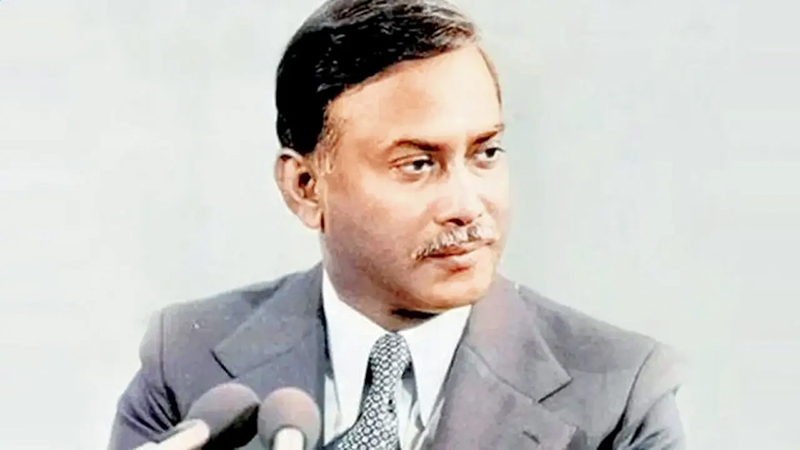







When History Speaks Across Borders: India’s Tribute to Ziaur Rahman and the Politics of Bangladesh’s Liberation Memory
In South Asian politics, history is rarely confined to the past. It is continuously revisited, reinterpreted, and deployed in contemporary political discourse. A recent social media post by the Indian High Commission in Dhaka, commemorating the 45th martyrdom anniversary of former Bangladeshi President Ziaur Rahman, has once again demonstrated how historical memory remains a powerful force in shaping political narratives and diplomatic relations in the region.
The post recalled Ziaur Rahman’s famous radio broadcast in March 1971, describing it as a moment that inspired resistance against oppression and encouraged the people of Bangladesh in their struggle for national liberation. The statement also reaffirmed India’s solidarity with Bangladesh, emphasizing the shared sacrifices that contributed to the country’s independence and the continuing partnership between the two nations.
At first glance, the message appears to be a straightforward tribute to a significant historical figure. Yet its political and symbolic implications extend far beyond a routine diplomatic gesture. In the context of Bangladesh’s deeply contested historical narratives, India’s recognition of Ziaur Rahman’s role carries important domestic, regional, and diplomatic significance.
The Enduring Legacy of a Contested Hero
Few figures in Bangladesh’s political history evoke as much admiration and controversy as Ziaur Rahman. To his supporters, he is a national hero, a freedom fighter, a military officer who played a crucial role during the Liberation War, and a statesman who sought to establish political stability during a turbulent period.
Perhaps the most widely remembered episode associated with Ziaur Rahman is his radio announcement during the early days of Bangladesh’s War of Independence in March 1971. For many Bangladeshis, particularly those aligned with the political tradition of the Bangladesh Nationalist Party (BNP), which Zia later founded, that announcement symbolized courage, resistance, and the formal articulation of the nation’s aspiration for freedom.
However, the interpretation of his role has long been intertwined with partisan politics. Competing political forces in Bangladesh have often emphasized different aspects of the Liberation War, assigning varying degrees of significance to different leaders and events. Consequently, debates surrounding Ziaur Rahman’s contribution are not merely historical discussions; they are deeply connected to questions of national identity, legitimacy, and political power.
Against this backdrop, India’s decision to publicly commemorate Ziaur Rahman’s radio address is noteworthy because it touches upon one of the most sensitive dimensions of Bangladesh’s political discourse: the ownership of liberation history.
Why India’s Message Matters
India played a decisive role in Bangladesh’s birth. Millions of refugees crossed into India during the 1971 crisis, and Indian military intervention in December of that year was instrumental in securing Bangladesh’s victory over Pakistan. As a result, India’s perspective on the Liberation War carries considerable historical weight.
For decades, observers often perceived New Delhi as being more comfortable with certain political narratives and political actors within Bangladesh than others. Therefore, the Indian High Commission’s acknowledgment of Ziaur Rahman’s contribution may be interpreted as a signal that India recognizes the broader spectrum of personalities who participated in Bangladesh’s independence struggle.
This matters because historical recognition from a neighboring state that was itself deeply involved in the events of 1971 carries symbolic significance. It suggests an effort to engage with Bangladesh’s history in a more inclusive manner, acknowledging that the liberation movement was shaped by numerous actors whose contributions resonated across ideological and political divides.
From a diplomatic perspective, the gesture may also reflect India’s understanding that sustainable bilateral relations require engagement with the full diversity of Bangladesh’s political landscape rather than any single narrative or political constituency.
The Politics of Historical Memory
The controversy surrounding liberation history in Bangladesh is not unique. Across the world, nations continue to debate how their foundational moments should be remembered and who deserves recognition for shaping them.
In Eastern Europe, disputes over wartime resistance movements, anti-colonial struggles, and post-war political transitions continue to influence contemporary politics. Similar debates occur in Latin America, Africa, and the Middle East. Historical memory often becomes a battleground because it helps define national identity and political legitimacy.
Bangladesh presents a particularly compelling example of this phenomenon. More than five decades after independence, discussions about 1971 remain central to political competition. Political parties frequently invoke liberation history to reinforce their ideological positions and mobilize public support.
India’s tribute to Ziaur Rahman therefore enters a highly sensitive arena. It implicitly acknowledges that the story of Bangladesh’s independence cannot be reduced to a single individual, institution, or political tradition. Rather, it was the result of collective sacrifice involving political leaders, military officers, freedom fighters, students, workers, and ordinary citizens.
Such recognition may contribute to a more comprehensive understanding of history one that accommodates complexity rather than insisting upon exclusivity.
A Message Beyond Domestic Politics
The Indian statement also contains an important regional dimension. By emphasizing shared sacrifice and continued partnership, the High Commission linked historical remembrance to contemporary diplomacy.
South Asia today faces numerous challenges, including economic uncertainty, climate vulnerability, energy security concerns, and geopolitical competition among major powers. Against this backdrop, stable and constructive relations between Bangladesh and India are increasingly important.
The reference to standing “shoulder to shoulder” with the people of Bangladesh serves as a reminder that the two countries share not only a border but also a unique historical experience. While political disagreements inevitably arise between neighbors, the memory of 1971 remains one of the strongest foundations for bilateral cooperation.
For India, reinforcing this shared historical narrative helps sustain goodwill in Bangladesh. For Bangladesh, recognition of its national heroes by an important regional partner can strengthen mutual understanding and trust.
The timing of the message is also significant. In an era when misinformation and polarized narratives often dominate political discourse, diplomatic recognition of historical events can serve as a stabilizing force, encouraging dialogue rather than division.
Implications for Bangladesh’s Political Future
The broader significance of the tribute lies in its potential impact on how Bangladesh approaches its own history moving forward.
Mature democracies are often characterized by their ability to accommodate multiple perspectives on national history without undermining national unity. This does not require abandoning historical facts or diminishing the contributions of key leaders. Rather, it involves recognizing that major historical transformations are rarely the work of a single individual.
Bangladesh has reached a stage in its national development where a more inclusive approach to historical memory could strengthen rather than weaken social cohesion. Acknowledging the contributions of various figures from the Liberation War era does not diminish the sacrifices of others. Instead, it enriches the national narrative by reflecting the complexity of the struggle itself.
India’s tribute can therefore be viewed as an invitation whether intentional or not to move beyond binary interpretations of history. It encourages a broader appreciation of those who contributed to Bangladesh’s independence and nation-building.
The European Perspective
For European observers, the episode offers valuable lessons about the relationship between history, identity, and diplomacy.
Europe’s own experience demonstrates that reconciliation often begins with mutual recognition of historical realities. The post-war European project was built upon acknowledging painful histories while creating space for cooperation and shared progress.
Similarly, South Asia’s future stability may depend in part on its ability to engage with history in a manner that promotes understanding rather than perpetual confrontation. Diplomatic gestures that recognize historical complexity can play a constructive role in that process.
The Indian High Commission’s message does not resolve longstanding debates about Bangladesh’s political history. Nor does it eliminate the differing interpretations that continue to exist within the country. What it does accomplish is something perhaps equally important: it acknowledges a historical moment that resonates deeply with many Bangladeshis and situates that moment within a broader narrative of shared sacrifice and regional partnership.
The tribute to Ziaur Rahman’s March 1971 radio address is more than a commemorative statement. It is a reminder that history remains a living force in South Asian politics, shaping identities, influencing diplomatic relationships, and informing contemporary debates about nationhood.
By recognizing Ziaur Rahman’s role in inspiring resistance during one of the most consequential moments in Bangladesh’s history, India has entered a complex but necessary conversation about historical memory and national identity. The gesture highlights the enduring significance of the Liberation War while underscoring the importance of inclusive historical recognition.
Ultimately, nations grow stronger when they are confident enough to embrace the full breadth of their history. Bangladesh’s story is one of extraordinary courage, sacrifice, and resilience. The contributions of all those who helped shape that story deserve thoughtful recognition. In that sense, India’s tribute may be remembered not only as a diplomatic message but also as a timely reminder that history, when approached with openness and respect, can serve as a bridge rather than a barrier between peoples and nations.
Views: 33

Shahidul Alam Swapan
Shahidul Alam Swapan is aSwitzerland-based Private Banking & Financial Crime Compliance Expert, Columnist and Poet.


