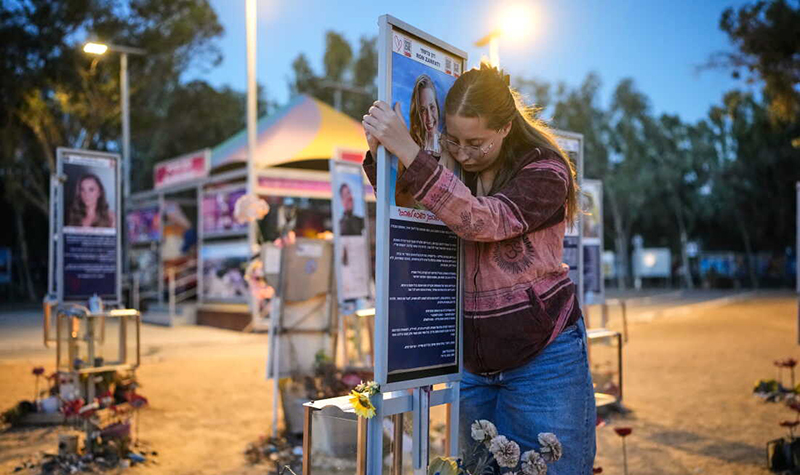







Three years after October 7, Europe knows what to say. It remembers the dead, condemns Hamas and promises to confront antisemitism. The harder question is whether those words carry sufficient authority beyond the ceremonies in which they are spoken.
This year, Ursula von der Leyen recalled the lives cut short and the ordeal of the hostages. Roberta Metsola renewed the European Parliament’s commitment to fighting antisemitism. Kaja Kallas placed a clear obligation on Europe itself, insisting that Jewish communities must be able to live openly, safely and without fear. Their statements matter because they establish a standard for which European institutions can be held accountable.
October 7 cannot be confined to Europe’s foreign policy. European citizens were among those murdered and abducted. Emmanuel Macron recalled French victims by name, while Friedrich Merz spoke of the right of Jews to live without fear in Germany. The connection is immediate. Europe was touched by the massacre, and the security of its Jewish citizens is its own responsibility.
In Rome, Cardinal Matteo Zuppi gave that responsibility a human expression. On the evening of 6 October, the president of the Italian bishops’ conference went to the synagogue to participate in the commemoration, sitting beside Rabbi Riccardo Di Segni. He described the attack as murderous madness and rejected any justification for antisemitism. His presence was an act of solidarity with a community whose grief he had come to share.
There is a particular significance in the head of Italy’s bishops taking that seat. Given the history of Christian Europe’s relationship with its Jewish communities, such gestures carry weight. Zuppi’s presence recognised Jewish mourning as something in which the wider society has a duty to participate. The community should not have to bear the task of remembrance alone.
Nor should it have to negotiate the terms on which its dead can be mourned. Families murdered in their homes, young people attacked at a music festival, children and elderly people taken hostage deserve remembrance without a political interrogation of those grieving for them. A commemoration is entitled to remain with their lives, their deaths and the families left behind.
The ease with which Jewish identity can be drawn into a debate about governments and borders makes this distinction essential. A Jewish citizen of Rome, Paris or Berlin is not a diplomatic representative required to answer for another country. Nobody should have to establish their political credentials before receiving solidarity after an antisemitic threat. Equal citizenship cannot depend on giving an acceptable answer about Israel.
That is where the anniversary becomes a test of European political seriousness. Condemnation has to be followed by the patient work of protecting institutions, investigating threats and ensuring that intimidation does not determine who feels able to participate in public life. The EU’s Fundamental Rights Agency has identified concrete priorities, including better recording of antisemitism, education, cooperation with Jewish communities and responses to online hatred. The agenda exists. Governments must account for its implementation.
There is also a responsibility for political leaders to give their own words continuity. A statement issued on October 7 should remain the standard on October 8, in a parliamentary argument, on a university campus or when confronting prejudice among one’s own supporters. The credibility of a principle is established when defending it becomes inconvenient.
Mattarella’s condemnation of the attacks and Palazzo Chigi’s rejection of any cause being used to justify the deliberate massacre of innocents provide that clarity. The challenge is to preserve it when the anniversary has passed and public attention has moved elsewhere.
Zuppi went to the synagogue. Europe’s leaders spoke in solidarity. What follows belongs to the institutions they lead and the societies they represent. The world is no safer than it was three years ago. Antisemitism makes newspaper headlines every other day. In this climate, Europe needs to move beyond expressing solidarity and take concrete steps to give it meaning. The question is how much longer that will take.
Views: 5

Matteo Bianchi
Matteo Bianchi is a geopolitical analyst and author. With a distinguished career in information and security in government and the corporate world, Bianchi has lived in 4 continents and worked in several verticals. He is currently retired and writes on geopolitics, AI and cybersecurity.