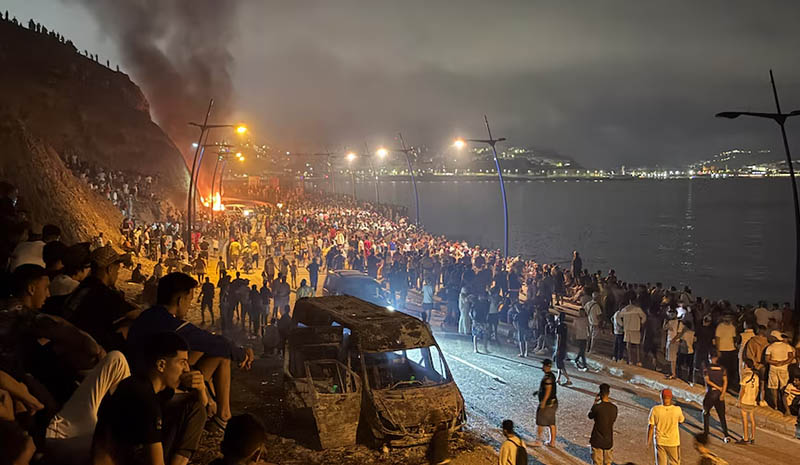







Ceuta has once again become the focal point of Europe’s migration debate after an estimated 60,000 irregular migrants reached the Spanish enclave in less than 48 hours. The surge followed a ruling by the Spanish Supreme Court on 29 June 2026 prohibiting the immediate return of migrants arriving by sea. Human trafficking and migrant smuggling networks quickly exploited the judgment, spreading claims across social media that Spain’s borders had effectively been opened. Within days, a legal decision had become an operational crisis.
From a humanitarian perspective, the Court’s ruling can be defended. Operationally, however, it failed to anticipate how organised trafficking networks exploit legal developments. By distinguishing between migrants arriving at the land fence and those reaching Ceuta by sea, the judgment created an opportunity that smugglers immediately weaponised. What the Court envisaged as a manageable legal framework became, once amplified online, the catalyst for one of the largest migration surges ever witnessed at an external European Union border.
The consequences were immediate. Ceuta, a city of just 85,000 residents, saw its population almost double overnight. Reception centres collapsed, thousands of migrants were left sleeping on beaches and streets, and dozens lost their lives attempting the crossing. The episode demonstrated that Europe’s asylum system is designed for a steady flow of arrivals, not a mass movement of tens of thousands within a matter of days.
Ceuta’s importance extends well beyond migration. Although geographically located in North Africa, it has been sovereign Spanish territory since voluntarily pledging allegiance to the Spanish Crown in 1668. Together with Gibraltar, it overlooks the Strait of Gibraltar, one of the world’s most strategically significant maritime chokepoints. A crisis in Ceuta is therefore not simply a Spanish problem but a European one.
This explains why the reaction across Europe was so forceful. For many Member States, including Italy, the crisis represented a breach of the European Union’s external frontier and therefore a threat to the integrity of the entire Schengen Area. Once confidence in the external border is lost, pressure inevitably grows to restore internal border controls, undermining one of the Union’s greatest achievements: the free movement of people and goods.
Spain’s critics argue that the crisis was not simply the product of unfortunate circumstances but of poor strategic planning. They point to Madrid’s decision earlier in the year to launch a large-scale regularisation programme for undocumented migrants while simultaneously failing to reinforce border security after the Supreme Court’s ruling. According to this view, the combination of these measures created a narrative that smugglers readily exploited, convincing prospective migrants that Spain had become an easier gateway into Europe. Critics also note that local reports indicated only a handful of officers were initially deployed at the principal crossing point when the crowds arrived.
The Spanish government strongly rejects this interpretation. Prime Minister Pedro Sánchez argues that the crisis resulted primarily from Morocco’s decision to relax border controls during a period of diplomatic tension rather than from Spanish negligence. Madrid also points to its response, repatriating more than 48,000 migrants within 48 hours while preventing any significant secondary movement into mainland Europe. From Spain’s perspective, the episode demonstrated operational resilience rather than institutional failure.
Whatever position one takes, Ceuta highlights several uncomfortable realities. First, Europe’s borders are no longer defended solely by fences and patrol boats. They also exist in the digital sphere. Trafficking networks used TikTok, Facebook and other platforms to spread false or misleading claims that rapidly mobilised thousands of people. The European Union should therefore regard coordinated online migrant recruitment campaigns as a security threat. Frontex, Europol, national intelligence agencies and technology companies must work together to identify and disrupt trafficking disinformation before it produces a physical crisis at the border.
Second, domestic immigration policy and external border security cannot be treated as separate issues. Major regularisation programmes may pursue legitimate domestic objectives, but they should always be accompanied by a visible reinforcement of the Union’s external borders. The perception that Europe’s borders have become easier to cross is often as dangerous as reality itself.
Third, the European Union remains too dependent on neighbouring states to protect its borders. Cooperation with countries such as Morocco is essential, but it also creates strategic vulnerabilities whenever diplomatic relations deteriorate. Europe should strengthen its own permanent presence at vulnerable frontiers such as Ceuta and Melilla and, where agreements with host governments exist, establish permanently staffed European border support facilities in key transit countries such as Libya and Tunisia. Such facilities would reinforce security while also providing humanitarian screening and processing closer to migration routes, reducing dangerous sea crossings and saving lives.
Finally, Europe requires an automatic crisis response mechanism. The Ceuta emergency showed that existing asylum procedures become extremely difficult to administer during sudden mass influxes. A major breach of the Union’s external border should immediately trigger a coordinated European response, including additional personnel, logistical support, intelligence sharing and emergency processing capacity. Such a system would reinforce confidence in the external frontier and reduce the political pressure for Member States to restore internal Schengen controls.
Ceuta is not simply a Spanish border dispute. It is a warning that Europe’s migration framework was designed for yesterday’s challenges. Today’s migration crises are organised by transnational criminal networks, amplified by social media and capable of overwhelming border systems within hours. Unless the European Union adapts accordingly, the next Ceuta will not be an isolated incident but the beginning of a recurring pattern.
Views: 18

Matteo Bianchi
Matteo Bianchi is a geopolitical analyst and author. With a distinguished career in information and security in government and the corporate world, Bianchi has lived in 4 continents and worked in several verticals. He is currently retired and writes on geopolitics, AI and cybersecurity.