






As the last Caliph of the Muslims, Abdülmecid II was forced onto the Orient Express in the middle of the night in Istanbul in 1924, he declared that the decision to abolish the Caliphate was a “suicidal act of historic illiteracy” and that, by destroying the centre of gravity for hundreds of millions of people, the secular authorities were opening a Pandora’s box of ideological chaos.
It seems as though some divine power softly whispered, “so be it.” And today, in a rapidly polarizing world, we seem to be surrounded by that chaos.
The deepest fault line between Western capitalism and Islam may not be capitalism, economics or religion. It is individual freedom.
The individual, according to the modern liberal tradition, has the right to determine his or her own life, speak freely, question received wisdom, and choose one’s beliefs, one’s way of life, one’s relationships and so on. In fact, one of the main advantages of Western liberalism is the right to the pursuit of happiness. But when that concept of individual autonomy clashes with a political tradition in which freedom exists within a pre-existing moral code, chaos ensues.
The two systems have tried to coexist peacefully. Millions of Muslims live comfortably within Western liberal democracies. But if the balance of power shifts, when religious conceptions of communal obligation and moral authority seek political power within democratic institutions founded upon individual sovereignty, the potential for conflict is real.
The abolition of the Caliphate may not have created political Islam, but something fundamental changed. The Muslim world no longer possessed a universally recognizable political centre capable of claiming authority over the wider community.
The vacuum that was created gave rise to important dilemmas, and efforts to fill that vacuum gave rise to several organizations. One of these was the Muslim Brotherhood, one of the ideologies that took root in Egypt and subsequently travelled west.
Organizations such as the Council on American-Islamic Relations, CAIR, and the Islamic Society of North America, ISNA, are important parts of this landscape. They have been perfunctorily connected to the Brotherhood in the past, but wield substantial influence through Muslim civic engagement, political advocacy, education and community organization. Over time, they have cultivated political standing and accumulated influence through elections, lobbying, advocacy organizations, litigation, media, voting blocs and the cultivation of political alliances.
That is where the rise of politicians such as Zohran Mamdani in New York and Abdul El-Sayed in Michigan becomes significant.
The striking rise of politicians such as Zohran Mamdani in New York and Abdul El-Sayed in Michigan does not fit neatly into the conventional American political categories. Both are products of the American progressive left, advocating expansive government programs and economic redistribution, while simultaneously being unapologetically Muslim and giving considerable political weight to their Muslim identity and to the Palestinian question.
Their politics are therefore difficult to place on the conventional left-right spectrum. They are progressive on economics and on a number of social issues, while holding deeply rooted religious, communal and geopolitical convictions that are not easily explained by conventional American liberalism. Yet they are unapologetically Muslim in identity and deeply shaped by a distinctly Muslim political consciousness, particularly over Palestine and Israel.
Their emergence is significant not because either man seems to represent a straightforward attempt to impose Islamic government on America. It is significant because they illustrate something new: the growing ability of Muslim political identity to operate not at the margins of American politics, but within its mainstream political machinery.
The irony may be that neither Mamdani nor El-Sayed needs to consciously advance an “Islamic agenda” for the political consequences to matter. Political ideas can travel through identity, institutions and coalitions without those carrying them necessarily seeing themselves as part of a larger ideological project.
The question arises whether this is simply American democracy becoming more representative of its Muslim citizens, or whether it is the beginning of a new political synthesis in which Muslim communal identity and Western progressive politics reinforce one another, potentially producing political positions that neither traditional American liberalism nor traditional conservatism can successfully defend.
It is a scary proposition.
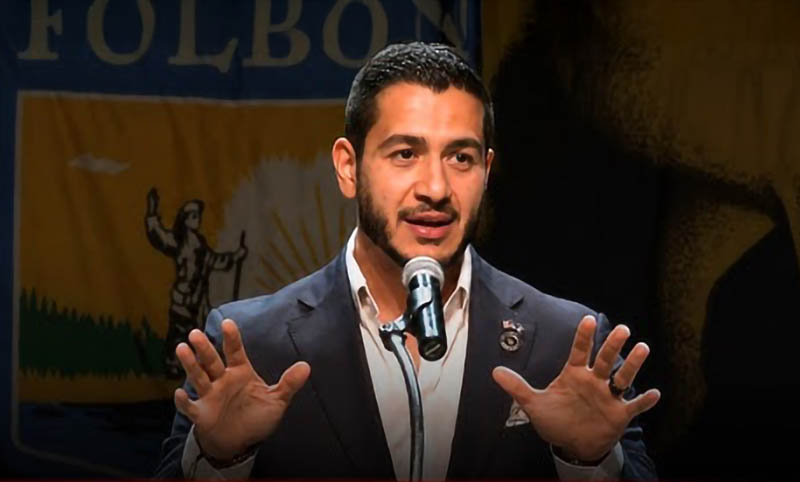
The most revealing example may be unfolding in Michigan, where Abdul El-Sayed, a second-generation American born and raised in Michigan to Egyptian immigrant parents, has just fought and won one of the most consequential Democratic Senate primaries of the year. El-Sayed, a physician and former Detroit health official, is attempting something that would have been difficult to imagine in American politics only a generation ago. He has brought together an explicitly Muslim identity, a populist economic program and an uncompromising position on Palestine as the foundation of a serious campaign for the United States Senate.
His appeal is not narrowly religious. On the domestic front, El-Sayed is firmly of the American progressive left. His platform calls for universal health care, affordable housing, stronger public education, taxation of billionaire wealth, and sweeping reforms to campaign finance and voting. He presents himself as an economic populist taking on corporate power and a political establishment that, in his view, has abandoned ordinary Americans.
But his politics become considerably more distinctive when he talks about Israel.
El-Sayed has called Israel’s actions in Gaza genocide and has argued for ending both offensive and defensive U.S. military aid to Israel. He has gone further than the increasingly common Democratic criticism of the Netanyahu government, questioning whether the concept of Israel as a specifically Jewish state can be reconciled with the liberal values Americans claim to uphold. When pressed on whether Israel has a right to exist as a Jewish state, he has repeatedly challenged the premise of the question.
The Arab-American community in Michigan has already demonstrated that Palestine can alter electoral calculations in ways that transcend traditional party loyalties. In 2024, some Arab-American voters withheld support from Kamala Harris over the Biden administration’s Gaza policy. Now, El-Sayed’s campaign is testing whether that discontent can be converted into a durable political movement rather than a one-election protest.
Abdul El-Sayed’s campaign is therefore about more than one Senate seat, just as Zohran Mamdani’s rise is about more than one mayoralty. They are early manifestations of a political landscape that is changing faster than the West’s understanding of it.
The eventual conflict may remain manageable. It may even produce a richer and more pluralistic democracy. But it may also expose a fault line that neither side has yet fully acknowledged. Because a society can accommodate enormous differences in religion, ethnicity and culture, but it cannot indefinitely avoid answering the question of who has the final word over the individual.
The Caliphate disappeared in 1924. The struggle over authority did not. It merely lost its centre.
A century later, that struggle is finding new institutions, new constituencies and new political languages in the very heart of the liberal West.
Views: 13

Matteo Bianchi
Matteo Bianchi is a geopolitical analyst and author. With a distinguished career in information and security in government and the corporate world, Bianchi has lived in 4 continents and worked in several verticals. He is currently retired and writes on geopolitics, AI and cybersecurity.