






ROME: Pakistan’s recurring claims of Islamophobia on the global stage demand closer scrutiny, not automatic endorsement. The language of victimhood has become a convenient diplomatic tool, deployed to deflect attention from its own deeply troubling record toward Muslim communities within and beyond its borders.
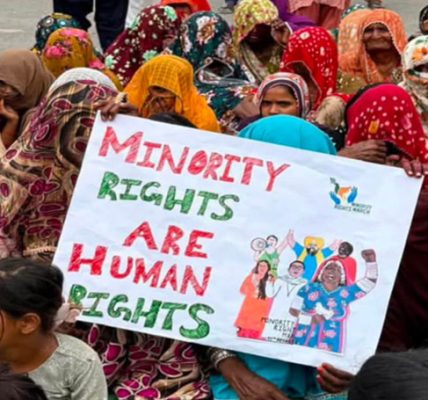
At the heart of the issue lies a contradiction that is increasingly difficult to ignore. A state that positions itself as a defender of Muslims worldwide continues to preside over systemic discrimination and violence against its own Muslim minorities. The persecution of Shia communities in Pakistan is neither incidental nor isolated. Sectarian attacks on Shia mosques, processions, and neighborhoods have persisted for decades, often with inadequate accountability. The situation of the Ahmadiyya community is even more stark. Constitutionally declared non Muslim, Ahmadis face legal discrimination, social exclusion, and periodic mob violence. Their mosques are attacked, their religious practices criminalized, and even the simple act of self identification as Muslim can lead to prosecution.
These are not marginal failures. They are structural realities embedded within the state’s legal and political framework. For Pakistan to speak of Islamophobia abroad while tolerating, and at times enabling, such conditions at home raises legitimate questions about credibility.
The contradiction extends beyond its borders. Pakistan’s military actions in Afghanistan, including operations during Ramadan, have resulted in civilian casualties in a neighboring Muslim country. Whatever the stated security rationale, the optics and the human cost are difficult to reconcile with claims of religious solidarity. The idea of a unified Muslim ummah is frequently invoked in diplomatic rhetoric, yet it appears selectively applied when strategic interests are at stake.
Even in its relations with key Muslim partners, this pattern of selective solidarity is evident. Under the leadership of General Asim Munir, Pakistan has shown reluctance to respond to Saudi Arabia’s expectations under longstanding security and defence understandings. At moments when Riyadh has sought support, Islamabad has invoked its commitments on the Afghan front and broader internal security pressures as justification for restraint. Yet this selective invocation of constraints contrasts sharply with Pakistan’s readiness to project itself as a champion of Muslim causes elsewhere. The Afghan war, frequently cited as a burden, has thus also become a convenient alibi, deployed when political or strategic costs of alignment are deemed too high.
A similar pattern can be observed in the broader regional dynamic, particularly in relation to Iran. Tehran has, at various moments, called upon the ummah for unity and support. Yet its well documented use of proxy groups across the Middle East has contributed to instability and violence in several Muslim majority countries. From sectarian militias to armed non state actors, these interventions have often deepened intra Muslim conflicts rather than resolved them. The language of unity, in this context, risks becoming detached from reality.
Pakistan’s alignment with such narratives, while simultaneously amplifying claims of Islamophobia in international forums, creates an uneasy dissonance. It suggests that the term is being instrumentalized rather than consistently applied. Genuine Islamophobia is a real and serious issue in many parts of the world, and it deserves to be addressed with clarity and integrity. However, when the term is used selectively, it risks losing both its moral weight and its analytical precision.
There is also a broader consequence. By framing itself primarily as a victim of external prejudice, Pakistan diverts attention from necessary internal reforms. Issues such as minority rights, sectarian violence, and legal discrimination require sustained political will and institutional change. These are not challenges that can be addressed through international rhetoric alone.
If Pakistan wishes to be taken seriously as a voice for Muslim communities globally, it must begin by addressing the conditions within its own borders. Credibility in international advocacy is built on consistency. Without it, even legitimate concerns risk being dismissed as opportunistic.
The conversation on Islamophobia should not be abandoned. It should be grounded. And grounding it begins with an honest reckoning, not just with how Muslims are treated elsewhere, but with how they are treated at home and in the region.
Views: 24

Carlo Lombardi
Carlo Lombardi is an Italo-Canadian analyst and commentator on economics and geopolitics. A qualified Chartered Accountant and Auditor in Italy, he extensively works in India assisting companies in planning strategy and expansion.