


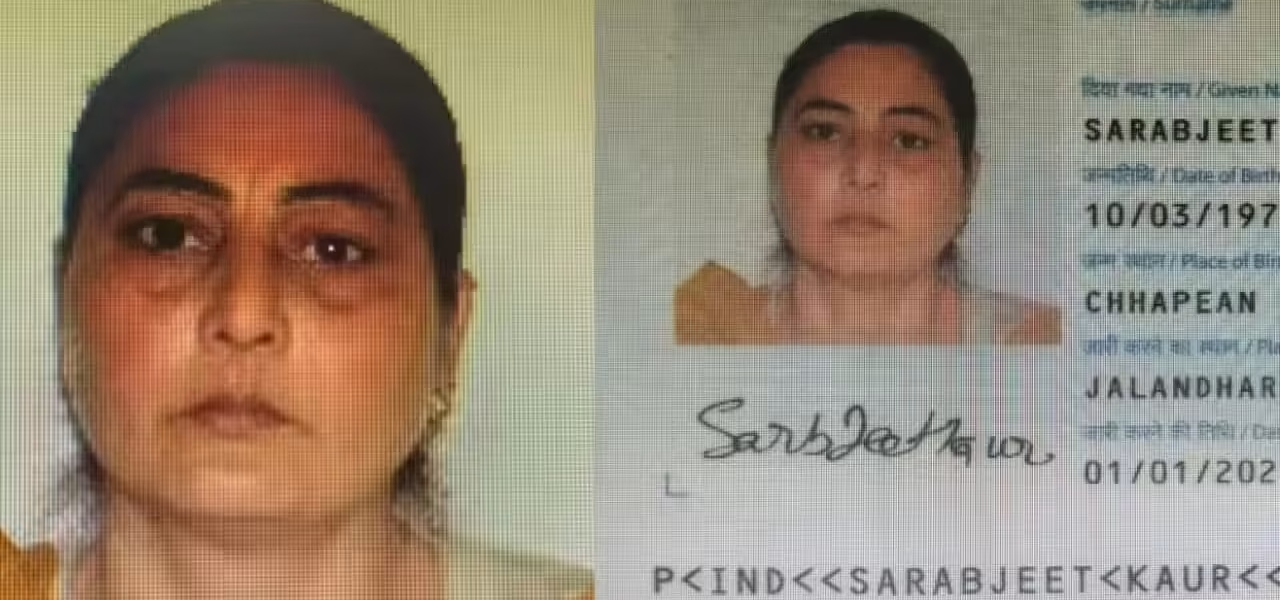







AMRITSAR: The disappearance and subsequent conversion of Indian pilgrim Sarabjeet Kaur during a recent Sikh pilgrimage to Pakistan has triggered a wave of controversy and prompted the Shiromani Gurdwara Parbandhak Committee (SGPC) to consider barring lone women from joining future jathas. The case has reopened sensitive debates around security, faith, and cross border vulnerability at a time when Sikh pilgrimages to Pakistan remain deeply symbolic yet politically delicate. SGPC’s current declaration also questions the radicalisation of this body as well as its commitment to women’s rights.
Kaur, a forty eight year old Sikh woman from Punjab’s Kapurthala district, travelled to Pakistan on November 4 as part of a 1,932 member jatha marking the five hundred fifty sixth birth anniversary of Guru Nanak Dev. When the group returned to India on November 13, she was reported missing, setting off a chain of inquiries in both countries.
Within days, Pakistani media circulated documents and an eighteen second video showing Kaur stating before a magistrate that she had known a Pakistani man, Nasir Hussain, for nine years, loved him and was willingly converting to Islam and marrying him. Pakistani reports suggested that the nikah had taken place on November 5, shortly after her arrival. She also reportedly adopted the name Noor Hussain and contacted the Indian mission seeking to obtain Pakistani nationality. The video has not been independently verified, but its widespread circulation intensified public attention on the case.
What emerged next deepened the controversy. Police in Punjab confirmed that Kaur had three fraud and cheating cases registered against her in Bathinda and Kapurthala, while her sons had nine cases involving fraud, assault and cheating across several districts. Investigators also revealed that she had listed a permanent address in Malout on her passport but did not provide her citizenship or passport number on the Pakistani visa immigration form. Her husband has been living in the United Kingdom for more than fifteen years and her sons were reportedly not in contact with her. These details complicated the narrative and raised questions about whether her trip had been pre planned.
SGPC officials admitted that they had initially objected to Kaur travelling alone, but allowed her after she produced recommendations from her village sarpanch and nambardar. SGPC secretary Partap Singh criticised central agencies for failing to notice that she was already in communication with a Pakistani national. He framed the case as an institutional failure, warning that it had hurt the religious sentiments of the Sikh community and brought disrepute to the pilgrimage process. Singh also recalled the 2018 case of Kiran Bala, who similarly remained in Pakistan after converting to Islam and marrying there.
Local SGPC representatives attempted to track Kaur’s background as soon as she was declared missing. Gurinder Kaur, who headed the jatha, notified Gurpreet Kaur, a member from Sultanpur Lodhi, who then visited the pilgrim’s home in Amanipur. Gurpreet, who had recommended ten pilgrims including Kaur, stated that she had been unaware of any criminal cases linked to her.
Meanwhile, police in Kapurthala interrogated her sons and visited her village to understand her motives. Senior Superintendent of Police Gaurav Toora said investigators were coordinating with central agencies to piece together the circumstances surrounding her journey and her rapid marriage in Pakistan.
The SGPC said that this incident, combined with the earlier case of Kiran Bala, had caused significant embarrassment and shaken trust in the pilgrimage process. As a result, the body is now considering prohibiting lone women from joining Sikh jathas to Pakistan, a move that has already sparked debate within the community. Supporters argue that stricter safeguards are necessary to prevent misuse of religious travel, while critics caution against restricting women’s freedom on the basis of isolated episodes.
The case of Sarabjeet Kaur, now known as Noor Hussain, highlights the fragile intersection of personal agency, religious devotion and the complex politics of India Pakistan relations. It underscores how a pilgrimage meant to celebrate faith can unexpectedly become a flashpoint, revealing deeper anxieties about security, social vulnerability and cross border movement.
Views: 34

Carlo Lombardi
Carlo Lombardi is an Italo-Canadian analyst and commentator on economics and geopolitics. A qualified Chartered Accountant and Auditor in Italy, he extensively works in India assisting companies in planning strategy and expansion.


