






China may be diplomatically recognised as a neighbour by the Union government in New Delhi, but for many Indians, it is nothing but an aggressor which occupied the sacred land of Tibet seven decades ago to come closer to Bharat. Millions of them still believe that Tibet will someday emerge as a sovereign land where the Dalai Lama would rule the Himalayan Shangri-la from the Potala Palace. The global Tibetan Buddhist population is ready for any sacrifice to make their original motherland an independent country rather than a part of China, while the Communist regime in Beijing appears determined to maintain its rule over the Tibetan plateau and suppress any movement that challenges its authority.
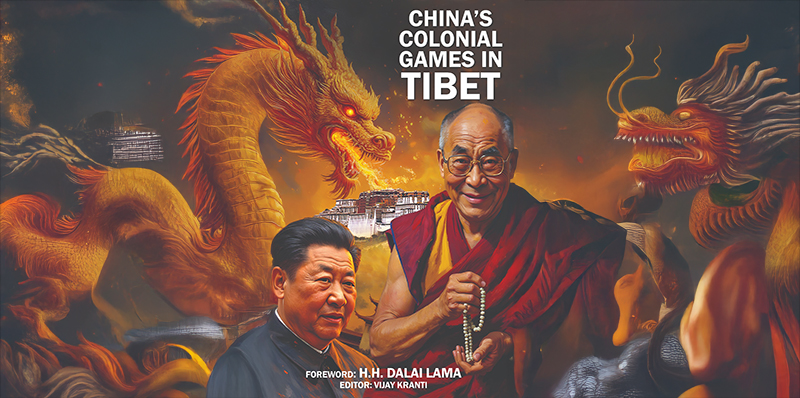
A new book, titled ‘China’s Colonial Games in Tibet’, is coming to the market exposing the designs of Beijing inside Tibet for decades. Edited by veteran journalist-author Vijay Kranti and published by VK Media Group for the Centre for Himalayan Asia Studies and Engagement (CHASE), the book comprises nearly 60 essays and presentations by 39 leading experts on Tibet and China, which were discussed in over 30 international webinars between 2020 and 2023. The hard-bound 486-page book (priced at Rs 2500 and USD 40) emerges as an act of collective courage and wisdom while providing comprehensive information to scholars, researchers, diplomats and policy makers on security, strategy and defence matters.
His Holiness the 14th Dalai Lama, in his foreword message for this book, writes that Tibet is situated on the Roof of the World and remains the source of many of Asia’s great rivers. Therefore, protecting the environment of the Tibetan plateau is of utmost importance. The plateau plays a crucial role in the global climate system, so much so that scientists have called it the ‘Third Pole’. The rivers which flow from Tibet sustain the lives of over a billion people across Asia, says the spiritual leader with concern for global environmental challenges.
Having himself authored or co-authored more than 100 books, the Dalai Lama adds, “I have made repeated efforts to safeguard my homeland and my people. Because our cause is grounded in truth and justice, I remain hopeful that we will achieve a peaceful and mutually acceptable resolution to our long-standing struggle.” He has expressed hope that this book will help raise greater awareness about Tibet and the ongoing efforts to find a lasting solution through dialogue conducted in a spirit of understanding and mutual respect.
Born as Lhamo Dhondup to a farmer’s family in a remote locality of north-eastern Tibet on 6 July 1935, the present Dalai Lama was recognized as the reincarnation of the 13th Dalai Lama as a four-year-old child. He was installed as the 14th Dalai Lama, renamed Tenzin Gyatso, in Lhasa’s Potala Palace in 1940. Following the Chinese invasion in 1950, the Dalai Lama assumed political authority when he was just a 15-year-old. He tried his best to negotiate with the Chinese regime in Beijing through personal visits and envoys but achieved little success. As the dominance of Beijing’s communist regime intensified, a national uprising against Chinese rule spread across Tibet in 1959.
The Dalai Lama had to escape to India following the events in Lhasa in March of that year. Tibetan exile sources have long maintained that as many as 87,000 Tibetans were killed during the suppression of the uprising, ultimately leading to full-fledged Chinese control over Tibet.
On 31 March 1959, the Dalai Lama and his associates crossed the Indian border through Khenzimane Pass in Tawang district of Arunachal Pradesh. Later, the Dalai Lama established the Central Tibetan Administration (CTA) in Himachal Pradesh to look after Tibetan refugees and pursue a peaceful resolution of the Tibet-China dispute. Despite a series of intermittent dialogues and irregular contacts between Dharamshala and Beijing, there has been little measurable progress. Rather, Beijing has consistently tightened its grip on Tibet through the development of defence infrastructure, expansion of internal security networks and changes to Tibet’s demographic structure through large-scale settlement programmes involving Han Chinese from the mainland. This has only added to the already simmering frustration among many Tibetans.
This frustration has reflected itself through a long chain of more than 160 self-immolations by Tibetans, most of them young men and women, monks and nuns. A section of the book focuses on the magnitude and causes of this phenomenon. In one of the essays, the author highlights what he sees as the international community’s near-complete indifference to this continuing wave of self-immolations, contrasting it with the global reaction to the self-immolation of a Tunisian street vendor that helped trigger the Arab Spring, or the self-immolation of a Buddhist monk during the Vietnam War.
The book also compares the international outrage following the Taliban’s destruction of the Buddha statues in Bamiyan with what the contributors describe as the large-scale destruction of Buddhist statues and monasteries across Tibet under policies implemented by Beijing.
Author Kranti, a long-time admirer of the Dalai Lama, has acknowledged the support of the Tibetan Youth Congress in the process. The celebrated Tibetologist and professional photographer also revealed that the collection of essays and commentaries covers all relevant issues, especially the colonial practices which, according to the contributors, have been pursued by the Beijing administration in Tibet.
The book can be seen as an attempt to draw global attention to what the authors regard as Beijing’s colonial policies toward the Tibetan people, including the mass-scale ideological reorientation of Tibetan children through the Chinese Communist Party’s network of residential schools. Many Tibetan activists, scholars and human-rights advocates describe these policies as a form of cultural genocide.
All this makes the book useful for scholars, diplomats and security experts seeking a clearer understanding of China’s policies in Tibet and their broader implications for the region.
Views: 68

Nava Thakuria
Nava Thakuria is a senior journalist based in Assam and associated with the profession for more than three decades. He was lately awarded by the Geneva-based Press Emblem Campaign (PEC), a global media safety and rights body, which comes to India for the first time.