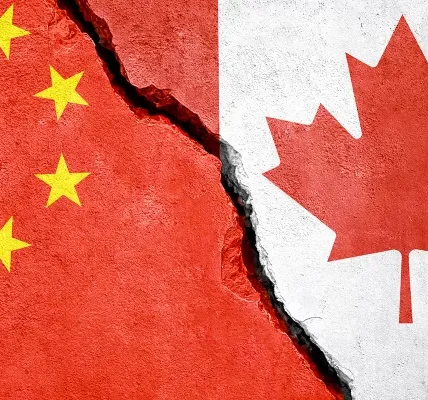







BEIJING: Donald Trump’s visit to Beijing is being staged as a summit between two leaders, but its real message is broader. This is not only a meeting between the American president and Xi Jinping. It is a parade of American corporate power into the heart of China at a moment when the world’s two largest economies are trying to prevent rivalry from hardening into rupture.
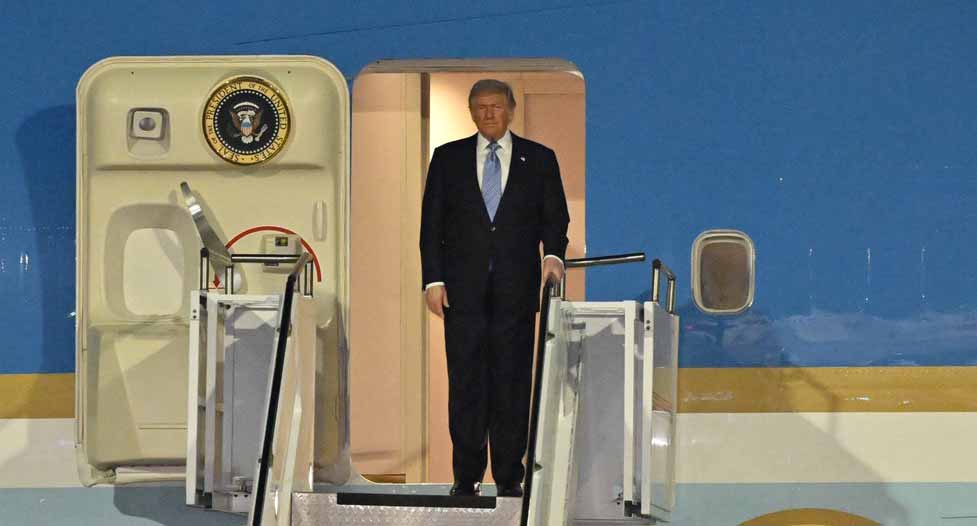
The optics are unmistakable. Trump arrived in Beijing for a two-day summit with Xi, the first visit by a sitting U.S. president to China in almost a decade, amid a fragile trade truce, the continuing fallout of the Iran war, tensions over Taiwan, and the increasingly central question of artificial intelligence. Xi opened the meeting by warning that Taiwan remains the issue most capable of pushing relations onto a dangerous path, while Trump framed the summit as an opportunity to secure economic wins and “open up” China to American business.
The American delegation tells the story. Alongside senior officials including Secretary of State Marco Rubio and Defense Secretary Pete Hegseth, Trump brought a striking business entourage. The list includes Elon Musk of Tesla and SpaceX, Tim Cook of Apple, Jensen Huang of Nvidia, Larry Fink of BlackRock, Stephen Schwarzman of Blackstone, David Solomon of Goldman Sachs, Jane Fraser of Citigroup, Kelly Ortberg of Boeing, Michael Miebach of Mastercard, Ryan McInerney of Visa, H. Lawrence Culp of GE Aerospace, Sanjay Mehrotra of Micron, Cristiano Amon of Qualcomm, Brian Sikes of Cargill, Jacob Thaysen of Illumina, Jim Anderson of Coherent, and Dina Powell McCormick representing Meta. Reuters first reported the wider corporate roster, with Huang later added to the delegation.
This is Trumpian diplomacy in its purest form. The state visit is not being presented primarily as a values summit, a strategic dialogue, or a human-rights confrontation. It is being packaged as a deal-making mission. Boeing wants aircraft sales. Apple wants supply-chain stability and access to Chinese consumers. Nvidia wants room to operate in the world’s most important AI hardware market. Tesla wants protection for its China position. Visa and Mastercard want financial access. BlackRock, Blackstone, Goldman Sachs and Citi want predictability in a market where political risk has become impossible to ignore.
For Beijing, the choreography is equally useful. Xi receives not merely an American president but a cross-section of the American economy. That allows China to project confidence. Despite tariffs, export controls, talk of decoupling, Taiwan tensions, and accusations of unfair industrial policy, the leaders of U.S. capitalism still want access to China. Beijing’s message is simple. America may distrust China, but American business still needs China.
The venue and ceremony matter. Trump was welcomed with military honors, flags, and the full theatre of Chinese state protocol. Chinese officials also chose a higher-level airport reception than in 2017, with Vice President Han Zheng among those greeting him. In Beijing’s diplomatic grammar, rank is never accidental. It signals that China wants the world to see this as a serious reset, or at least as an attempt to stabilize relations after years of tariff war and strategic suspicion.
Yet this is not a return to the old globalization. The summit takes place in a world where trade is now inseparable from security. Semiconductors are not just products. They are strategic assets. AI chips are not simply commercial goods. They are the nervous system of future military, industrial and surveillance power. Boeing aircraft, payment networks, cloud systems, rare earths, shipping lanes and energy corridors all sit inside the same new logic. Economic interdependence has not disappeared, but it has become weaponized.
That is why Jensen Huang’s presence is especially significant. Nvidia sits at the centre of the AI race, and China remains a massive potential market for advanced chips even as Washington worries about the military uses of frontier technology. Huang’s last-minute inclusion sends a message that Trump wants to bargain not only over soybeans, aircraft and tariffs, but over the architecture of the next technological order.
Iran gives the meeting an additional strategic layer. Trump is looking to Xi not only as an economic rival but as a potential stabilizer, or at least a restraining influence, in a wider crisis. The war with Iran and anxieties over the Strait of Hormuz have exposed how quickly regional conflict can become global economic shock. Washington wants Beijing to avoid giving Tehran military or economic lifelines that could complicate American pressure. China, for its part, understands that U.S. distraction in the Middle East gives it leverage in Asia.
Taiwan remains the hardest question. Xi used the summit to underline that mishandling Taiwan could lead relations down a dangerous path. For Washington, Taiwan is not only a democratic partner but also central to the semiconductor ecosystem and the balance of power in the Western Pacific. For Beijing, it is the core sovereignty issue. No amount of CEO diplomacy can erase that structural collision.
The deeper question is whether Trump’s approach can deliver more than spectacle. Bringing CEOs to Beijing creates pressure for deals. It also gives Xi a clear map of American vulnerabilities. The more visibly U.S. companies ask for Chinese market access, the easier it is for Beijing to separate American business interests from American strategic concerns. That is useful for China. It can offer selective commercial concessions while resisting structural demands on subsidies, industrial policy, intellectual property, coercive trade practices and Taiwan.
Still, the visit cannot be dismissed as theatre. In the current climate, theatre is policy. A calm Trump-Xi summit can reassure markets, reduce the risk of accidental escalation, and buy time for both sides. The United States needs China’s cooperation on trade, fentanyl, Iran and financial stability. China needs access to American capital, technology, consumers and diplomatic breathing space as its economy faces internal pressure. Neither side trusts the other. Both sides still need the other.
The Beijing visit therefore marks neither reconciliation nor surrender. It is a transactional pause in a long strategic contest. Trump is trying to show that only he can talk to Xi, extract concessions and bring American business home with victories. Xi is trying to show that China is too powerful to isolate and too central to global commerce to ignore.
The danger is that both men may leave believing they have managed the rivalry when they have merely postponed its next eruption. The CEOs in the room can help produce deals. They cannot resolve the central contradiction of U.S.-China relations. America wants China open enough for business, but constrained enough not to dominate the future. China wants American access, capital and technology, but not American rules.
That is the real negotiation in Beijing. Not simply tariffs. Not simply Taiwan. Not simply AI. It is a struggle over who gets to set the terms of the next global economy.
Views: 21

Matteo Bianchi
Matteo Bianchi is a geopolitical analyst and author. With a distinguished career in information and security in government and the corporate world, Bianchi has lived in 4 continents and worked in several verticals. He is currently retired and writes on geopolitics, AI and cybersecurity.