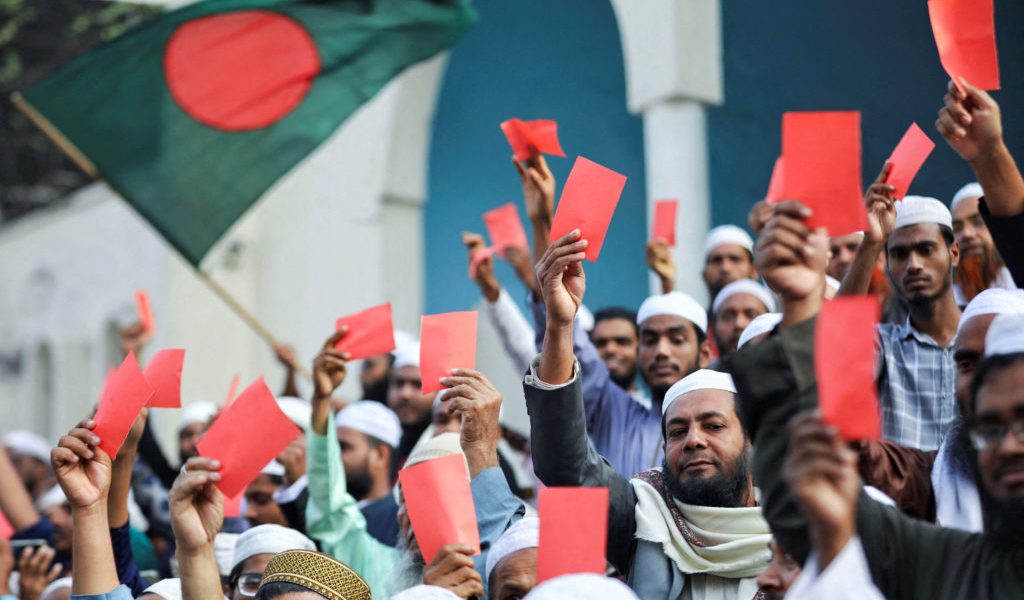







DHAKA: More than a year after Nobel laureate Muhammad Yunus took charge of Bangladesh’s interim administration, public frustration is spilling back onto the streets. What began as isolated gatherings has grown into a broader wave of protests directed at a government that arrived with promises of justice, accountability and reform, but is now struggling with accusations of inertia, impunity and a worsening security situation.
The demonstrations have a striking irony: Yunus and his cabinet of academics and former civil servants came to power on the back of a mass uprising that toppled Sheikh Hasina’s long-running administration in August 2024. Many believed that the fall of Hasina, whose decade and a half in office was marked by widespread allegations of enforced disappearances, extrajudicial killings and systematic abuse by security forces, would usher in a new era. Yunus vowed a “Bangladesh free from fear”. Rights groups cautiously welcomed a fresh start.
But a year on, the records tell a more complicated story.
A Legacy of Violence That Never Fully Ended
Odhikar, one of Bangladesh’s most prominent human rights organisations, recently published data showing that while the scale of killings has dropped sharply since Hasina’s ouster, unlawful deaths have not disappeared. Between August 2024 and September 2025, at least 40 people were killed in incidents involving security forces. Many were shot in alleged “crossfire”, died under torture or were beaten to death in custody. The methods – arrests without warrants, vague police statements, bodies delivered to hospitals without proper explanation – echo the darkest excesses of the previous era.
For families of victims, the return of such incidents has brought disillusionment. The cases paint a disturbing pattern:
• Asif Shikdar, a BNP youth leader in Dhaka, arrested and declared dead hours later.
• Towhidul Islam, detained in Cumilla and found dead with visible torture marks.
• Habibur Rahman, a garment worker in Gazipur, shot by police during a labour protest.
• Nazrul Islam, dead after alleged custodial torture in Bhola.
Despite Yunus’s stated commitment to justice, accountability remains patchy. In some cases, inquiry committees have been formed, and a handful of officers were disciplined. But rights groups argue that these measures fall far short of systemic reform.
“The security forces operating today are the same as those that operated under Hasina,” said Taskin Fahmina, Odhikar’s director of advocacy. “The numbers have come down, but the institutional mindset has not changed.”
A Government With Moral Standing But Limited Power
Public anger is fuelled by a perception that Yunus lacks the political authority to rein in the security establishment. Although many in civil society initially saw him as a moral contrast to Hasina, the reality of managing a state with powerful, entrenched security agencies has proven far more difficult.
The Rapid Action Battalion (RAB), sanctioned by the United States in 2021 for extrajudicial killings, still operates. The Directorate General of Forces Intelligence (DGFI), accused for years of running secret detention sites, remains untouched. The army continues to be deployed across the country, a legacy of the July 2024 uprising, when the civilian police force collapsed and many stations were abandoned.
“The army is not trained for civilian law enforcement,” Fahmina said. “Their long deployment has affected discipline.”
Even the Commission of Inquiry on Enforced Disappearances (COIED), formed by the interim government to investigate atrocities committed under Hasina, struggles with public expectations. It has documented 1,752 cases of enforced disappearances under the previous regime, yet it has no clear mandate to prosecute offenders directly.
Protests Intensify Ahead of Elections
With parliamentary elections set for February 2026, discontent is rising. BNP supporters accuse the interim government of failing to dismantle the machinery of repression that targeted them for years. Awami League supporters, outraged by the trial of Hasina in the International Crimes Tribunal, have also taken to the streets.
Tensions sharpened after the tribunal announced that the verdict in Hasina’s case for crimes against humanity would be delivered on Monday. Her party called for nationwide demonstrations, bringing rival groups face-to-face with security forces in multiple districts.
Earlier clashes in Gopalganj, Hasina’s home district, left five people dead when security forces opened fire – a stark reminder that excessive force continues under the new administration.
Meanwhile, labour unrest, economic uncertainty and anger over rising living costs have brought new groups into the streets, broadening the protest base beyond traditional partisan lines.
A Crisis of Legitimacy
Analysts argue that the core problem is political: Yunus’s government is unelected, untested and lacks a clear mandate to push through major reforms. Without elected accountability, law enforcement agencies operate in a grey zone.
“Without a political authority and legitimacy, the administration often does not take directives seriously,” said senior BNP leader Amir Khasru Mahmud Chowdhury. “They act on their own.”
Yunus announced that a referendum on democratic reforms will be held alongside February’s election, but scepticism remains high.
For many Bangladeshis, the promise of a “new Bangladesh” feels distant. They fear that the cycle of impunity, violence and political instability is repeating itself – only under different leadership.
As protests grow louder and the February election approaches, the country stands at a fragile crossroads. The choices made in the coming months will determine whether Bangladesh marches toward reform and accountability, or whether the ghosts of its past continue to define its future.
Views: 20