






Since India’s education system has undergone significant changes in the recent past to meet the changing needs of students, Indian policymakers have recently introduced the National Educational Policy (NEP), 2020, replacing the 34-year-old policy with a flexible, holistic, and multidisciplinary approach from early childhood to higher education. NEP aims for a 100% Gross Enrolment Ratio (GER) by 2030, which is aligned with Sustainable Development Goal (SDG) 4. Backed by initiatives taken under the Union budget 2025-26, such as AI Centre of Excellence, National Centres of Excellence for Skilling, IIT expansion, medical seat expansion and flagship Programs like Samagra Shiksha Abhiyan, PM SHRI (Pradhan Mantri Schools for Rising India) and PM POSHAN (Pradhan Mantri Poshan Shakti Nirman), are driving improvements in infrastructure, teacher training and learning outcomes.
At least on paper, these reforms reflect that education is one of the top priorities for the government, which is continuously working to strengthen human capital and make education more accessible and inclusive. It is evident from the fact that higher education enrollment increased from 3.42 crore to 4.33 crore, GER reached 28.4% from 23.7%, universities increased to 1213 from 723, IIT colleges expanded from 16 to 63, and MBBS seats, along with postgraduate medical seats, also significantly expanded over time. These achievements demonstrate that India has filled a wider gap which used to persist in the education sector and is on the way to becoming future-ready by expanding education opportunities soon. However, schools and universities cannot earn legitimacy only through new buildings or increasing enrolment alone. Rather, institutional accountability and transparency are what give legitimacy to the above-mentioned data. Students, particularly young generations, believe that these institutions listen, explain their decisions, and treat them fairly by giving an equal chance to compete.
Even with the introduction of all the reforms, initiatives and flagship programs, the grievances of students keep coming in the form of protests. This shows the difference between education policy and governance, where education policy decides what reforms need to be taken, and governance focuses on how these reforms are properly implemented. Therefore, the foundational aspect of Indian education policy is not only to expand enrolment or come up with new reform policies, but also to bring in a proper grievance redressal mechanism, as transparency and accountability reduce uncertainty and build institutional trust.
Democratic Political Reform
Although the government, in response to a massive youth-led protest, has recently passed an anti-paper-leak bill concerning institutional reforms in examination patterns, it still requires holistic changes in the overall democratic set-up of political institutions. As per a report published by Indian Express, while the age to contest elections for MPs and MLAs in India is 25 years, the representation of Gen-Z in politics is restricted to just 26 (6 MPs and 20 MLAs), even though their population constitutes around 26% of India’s population. And this is the catch the government must think about. While the existing Indian political system favours millennials more, the emerging dissatisfaction of youth towards government institutions is a witness to the fact that this system is possibly not in sync with Gen Z populations per se.
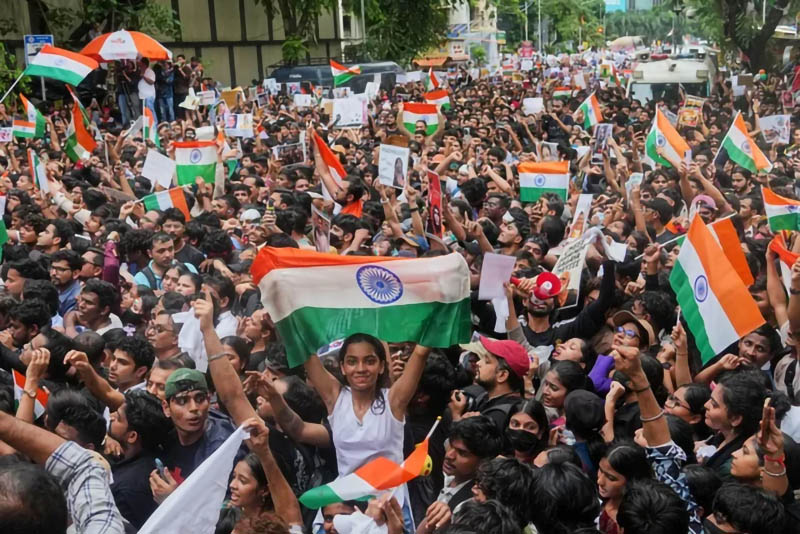
In this context, the recent protest, which was held at Jantar Mantar under the leadership of GenZ-led Cockroach Janta Party (CJP), was neither against nor in favour of any political party or agenda, while their motive was to bring attention to the issues going on in the overall education system in recent years. Mass public outrage led by Indian youths was triggered by the systemic irregularities, followed by the cancellation of the medical exam (NEET), but these issues have already been persisting for a long time in India. The gravity of this movement lies in the fact that the Prime Minister himself took these issues into consideration and started interacting with the students via social media. Although the government has brought significant change at the policy level by passing a bill regarding the examination paper leak, there is no guarantee that similar incidents of paper leaks will not occur in the future, as this requires broader systemic-level reforms aimed at changing the behavioural attitude of citizens.
Although the primary reason for this movement was related to NEET, it had a wider base aimed at questioning the overall accountability of the education system in India. Furthermore, the foundational aspects of this movement pointed towards the lack of credibility of educational institutions and public governance. This movement provided impetus to demand reform in the system and, at the same time, accountability from authority through this nationwide movement. Though this student movement was given a political colour on the grounds that it was backed by several political parties, as critics argue, the wider base of this movement was still the youth aged below 25 years, which is very often termed the Z Generation.
Keeping the nationwide outrage in mind, it would not be wrong to conclude that the government, along with harsher provisional amendment acts, must also consider bringing changes to the democratic institutions, intending to incorporate more Gen-Z lawmakers in the political system. As mentioned above, 26 lawmakers (MPs and MLAs), in comparison to the overall strength of parliaments and state legislatures, are almost negligible. PRS Legislative Research reports that more than 90% of Parliamentarians in India are above 40 years old, while around 52% of lawmakers are above 56 years old. Therefore, the government must look at the representational aspect to address the emerging challenges in the Indian political system. Simply passing and implementing the anti-paper-leak bills with harsher provisions intended to crack down on the mafias is not going to solve the problem from the root. It needs a foundational change to mend the mindset of the young generations and common citizens, focusing on building scientific temperament and civic sense as a priority. Therefore, to deal with the emerging crisis, India needs holistic reform in its overall political architecture.
Views: 94

Sanjay Turi
Sanjay Turi, Doctoral Candidate, Centre for West Asian Studies, School of International Studies, Jawaharlal Nehru University, New Delhi

Ayushi Kumari
Ayushi, an Independent Policy Researcher, St Xavier College Ranchi