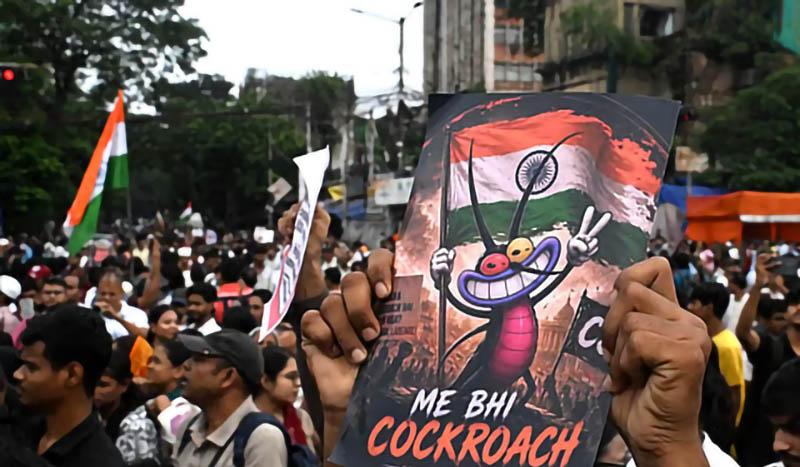







The great American President Abraham Lincoln once stated that democracy is a government of the people, by the people, for the people. The most important feature of democracy is popular sovereignty, which is guided by the principle that the ultimate power in a democratic government always rests with the people. With the resignation of Education Minister Dharendra Pradhan from his portfolio, a month-long, relentless student protest led by Cockroach Janta Party (CJP) has proved it well. It has not only proved that popular sovereignty lies with the people, but also the importance of transparency and accountability in governance. No matter how brutal this student protest has been in the past few weeks, the immense success of this CJP-led movement has made an example, further setting a good precedent for the government to remain committed to the accountability of the institutions held by a Minister, which will further help deal with problems arising from the institutional failures in the government.
Be it JP’s moral revolt in 1974 against authoritarianism or Anna Hazare’s movement against corruption in 2011, they were still peaceful movements per se. Unlike JP and Anna Hazare’s movements, the CJP’s Gen Z movement was quite different and relatively more violent. It may be because the existing political systems in India are possibly not designed for the new generation called Gen Z, but for millennials. Although JP and Hazare’s movements were more intense and oriented toward institutional reform than CJP’s, they still abided by the rule of law and did not dare to cross the limits imposed by the constitution.
However, CJP-led students marching toward the Parliament building reflects how irresponsibly the government acted on their demands for accountability; Although the government’s irresponsible behaviour towards students’ legitimate demands resulted in the resignation of the Union education minister, their violent march to the Parliament building is not at all justified from a democratic point of view.
No matter how bad democracy is, the concerns of the people are still well represented in a representative democracy only, compared to other forms of government. Considering the size and population of India, there is no other system of government that can ever be more fruitful for India. In this system of governance (representative democracy), people generally elect Members of Parliament (MPs) in their constituencies who represent their voices in parliament. People are not directly involved in policy-making, as it is not possible in a representative democracy. There is no doubt that direct democracy is relatively better than representative democracy; however, it is not suitable in a country like India, which is sub-continental in size. Therefore, unlike smaller countries exercising direct democracy, political issues in India should not and cannot be settled on the street.
The idea of parliamentary democracy or representative democracy is designed in such a way that social and political disputes are resolved through respective channels or decentralised institutions. In a parliamentary form of representative democracy, it would not be wrong to argue that no matter how grave a problem is, people cannot simply visit parliament to directly raise their concern in front of the lawmakers. This may be possible in anarchy, but India, without any doubt, is a democracy. In fact, India is the largest and one of the most successful democracies in the world. Democracy has sustained in India mainly because of its strong democratic parliamentary set-up.
Winston Churchill, former British Prime Minister, once said: Democracy is the worst form of government except for all those other forms that have been tried from time to time. The democratic form of government that we practice today has taken hundreds of years to ultimately reach here. This journey to becoming a democracy is so fragile that it has witnessed significant human exploitation in the past.
However, in the modern Indian context, hundreds of years of struggle of Indian freedom fighters against British colonialism gradually culminated in the democracy that we practice today. Additionally, the Ambedkar-led draft constitution that we adopted on 26th November 1949 today provides us with all kinds of rights and duties through which the Indian governance system is actually run. In addition to popular sovereignty, one of the most important features of Indian democracy is accountability, which eventually became the foundational principle of the CJP’s student movement at the heart of Delhi, Jantar Mantar.
From a governance point of view, transparency and accountability are very much needed for the smooth functioning of democratic institutions. In a representative democracy, popular sovereignty is generally tested through the accountability of the democratic institutions. Without accountability, democratic institutions set up to serve the purpose of popular sovereignty do not make sense in reality. However, when it is not exercised with sensitivity, it becomes a threat to democracy. It is more like a double-edged sword, which has the potential to weaken the stability of the government when used as a political weapon.
In the context of CJP’s demand for the resignation of the education minister, it is very much justified as long as it asks for transparency and accountability of the said position held by a person elected through popular sovereignty. However, in the name of accountability, thousands of students violently marching to parliament is not justified at all. Had Gandhi been alive today and headed the CJP movement, he would have never allowed the students to march to parliament at any cost. In this context, an African proverb says that no matter how hungry you are, you do not use both hands to eat food. Even Gandhiji believed that the end should never justify the means. People defending the students’ march to parliament and criticising police lathi charges against this march are those who must be aware of the outcomes of similar incidents in Nepal, Bangladesh, and Sri Lanka in the recent past.
India has a representative democracy. Political disputes of popular sovereignty in India must be resolved through concerned authorities or democratic institutions. If political disputes are settled on the street, then what is the need for parliamentary institutions set to function in a representative democracy? Although accountability is the best way to put pressure on office-bearers or institutions, it must not be used as a political tool. Otherwise, it not only slows down the governance system, but also undermines the ethos of the very idea of representative democracy. Given that India is the fastest-growing economy in the world and rapidly moving toward achieving the goals of Vision 2047, it cannot afford to have instability in the government.
Views: 122

Bhimmaya Tamang
Bhimmaya Tamang, Independent Researcher, Sikkim Manipal University, Sikkim

Sanjay Turi
Sanjay Turi, Doctoral Candidate, Centre for West Asian Studies, School of International Studies, Jawaharlal Nehru University, New Delhi