






“Let those who have weapons lay them down.” That was the sharpest line in Pope Leo XIV’s Easter message today, and it landed with unusual force. Easter is often treated as a feast of reassurance, a moment of candles, bells and family ritual. But the Pope used it differently. He turned the Church’s holiest celebration into a warning against moral numbness in an age of war, social fracture and growing indifference.
That is what gives Easter its enduring seriousness. At the heart of the feast is not comfort but reversal. The story moves through betrayal, suffering and death before it arrives at renewal. It is, in that sense, the opposite of sentimental optimism. It does not deny darkness. It insists that darkness is not sovereign. In troubled times, that idea carries public weight as much as private meaning. People do not need slogans about hope. They need a reason to believe that cruelty, exhaustion and fear are not the final terms of history.
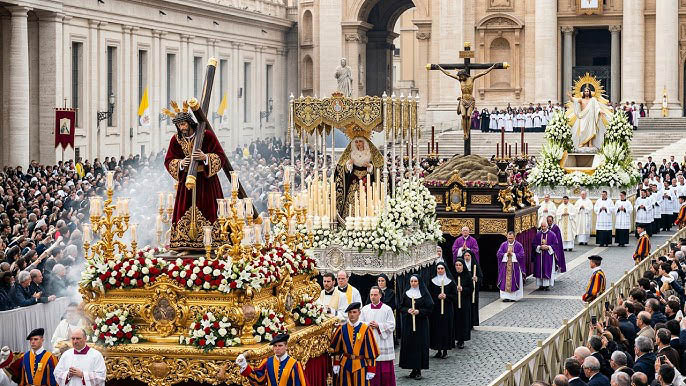
Across the world, that conviction is expressed in very different forms. In Rome, Easter unfolds in the ceremonial vastness of St Peter’s Square. In Spain, especially in cities such as Seville, Holy Week fills the streets with processions that combine grief, discipline and public spectacle. In Greece, the feast remains the emotional center of the religious calendar, moving from mourning to the sudden blaze of midnight celebration. The settings differ, the customs differ, even the calendars sometimes differ, yet the underlying instinct is recognizably the same. Easter speaks to communities because it gives shape to a universal human need, the refusal to accept that loss, violence and failure are the end of the story.
The Pope’s message today mattered because it did not leave that truth floating in abstraction. He connected it to the condition of the world as it is. His Easter appeal was not simply devotional. It was moral and political. The Resurrection, in his framing, cannot be separated from the wounded realities of injustice, war and the abandonment of the vulnerable. To celebrate Easter while growing accustomed to destruction is to miss the point entirely.
That is also why Easter remains relevant far beyond the devout. Even in increasingly secular societies, it retains symbolic force because it addresses something permanent in human affairs. Civilizations survive not only by wealth or power, but by whether they can still imagine recovery after catastrophe, mercy after brutality, and renewal after failure. A culture that stops believing in those things does not become realistic. It becomes exhausted. The Pope’s words today were, at bottom, a protest against that exhaustion.
In that sense, Easter is not an escape from reality but a challenge to it. It asks whether people and nations will accept a world organized around force, resentment and despair, or whether they still possess the moral imagination to choose something better. That is why the feast continues to resonate in hard times. Its message is not that suffering is unreal. It is that suffering need not have the last word. And in a world that has begun to adapt itself too easily to conflict, that is not a gentle claim. It is a radical one.
Views: 12