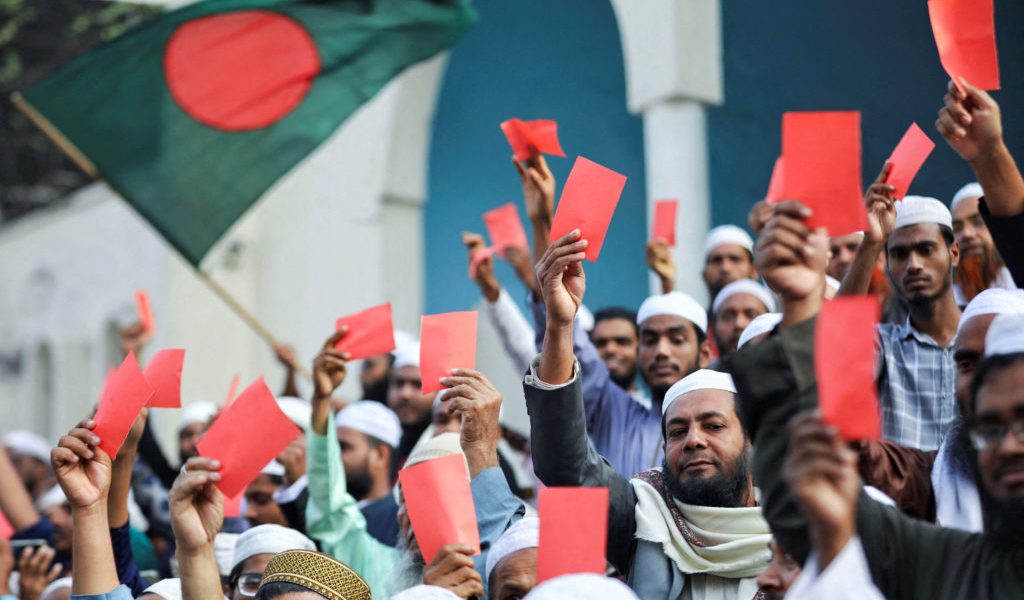







DHAKA: On August 5, 2025, the Nobel Prize-winning interim head of Bangladesh’s transitional government announced in a televised address that the upcoming parliamentary elections would be held in February 2026, before the start of Ramadan, with the aim of sending a letter to the Election Commission to organize the electoral process in a timely manner.
On August 10, 2025, the chairman of the Election Commission (CEC), Nasim Uddin, announced that the elections would be held in the first week of February 2026, adding that the exact date would be revealed about two months before the elections. The upcoming general elections will be the first since the dramatic fall of long-time Prime Minister Sheikh Hasina in August 2024, following a student-led uprising that many call the country’s “second liberation.” The current situation in Bangladesh is quite reminiscent of the situation in Pakistan between 2007 and 2013, when there was also a transitional military government whose legitimacy was disputed, as political parties were banned from participating in elections and restrictions on the media.
Mohammed Yunus took office in August 2024, following mass protests against Hasina’s 15-year rule, a regime accused by its critics of authoritarianism, corruption, and suppression of dissent. Of course, instead of falling into the simplistic logic of “black and white,” it is good to see what positives the people of Bangladesh gained from Sheikh Hasina’s 15 years in power. Bangladesh has recorded some of the highest growth rates in Asia (often 6–8% per year). Per capita income more than doubled between 2009 and 2022 as the garment industry grew into a global manufacturing hub, creating millions of jobs. The poverty rate fell significantly, and extreme poverty was reduced from ~25% to below 10% in about a decade. In addition, investments were made in the form of social benefits, mainly for rural and poor families. The Sheikh Hasina government proceeded with the construction of major projects such as the Padma Bridge and the modernization of the road network with new railway lines. Furthermore, the country achieved almost universal electricity coverage.
However, despite these positive steps, Sheikh Hasina’s government has been strongly criticized for restricting press freedom, suppressing the opposition, and raising doubts about the transparency of elections. The question now is how much clearer Yunus’ government is than the previous one in this area.
More than 640 journalists have been targeted and subjected to violent attacks and imprisonment. Even media outlets such as The Daily Star and Prothom Alo have been attacked and intimidated. In addition, the following contradictory situation has arisen. While the Yunus government accuses Sheikh Hasina of holding unclear elections, it is now illegally prohibiting the Awami League party from participating in these elections. Analyst Rezaul Karim Rony points out that the transitional government has lost the sense of unity among the various political groups, which are giving rise to contradictions and different interests. More than 420,000 people have been arrested during crackdowns dubbed “Operation Devil Hunt.”
My personal opinion on the elections in Bangladesh has been influenced by the intense wave of Islamophilia that is currently sweeping across Europe. Hordes of Islamist immigrants are flooding into the old continent, flying the flag of adherence to and propagation of the Koran, tolerated by the religious freedoms of progressive Europe. are the guests who ultimately put European states in a difficult position. Islam seems to have been reignited worldwide and has opened fire on religions that promote freedom of thought, such as Christianity and Hinduism. Therefore, referring to the situation in Bangladesh, the most dangerous issue facing the Yunus government at the moment is the rise to prominence of these extremist Islamic groups who want to return the country to the Middle Ages, from which it has worked so hard to emerge.
The Yunus government officially lifted the ban imposed on Jamaat-e-Islami by the Sheikh Hasina government with an official decree on August 28, 2024. Furthermore, in May–June 2025, the Supreme Court legally restored the party’s right to register, paving the way for its participation in elections. The reappearance of Jamaat-e-Islami, combined with the release of Islamist leaders from prison and the easing of restrictions on other groups, has been interpreted as a sign of a more “pro-Islamist” political trend on the part of the Yunus government. In October 2024, a delegation from Jamaat-e-Islami, led by Ameer Shafiqur Rahman, held talks with Chief Adviser Yunus . Furthermore, in May 2025, the party drafted a written endorsement for the holding of elections under the Yunus government, arguing that reforms were needed before the electoral process could be granted. Finally, Jamaat-e-Islami Secretary General Mia Golam Parwar warned Yunus that if the elections were not conducted fairly, a “serious national crisis” would ensue. With this party in the spotlight, there has been an increase in attacks on religious minorities, especially Hindus, as well as vandalism of sculptures and religious symbols, mainly during religious festivals such as Durga Puja.
In addition, the risk posed by another political factor that has emerged in Bangladesh’s turbulent political scene must be considered, as it will certainly play a crucial, if not dangerous, role in the upcoming elections, particularly for the NCP party. Many of the founding leaders of the NCP, National Citizen Party (e.g., Nahid Islam, Asif Mahmud) come from the “Students Against Discrimination” network, which organized mass demonstrations against Sheikh Hasina in September 2024. The NCP explicitly calls for the drafting of a new constitution through a Constituent Assembly. Their idea of a “Second Republic” envisages the abolition of entrenched dynastic politics, nepotism, and corruption. The party is wary of a return to authoritarianism or models of temporary governance supported by the military. Its manifesto emphasizes the independence of the judiciary, decentralization, the protection of minorities, and transparency in public institutions in order to protect the reforms that emerged from the 2024 uprising. Recent polls show him trailing established parties such as the BNP and Jamaat. Furthermore, his categorical refusal to participate in elections under the current Election Commission may limit his ability to translate the revolutionary movement into parliamentary influence in the short term.
As Bangladesh approaches its 2026 general election, it finds itself at a critical crossroads. The promise of democratic renewal is tempered by concerns about political exclusion, institutional reforms, and the legacy of previous regimes. For the elections to be truly free, fair, and inclusive, it is vital that all political parties, including the banned Awami League, be allowed to participate. The political system must be transparent, and reforms must be implemented to ensure that the electoral process remains impartial. If these conditions are met, the upcoming elections in Bangladesh could be a real test for the country’s democracy. However, if the necessary reforms are ignored and exclusion continues, the elections may become yet another chapter in the history of divisive and anti-democratic practices.
Views: 62

Dimitra Staikou
Dimitra Staikou is a Greek lawyer, human rights advocate . She works as a journalist writing about human right's violations in South Asia and ctravels to India to get informed about the political situation there and the geopolitcs between India,China ,Pakistan and Bangladesh. She works for Greece's biggest newspaper Skai.gr and Huffpost.Gr as well as international distinguised news sites as Modern Diplomacy and Global Research.