


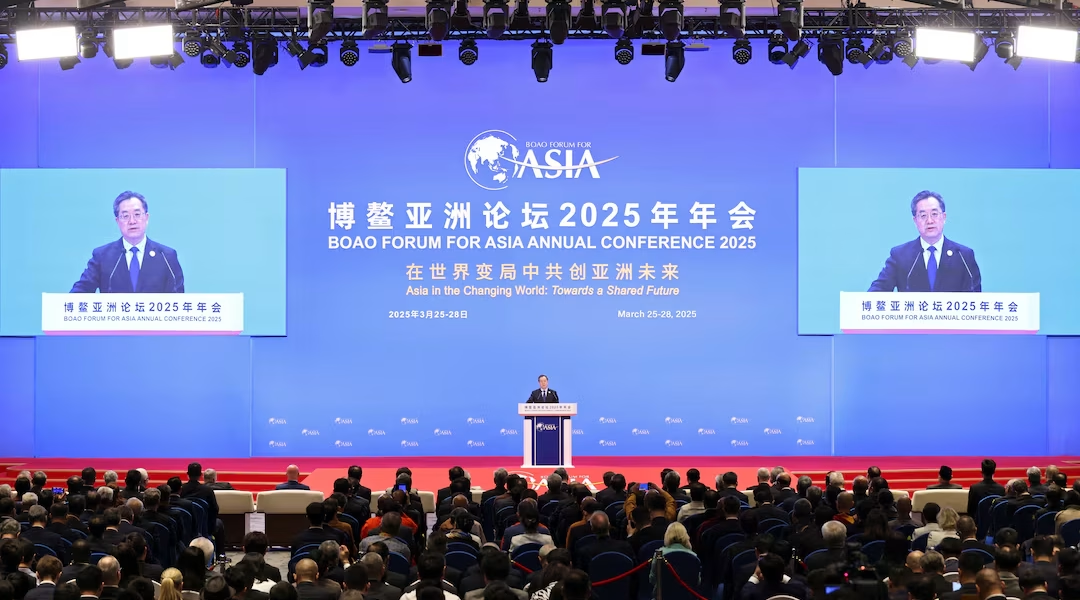







BEIJING/BOAO: China recently hosted two significant forums aimed at bolstering international cooperation and addressing pressing global challenges: the China Development Forum (CDF) 2025 and the Boao Forum for Asia Annual Conference 2025.
China Development Forum 2025
Held in Beijing from March 23 to 24, the CDF 2025 convened over 80 CEOs from leading multinational corporations, including Apple, Citadel, and Qualcomm. Themed “Unleashing Development Momentum for Stable Growth of Global Economy,” the forum served as a platform for dialogue between Chinese policymakers and global business leaders. Premier Li Qiang delivered the keynote speech, emphasizing China’s commitment to opening its markets and fostering a business-friendly environment despite global economic uncertainties. He highlighted the importance of cooperation over confrontation, particularly amid escalating trade tensions with the United States. Li assured foreign enterprises of equal treatment and welcomed their continued investment in China.
Boao Forum for Asia Annual Conference 2025
Following the CDF, the Boao Forum for Asia took place in Hainan Province from March 25 to 28, under the theme “Shaping Asia’s Future in a Changing World.” The conference attracted political leaders, business executives, and academics from across Asia and beyond. Discussions centered on enhancing regional cooperation, addressing economic fragmentation, and promoting sustainable development. Vice-Premier Ding Xuexiang underscored China’s intention to strengthen ties with countries in the Global South to reduce reliance on Western economies. He announced initiatives to stabilize foreign trade and investment while opposing protectionist measures. The forum also featured lively debates on technological collaboration, including artificial intelligence and digital capacity-building, reflecting China’s focus on innovation as a driver of economic growth.
The Boao Forum for Asia (BFA) Annual Conference 2025, held in Boao, Hainan Province, China, brought together a distinguished assembly of global leaders and dignitaries. Among the attendees were Kassym-Jomart Tokayev, President of Kazakhstan, David Adeang, President of Nauru, Dinesh Gunawardena, Prime Minister of Sri Lanka, Roosevelt Skerrit, Prime Minister of Dominica, Samdech Techo Hun Sen, President of the Supreme Privy Council to His Majesty the King of Cambodia, Daren Tang, Director-General of the World Intellectual Property Organization, and Mathias Cormann, Secretary-General of the Organization for Economic Co-operation and Development.
Bangladesh was represented by Chief Adviser Professor Muhammad Yunus, who played a significant role in discussions on regional cooperation and economic development. In his address during the opening plenary session, Yunus highlighted Bangladesh’s continued efforts in hosting over 1.2 million Rohingya refugees for more than seven years. He called upon Asian leaders to work together to ensure the safe and dignified repatriation of the displaced Rohingyas to Myanmar. He also emphasized the importance of investing in human capital, particularly by providing the youth with access to financial resources for entrepreneurship and sustainable solutions. He stressed that such investments are crucial for harnessing Asia’s demographic dividend and driving innovation and productivity across the region.
The forum took place against the backdrop of significant geopolitical and economic shifts, with world leaders discussing pressing issues such as economic stability, technological advancement, and climate change. China used the platform to reaffirm its commitment to strengthening regional ties and promoting economic integration across Asia. The discussions underscored the importance of cooperation in navigating global uncertainties, particularly in a post-pandemic world marked by trade tensions and economic recovery challenges.
Security and stability in Asia were also key points of discussion, especially as the region grapples with shifting alliances and changing diplomatic priorities. The presence of influential leaders from various parts of the world underscored the significance of Asia’s role in shaping the global order. Bangladesh, with its rapidly growing economy and strategic geopolitical position, stood out as a crucial player in the conversations. Muhammad Yunus’ participation highlighted the country’s proactive approach to addressing humanitarian issues and its broader vision for sustainable development.
The BFA Annual Conference 2025 served as a platform for fostering dialogue on issues that will shape the future of Asia. It reinforced the need for collaborative efforts in economic growth, social development, and geopolitical stability. The presence of key global figures, including Bangladesh’s Chief Adviser, reflected the region’s commitment to creating an inclusive and prosperous future through strategic partnerships and policy coordination.
These forums highlight China’s proactive approach to engaging with the international community, promoting multilateralism, and addressing global economic challenges through dialogue and cooperation.
Views: 13


