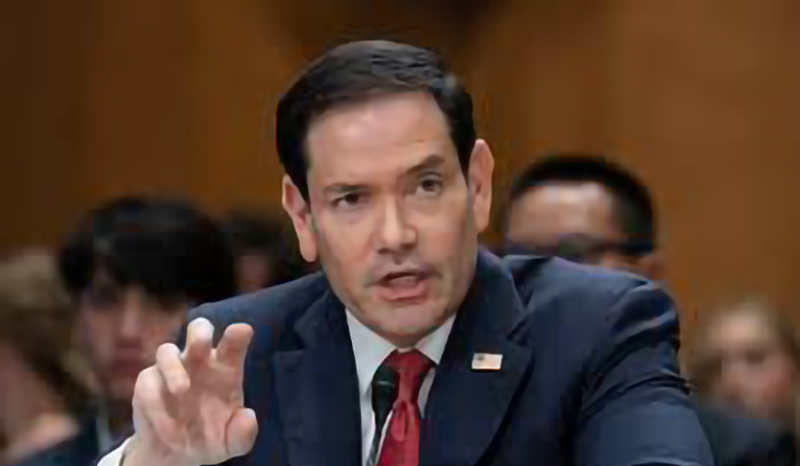







The June 2nd Congressional hearing before the House Appropriations Subcommittee on National Security, Department of State, and Related Programs was formally a budget session, but in substance it was a public sketch of how Secretary of State Marco Rubio intends to organize American power in the months ahead. The hearing was scheduled with Secretary Rubio as the sole witness, and it came against the backdrop of intense congressional scrutiny of U.S. foreign policy after the onset of the Iran war. Secretary Rubio was, in fact, appearing in back-to-back Capitol Hill hearings that day, under questions about Iran, Taiwan, and the broader direction of American diplomacy.
For international observers, Congressman Mario Díaz-Balart’s opening remarks were as important as the witness testimony itself. As chairman of the NSRP subcommittee, he set out a doctrine of restrained spending and intensified strategic selectivity, as the bill, he said, would reduce spending by $2.7 billion from enacted levels, while still increasing embassy security, Foreign Military Financing, and counter-narcotics and law-enforcement support. He framed this as an exercise in “peace through strength” and insisted that the real question was not merely how much is spent, but how it is spent. He also made clear that the bill would keep U.S. assistance tied to political and strategic conditions, including voting behavior at the United Nations, cooperation on migration, opposition to foreign adversaries, and burden-sharing among allies. And that point matters especially for an international audience.
Secretary Rubio’s recent public comments suggest that Washington is not abandoning NATO or the transatlantic relationship, but it is redefining the terms of engagement. On June 2nd it was reported that Secretary Rubio said there had been no change in U.S. policy on Taiwan and that Washington wants the status quo preserved. The next day, he confirmed that President Trump will attend the NATO summit in Turkey, while warning that the alliance must still be “good for all involved” and that the July meeting may be one of the most important in NATO’s history because key issues need to be “cleared up and fixed.” Earlier in May, Rubio had already said NATO has to be good for all members, and in 2025 he told allies the United States remained committed to NATO but expected them to spend much more on defence. The clear inference is that Europe should expect continuity in formal alliance structures, but far less patience for passivity, ambiguity, or dependence.
That same logic carried into the Iran discussion, as it was also reported that Secretary Rubio said any sanctions relief for Tehran would be tied to nuclear concessions, not simply to opening shipping lanes or de-escalating tension. It was likewise noted that Secretary Rubio faced extensive questioning about fragile diplomatic efforts around the world, in his first public congressional appearance since the Iran war began. The message to allies and adversaries alike is not that diplomacy has disappeared, but that it is being placed inside a much harder strategic frame, with coercion first, negotiation second, and concessions only where they produce measurable security gains.
Chairman Díaz-Balart’s own remarks made the hemispheric priorities equally plain. He stressed that the United States had “reprioritized the Western Hemisphere and put the Americas first,” praised stronger focus on Cuba, Venezuela, and Nicaragua, and said Europe should stand for democracy in the Western Hemisphere as well. He also linked regional policy to competition with China, access to critical minerals, and the nearshoring of vulnerable supply chains. In his telling, the Western Hemisphere is no longer a peripheral theatre; it is a central arena for American security, commercial leverage, and ideological contestation. That is a significant shift, and it will be watched closely in Latin America as well as in Europe, where policymakers increasingly depend on U.S. bandwidth for Ukraine, NATO, trade, and sanctions coordination.
Perhaps the most telling detail of all is institutional rather than rhetorical, as it was reported on June 4th that the White House’s Europe chief at the National Security Council is departing amid a broader personnel shake-up that may consolidate Rubio’s control over NSC policymaking, with Secretary Rubio’s allies moving into key positions. For those trying to understand where foreign policy power is actually being accumulated inside the Trump administration, this is highly instructive, as Secretary Rubio is not merely the face of diplomacy, but increasingly a central manager of the national security apparatus itself.
So what should we expect in the coming months? A more disciplined but more conditional American foreign policy, with stronger emphasis on allies pulling their weight, continued hard lines on Iran and China, greater attention to the Western Hemisphere, and a Congress, at least in Congressman Díaz-Balart’s corner, willing to fund security functions while tightening the purse strings elsewhere. For Europe, the takeaway is not alarmism but realism. The United States under Rubio does not look isolationist so much as hierarchical, as it will engage with anyone willing to come to the table, but on terms that privilege strategic utility, allied burden-sharing, and visible returns. Congressman Díaz-Balart’s hearing showed the congressional wing of that project with unusual clarity, and Secretary Rubio’s testimony appears to confirm that the executive branch is moving in the same direction. That is not a retreat from American leadership, but rather, appears to be a redefinition of it.
Views: 4780