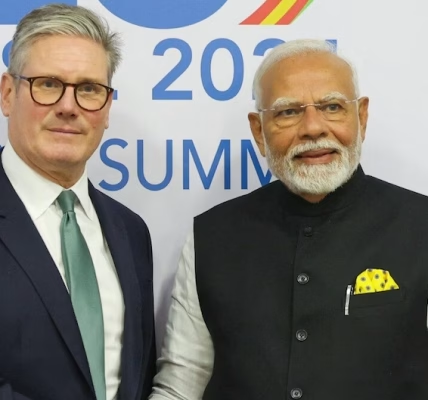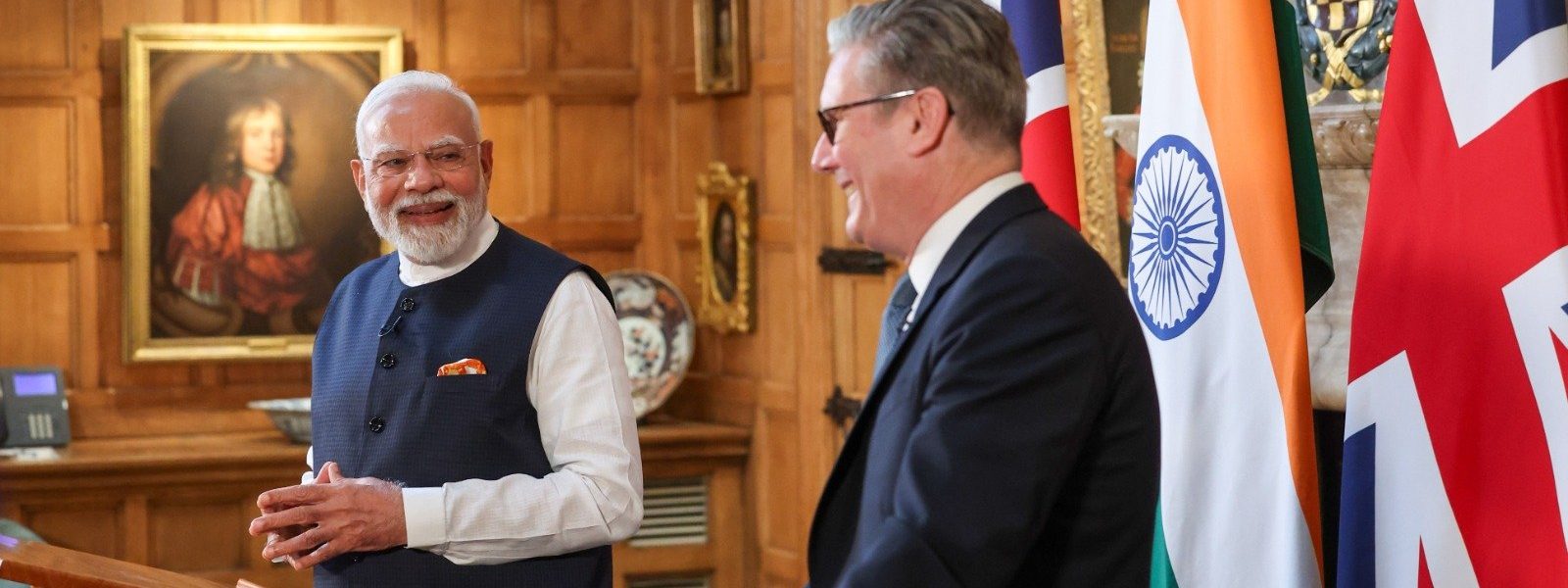







LONDON: The signing of the India–UK Free Trade Agreement (FTA) on July 24, 2025, marks a transformative moment in the trajectory of bilateral economic diplomacy. More than just a trade accord, the FTA signals a structural evolution in India’s international economic engagement and the United Kingdom’s quest for renewed global relevance in the post-Brexit era. The agreement reflects an intricate interplay of domestic imperatives, geopolitical realignments, and a shared aspiration to architect a new grammar of bilateralism rooted in sovereignty, symmetry, and strategic depth.
Negotiated over 14 rounds since January 2022 and finalized in May 2025, the India–UK FTA is India’s most comprehensive trade pact with a Western power to date. It promises to unlock over $34 billion in bilateral trade annually, drastically reduce tariffs, liberalize services, and facilitate skilled mobility across sectors. Nearly 99% of Indian exports to the UK—including textiles, rice, leather, and jewellery—will enjoy zero-duty access, a significant gain for India’s labour-intensive MSME sector. In return, UK exporters, particularly in whisky, automobiles, legal services, and education, will benefit from greater market penetration into one of the world’s fastest-growing economies.
What distinguishes this agreement is not merely its scale, but its philosophy. The FTA embodies a strategic bilateralism—a recalibrated economic alignment free from asymmetrical conditionalities often associated with older multilateral trade arrangements. Prime Minister Narendra Modi, in his statement following the signing, hailed the pact as “a win-win framework that elevates the India–UK relationship into a partnership of equitable prosperity.” UK Prime Minister Rishi Sunak described it as “an economic handshake across continents, deeply anchored in democratic values and mutual growth.”
This rhetoric is not empty diplomacy. The agreement is emblematic of India’s evolving trade doctrine—what scholars of political economy might term developmental bilateralism. India’s recent FTAs, including with the UAE, Australia, and now the UK, have sought not only tariff elimination but also technology transfer, value-chain integration, and skilled human capital mobility. The inclusion of mutual recognition of qualifications, a framework for digital trade, and a streamlined business visa regime in the India–UK FTA reflects this integrated approach.
On the UK side, the FTA aligns with Britain’s post-Brexit Global Britain vision. Having exited the EU’s common market, the UK has been aggressively seeking new trade partners to revitalize its export base. India—poised to become the third-largest economy by 2027—offers a market of unmatched demographic and economic scale. As UK Secretary of State for Business and Trade Kemi Badenoch noted, “This deal gives British businesses an edge in the Indo-Pacific century.”
But beyond numbers and negotiated chapters, the FTA must be viewed within the larger geopolitical rebalancing underway. In a world increasingly fragmented by protectionism, sanctions, and supply chain nationalism, the India–UK FTA sends a normative signal: that democratic market economies can cooperate on sovereign terms without succumbing to exploitative dependencies. India’s refusal to compromise on its agricultural protections or pharmaceutical pricing autonomy—both major sticking points—underscores New Delhi’s commitment to strategic autonomy within global interdependence.
This new bilateralism also challenges the traditional Western narrative of India as merely a market to be accessed. India, under Modi’s leadership, has repositioned itself as a co-architect of global economic norms, not just a rule-taker. The FTA reflects India’s rise as a rule-maker—a state that negotiates from a position of parity, not passive acquiescence.
Of particular note is the mobility and services chapter, long considered a thorn in India’s trade negotiations with the West. For the first time, the UK has agreed to a flexible visa framework for Indian professionals, including young entrepreneurs, tech specialists, and students, aligning with India’s strength in human capital exports. At a time when demographic anxieties afflict much of Europe, the UK’s openness to skilled Indian migration is both a political risk and an economic necessity—a testament to India’s bargaining leverage.
Critics may argue that the FTA is late and limited, especially given that India and the UK have failed to reach earlier trade milestones. Yet this very delay is revealing. Unlike the haste that marked earlier liberalization efforts, this agreement has been deliberate, consultative, and tailored, avoiding cookie-cutter models. The result is a custom-designed pact, resilient to populist pushback and electoral cycles.
Still, some contentious issues remain. Environmental clauses, digital taxation, and regulatory divergence in standards could pose implementation challenges. Yet, the Institutional Mechanism for Dispute Resolution and Review Committees embedded within the agreement offer agile pathways to manage future frictions.
At the societal level, the FTA will likely catalyse deeper people-to-people linkages. The Indian diaspora in the UK—numbering over 1.8 million—is already a robust economic and cultural bridge. With this agreement, cross-border education, dual-degree programs, and startup collaborations are expected to intensify. The impact of this agreement, therefore, transcends tariffs—it is about trust, talent, and a shared future.
From a political economy perspective, the India–UK FTA also has demonstration effects. As other countries observe India’s capacity to strike mutually beneficial deals with the West on its own terms, New Delhi’s reputation as a credible, constructive, and confident economic actor is solidified. For the UK, the agreement helps offset the narrative of post-Brexit economic decline and affirms its relevance in the Indo-Pacific calculus.
This agreement is also India’s subtle rejoinder to China’s growing influence in global trade corridors. By strengthening ties with London, India reinforces its role as a counterweight to authoritarian mercantilism and reaffirms its commitment to rules-based economic order—not by preaching it, but by practicing it.
In conclusion, the India–UK FTA is more than a transactional pact—it is an architectural blueprint of what the future of equitable globalization can look like. It reflects a mature bilateralism wherein economic growth aligns with national interest, sovereignty coexists with cooperation, and strategic partnerships replace dependency-based trade alignments. For the United Kingdom, it marks a vital post-Brexit repositioning into high-growth economies beyond Europe, while for India, it stands as a landmark in economic statecraft and a definitive moment in the evolution of post-colonial economic diplomacy.
Views: 211

Divya Rani
Dr. Divya Rani holds a PhD from the Centre for European Studies, School of International Studies, Jawaharlal Nehru University (JNU), New Delhi. She serves as an Assistant Professor in the Department of Political Science at Banaras Hindu University (BHU), Varanasi. She contributes regularly on relevant issues shaping national and global affairs.