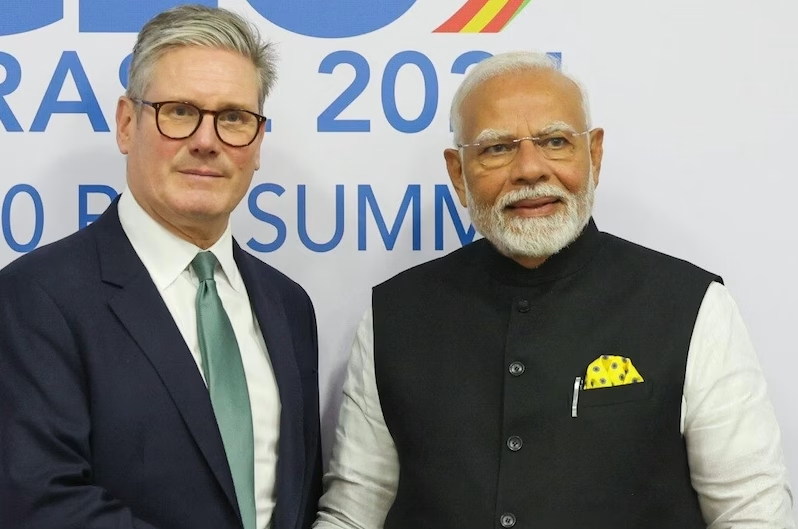







NEW DELHI: Prime Minister Narendra Modi’s scheduled visit (23-34 July) to the United Kingdom, marks a pivotal juncture in the arc of India–UK relations. The centrepiece of the visit—the anticipated signing of the long-negotiated India–UK Free Trade Agreement (FTA)—is emblematic of a broader diplomatic and economic reorientation in a world increasingly defined by multipolarity and interdependence.
If successfully concluded, the FTA will eliminate tariffs on up to 99 percent of Indian exports, opening significant avenues in textiles, pharmaceuticals, IT services, and automobiles. This trade pact is expected to generate an incremental bilateral trade boost of £25.5 billion annually by 2040, a figure that reflects not just economic optimism but the deep strategic intent driving both capitals.
This is not merely a transactional agreement. It is an articulation of mutual confidence and shared vision. At a time when globalisation is undergoing recalibration—buffeted by protectionism, fractured supply chains, and geoeconomic rivalry—India and the UK are choosing strategic convergence over uncertainty.
A Post-Brexit Imperative Meets an Aspiring Global South Leader
The United Kingdom, in the post-Brexit era, finds itself in urgent need of redefining its external trade and diplomatic architecture. For London, India offers more than a vast market—it represents a rising power whose demographic, digital, and development credentials position it as a key node in the emerging global order. In turn, India views the UK not merely as a historic partner, but as a strategic bridge to the transatlantic economies, a hub of technological innovation, and a willing collaborator in multilateral forums.
What makes this FTA particularly significant is India’s deft handling of the negotiations. Contrary to earlier FTAs where India was seen as a defensive actor, the current agreement reflects assertive negotiation—securing favourable terms while protecting domestic interests in agriculture, dairy, data sovereignty, and pharmaceutical pricing. It represents a more mature and confident trade policy aligned with national priorities.
Moreover, the FTA fits neatly into India’s broader strategy of economic diversification, reducing overdependence on any single bloc or geography. While New Delhi continues to strengthen its ties with the United States and the European Union, it is also building new pathways with the Global South and the Commonwealth economies, making the UK deal both symbolic and systemic.
Strategic Trust Anchored in Values
The timing of Modi’s visit carries symbolic and substantive weight. With India firmly positioned as the voice of the Global South, and the UK seeking to revive its relevance as a democratic and economic power post-Brexit, the convergence has moved beyond rhetoric. Both nations are democracies with vibrant institutions, a strong legal framework, and a growing diaspora that links them in dynamic and multifaceted ways.
This trust is also reflected in the evolving security dialogue. From maritime cooperation in the Indo-Pacific to counterterrorism, cyber resilience, and clean energy transition, India and the UK have expanded their agenda beyond trade. The Comprehensive Strategic Partnership signed in 2021 laid the groundwork; the FTA now becomes its most visible milestone.
Additionally, the Indian diaspora—over 1.7 million strong in the UK—is increasingly becoming a bridge of innovation, enterprise, and soft power. The contribution of Indian professionals to Britain’s NHS, academia, technology sector, and business landscape continues to redefine the bilateral compact.
Balancing Global Tensions and Economic Realities
Yet, this economic optimism is not without challenges. Washington’s concerns about digital services taxation and potential trade diversion, especially in a shifting US political landscape, have made India’s balancing act more delicate. Reports of proposed 26% retaliatory tariffs by the US if the UK-India deal re-routes American exports to British shores are indicative of the geo-economic tightrope India must navigate.
However, this deal must also be understood as a larger signal to the world: India is not a passive participant in the global trade order. It is a rule-shaper, not just a rule-taker. The FTA demonstrates India’s ability to strike equitable agreements with major powers without compromising on sovereignty or economic autonomy.
At a time when many developing nations are grappling with asymmetrical trade regimes and conditionalities, India’s calibrated yet confident approach provides a model of negotiated dignity. It is a rare instance where national interest, economic ambition, and international cooperation converge meaningfully.
The Road Ahead: Beyond the FTA
As Prime Minister Modi engages with British counterparts, business leaders, and diaspora groups during this visit, the message is clear: the India–UK relationship is no longer confined to legacy narratives. It is forward-looking, dynamic, and rooted in mutual respect.
The FTA is not the culmination but the beginning of a new chapter. Future collaboration must now focus on joint innovation ecosystems, climate finance, defence manufacturing, academic mobility, and AI regulation frameworks. With geopolitical volatility on the rise, partnerships like India–UK—anchored in trust and tempered by pragmatism—could offer much-needed stability.
Views: 282

Divya Rani
Dr. Divya Rani holds a PhD from the Centre for European Studies, School of International Studies, Jawaharlal Nehru University (JNU), New Delhi. She serves as an Assistant Professor in the Department of Political Science at Banaras Hindu University (BHU), Varanasi. She contributes regularly on relevant issues shaping national and global affairs.