






Khalilur Rahman’s Visit and the Strategic Recalibration of India-Bangladesh Relations
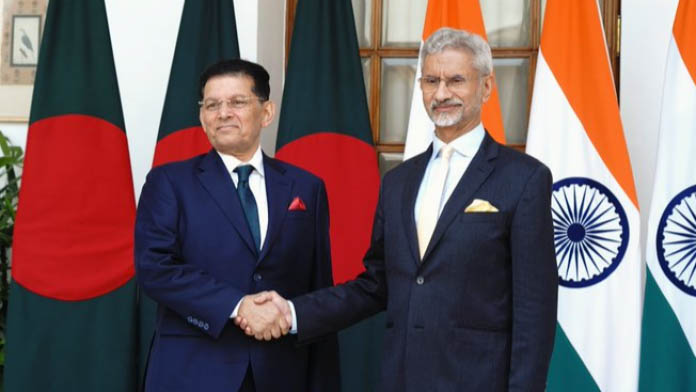
On 7 April 2026, Bangladeshi Foreign Minister Dr. Khalilur Rahman arrived at Indira Gandhi International Airport carrying a diplomatic portfolio of historic significance and strategic promise. A 1985-batch Foreign Service officer, a medical doctor, and a scholar trained at Jawaharlal Nehru University, Dr. Rahman came to New Delhi as an emissary of recalibration, with a clear mandate to restore balance and further strengthen the enduring ties between India and Bangladesh. Accompanied by Humayun Kabir, Adviser to Prime Minister Tarique Rahman on Foreign Affairs, the visit reflected the full confidence and support of Bangladesh’s executive leadership. Framed as a stopover en route to the Indian Ocean Conference in Mauritius, the engagement carried deeper strategic weight. It marked a renewed phase of structured, high-level bilateral dialogue and signalled a constructive movement toward continuity, reinforced trust, and a forward-looking partnership grounded in pragmatic cooperation.
Its significance gains fuller clarity when situated within the broader trajectory of the preceding eighteen months, which witnessed shifting diplomatic postures, adjustments in visa regimes affecting cross-border mobility, challenges concerning diplomatic facilities, and heightened societal sensitivities that drew attention across South Asia. Within this evolving context, the Rahman visit emerged as a structured effort toward institutional renewal, and its diplomatic architecture invites careful analytical attention.
The Ministry of External Affairs in New Delhi issued a warm welcome affirming that the two countries share “warm and historic ties anchored in strong people-to-people relations.” Dhaka’s Foreign Ministry, calibrating for domestic consumption, described the engagement as a goodwill stopover. This asymmetry of framing is analytically instructive. It illuminates the structural tension embedded within Bangladesh’s foreign policy; the imperative to engage India substantively while managing the nationalist sensitivities of the BNP’s electoral coalition. India’s deliberate characterisation of the engagement as an official visit, rather than a limited stopover, signalled New Delhi’s recognition of the moment’s gravity.
The substantive meetings were structured with evident deliberation. On 8 April, Dr. Rahman held wide-ranging discussions with External Affairs Minister Subrahmanyam Jaishankar at Hyderabad House, India’s premier venue for high-stakes bilateral diplomacy, its deployment in this context constituting an architectural statement of institutional seriousness. Dr. Jaishankar’s public formulation conveyed cautious optimism without overextension, consistent with New Delhi’s preference for demonstrable deliverables over rhetorical commitments. Separately, Dr. Rahman met National Security Adviser Ajit Doval, a pairing of particular strategic significance given Rahman’s prior role as National Security Adviser during the Yunus interim period, when the Doval channel served as a sustained line of communication between the two capitals.
The inclusion of Commerce Minister Piyush Goyal and Petroleum Minister Hardeep Singh Puri in the itinerary signalled that the agenda was operationally specific rather than merely ceremonial. Preparatory groundwork had been laid the previous day, when High Commissioner Pranay Verma met Prime Minister Tarique Rahman in Dhaka to reaffirm New Delhi’s commitment to a positive, constructive, and forward-looking approach, providing Dhaka with a domestically resonant narrative of Indian goodwill while signalling that New Delhi was prepared to engage the new government on its own terms.
The bilateral agenda was both broad and interlocking. Visa normalisation emerged as a central and politically salient priority, particularly for ordinary Bangladeshis like students seeking Indian university placements, patients accessing specialised medical care, and families sustaining cross-border ties. The evolving visa regime since July 2024 has shaped daily mobility patterns in ways that carry clear humanitarian and social significance. Energy cooperation, trade facilitation across the shared 4,156-kilometre frontier, border management protocols, river water-sharing frameworks, and people-to-people connectivity together form an integrated agenda in which each element reinforces the others, reflecting the structural interdependence that binds the two economies.
The Teesta river dispute deserves extended treatment as both a substantive policy concern and a political barometer of the bilateral relationship’s deeper institutional health. Since 2011, when West Bengal Chief Minister Mamata Banerjee paused a near-finalised interim accord that would have allocated 37.5 percent of Teesta’s dry-season flow to Bangladesh, the water-sharing framework has remained in institutional stasis which is a condition that, over fifteen years, has evolved from a political obstacle into a structurally embedded feature of the bilateral landscape. West Bengal’s agricultural sector, particularly the terai districts of Jalpaiguri and Cooch Behar, depends on Teesta irrigation in ways that render any reallocation of dry-season flow politically sensitive. The state government’s water management priorities are substantive, and recognising them highlights the complexity of centre-state resource politics within India’s federal constitutional arrangement.
The Ganges Water Sharing Treaty faces its renewal deadline in December 2026, adding temporal urgency to an already intricate hydrological agenda. The April 2026 moment acquires added significance in light of the imminent West Bengal Legislative Assembly election where polling is between 23 and 29 April, with results declared on 4 May. The International Crisis Group in its December 2025 report identified these elections as a potential point of heightened sensitivity in India-Bangladesh engagement, noting that pre-election political signalling in Kolkata can carry amplified bilateral resonance.
A complementary analytical reading also emerges within this context. A renewed electoral mandate for Banerjee, secured alongside the conclusion of electoral cycles, can create political space for a phased and consultative Teesta framework in the latter half of 2026. Indian federal practice offers several instances where subnational leadership has demonstrated greater flexibility on inter-state arrangements once electoral imperatives have been addressed. New Delhi’s sustained attention to Teesta, accelerated as broader interest in infrastructure and basin development grew in the Bengal Basin, has repositioned the issue from a primarily riparian concern into a site of geoeconomic significance. This evolving strategic framing holds the potential to generate new avenues for cooperative solutions and to shape one of the most consequential diplomatic trajectories in the period ahead.
The deepening footprint of major external powers in Bangladesh constitutes an indispensable context within which India’s bilateral recalibration can be assessed. Beijing has extended infrastructure financing, deep-water port development at Chittagong and Payra, defence hardware supply chains, and telecommunications network architecture through initiatives that enhance China’s structural position in the Bay of Bengal littoral. Washington’s parallel cultivation of ties with Dhaka, rooted in shared democratic values, development finance partnerships, and Indo-Pacific strategic objectives, reflects its sustained aim of fostering a stable, multi-aligned regional order across the Indian Ocean. Both external powers pursue their interests through material incentives and normative alignment, creating a triangular geometry in which Bangladesh exercises sophisticated hedging behaviour, engaging each major partner to preserve strategic flexibility and diversified alignment pathways.
India’s position within this geometry remains structurally distinctive. Unlike China and the United States, India shares with Bangladesh a land boundary, interconnected river systems, an electrical grid, and a dense web of social, cultural, and familial linkages that sustain continuous interaction beyond formal policy frameworks. India’s engagement in Bangladesh is therefore both deeply embedded and uniquely pervasive, reflecting forms of connectivity that extend beyond transactional arrangements. This structural proximity enhances India’s long-term relevance while also requiring a nuanced and adaptive approach to bilateral management, aligning geographic intimacy with evolving strategic expectations.
A dimension of the bilateral relationship that merits prominent recognition alongside security-focused analyses is the developmental experience shared between India and Bangladesh. Bangladesh’s extraordinary achievements in human development through microfinance, poverty alleviation, and women’s economic empowerment represent not merely a complementary narrative to strategic analysis but a substantive dimension of bilateral soft power with measurable consequences for the normative architecture of South Asian regionalism. The Grameen Bank model, the legacy of Muhammad Yunus, has transformed rural credit access and female economic agency across Bangladesh and inspired replication in over a hundred countries.
India has drawn deeply and explicitly from this developmental inheritance. NABARD’s Self-Help Group–Bank Linkage Programme, which had mobilised over 67 million women’s groups by 2025, reflects the direct imprint of Grameen methodology, a lineage formally acknowledged in its own documentation. BRAC’s programming approaches have influenced state-level poverty alleviation initiatives across West Bengal, Bihar, and Odisha. Bangladesh’s female labour force participation rate, among the highest in South Asia, has been structurally enabled by microfinance-supported enterprise and sustained social mobilisation. This shared developmental trajectory constitutes a durable connective tissue between two societies advancing inclusive growth within democratic governance frameworks, enriching the broader understanding of the India-Bangladesh relationship.
The Land Boundary Agreement, the landmark resolution of 162 enclave exchanges under the Hasina-Modi partnership, offers an important illustration of the sensitivity of bilateral institutional achievements during periods of domestic political transition. Celebrated at the time as the definitive closing of a seven-decade colonial legacy, the LBA’s implementation experienced a phase of slowed momentum during the Yunus interim administration. Joint demarcation processes advanced gradually, enclave residents encountered administrative adjustments, and the broader framework for border normalisation entered a period of recalibration. The domestic political incentives associated with differentiating from earlier policy alignments have, at times, shaped the pace and emphasis of bilateral institutional continuity.
Advancing the full realisation of the LBA therefore merits a central place in any meaningful reset. It functions simultaneously as a confidence-building measure, as an affirmation that successive governments in Dhaka sustain the treaty commitments of their predecessors, a signal of considerable importance to New Delhi’s institutional memory and as an assurance to enclave residents that political transition is accompanied by administrative clarity and continuity. The diplomatic tenor of the interim period, characterised by heightened public articulation of positions and evolving domestic narratives, contributed to a recalibration of perceptions within India’s strategic community. The path forward accordingly rests on sustained implementation, institutional consistency, and the steady delivery of tangible outcomes that reinforce mutual confidence and long-term stability.
The strategic stakes of this reset extend well beyond the bilateral. Bangladesh’s deepwater port ambitions at Matarbari, capable, when realised, of handling Panamax vessels and transforming Bay of Bengal maritime logistics, invest the relationship with a regional significance that both governments can approach with shared strategic vision. India’s Act East Policy finds in Bangladesh an indispensable western hinge, where enhanced transit connectivity through Bangladeshi territory strengthens linkages between India’s Northeastern states and Southeast Asian markets, complementing the geographic realities of the Siliguri Corridor. Bangladesh’s role in the Bangladesh-Bhutan-India-Nepal sub-regional framework and its emergence as a maritime node in Bay of Bengal security architecture further extend its bilateral relationship with India into a wider theatre of regional connectivity and cooperation.
India’s strategic approach, in this context, benefits from sustained sophistication and long-term calibration. A Bangladesh that is economically dynamic, democratically stable, and confident in its strategic autonomy represents a valuable and enduring partner in shaping regional order. The experience of earlier phases of close bilateral alignment, which generated important insights into the interplay between domestic political dynamics and external partnerships, offers an opportunity to prioritise durable institutional cooperation, mutual sensitivity, and long-term strategic convergence. Such an approach strengthens the foundations of partnership while aligning bilateral engagement with evolving regional aspirations.
In conclusion, the foregoing analysis underscores that Dr Rahman visit is best understood as the opening of a diplomatic composition whose full score continues to unfold. The Teesta accord, the renewal of the Ganges Water Sharing framework, visa normalisation, energy cooperation, and the full realisation of the Land Boundary Agreement’s residual provisions together constitute a comprehensive reform agenda that, advanced through sustained political will, institutional discipline, and continuity across electoral cycles, can foster a relationship that is deeply reciprocal and durably grounded in mutual interest.
This evolving trajectory highlights the importance of actively nurturing structural complementarity, where interdependencies in energy, water, trade, and connectivity are strengthened through continuous institutional engagement. It also underscores the value of harmonising national and subnational dynamics, particularly in areas such as the Teesta, through calibrated domestic coordination aligned with broader bilateral priorities. At the same time, Bangladesh’s achievements in microfinance, women’s economic empowerment, and poverty alleviation emerge as significant normative assets, enriching the partnership with a developmental dimension that complements its strategic and geoeconomic foundations.
In an era shaped by dynamic regional alignments and expanding geoeconomic interactions, India and Bangladesh are uniquely positioned to advance a path of strategic recalibration rooted in pragmatic realism and guided by long institutional memory. Geography, constant and enabling, encourages sustained engagement, deeper connectivity, and shared opportunity. Through consistent cooperation, both countries can strengthen energy security, expand economic integration, and enhance regional connectivity in ways that reinforce stability across South Asia and the wider Indo-Pacific.
The conversations initiated at Hyderabad House on 8 April 2026 thus represent more than a diplomatic moment; they mark the steady emergence of a forward-looking partnership with the capacity to shape regional order. As dialogue translates into institutional outcomes and shared initiatives, India and Bangladesh can collectively transform proximity into strategic advantage, building a resilient, cooperative, and future-oriented framework whose impact will resonate across the region for a generation.
Views: 583

Biswajit Choudhury
Dr. Biswajit Choudhuryis an Associate Professor and Head of Political Science at Handique Girls’ College, Guwahati. He did his PhD, MPhil, and MA from Jawaharlal Nehru University, New Delhi. He serves as Project Director of an ICSSR-funded Major Research Project, Research Fellow at the Centre for Asian Politics and Policy(CAPP), and Associate Editor of the Journal of Asian Politics and History (JAPH), Hong Kong. His work on India’s Act East Policy, diaspora governance, and rural development is widely published and presented at leading academic and policy forums.